Apollonius of Rhodes wrote in Alexandria in the third century BCE, and ancient tradition says he worked at the great Library. That is a strange place to write an epic. Homer was already five hundred years old. Everyone knew the genre had peaked. Callimachus, another poet of the same circle, is quoted as saying a big book is a big evil, and ancient writers liked to imagine a feud between the two men. Modern scholars doubt much of the gossip. But the question hangs over the poem: how do you write a Homeric epic when you know you are late?
The setup
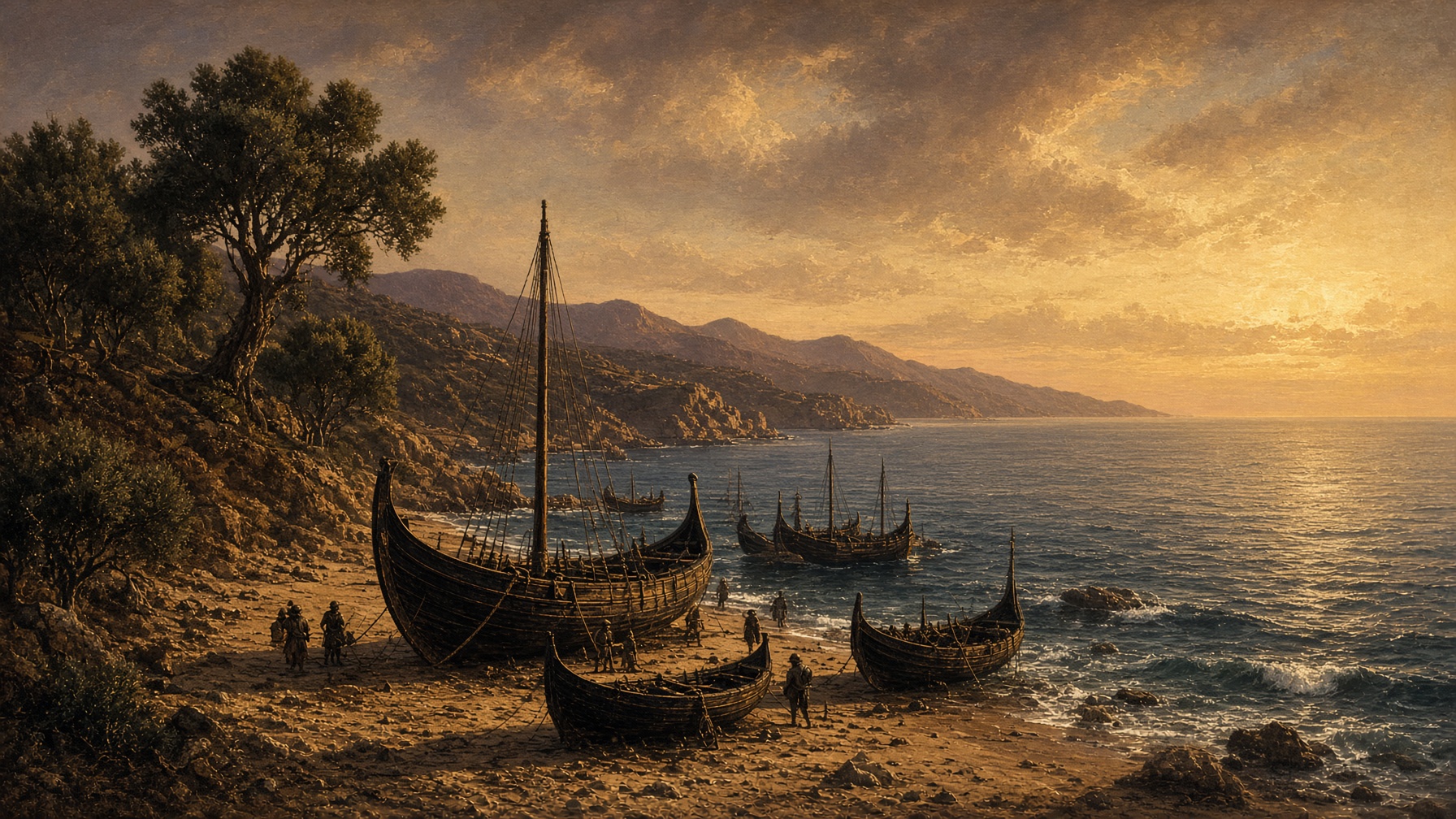
Jason is sent to Colchis, on the far edge of the Black Sea, by his uncle Pelias, who has taken his father's throne. The prize is the Golden Fleece. He arrives in Iolcus wearing one sandal, which is the very sign an oracle told Pelias to fear. The ship, the Argo, is built with Athena's help, and the crew is a roll call of heroes: Orpheus, the twin Dioscuri, the winged sons of the North Wind, and Heracles.
Heracles doesn't last. In the first book his young companion Hylas is pulled into a spring by nymphs, and Heracles goes looking for him and never returns to the ship. I read it as a deliberate choice. If the strongest man in Greece stayed aboard, he would be the hero, and Apollonius wants someone else.
A hero with no plan
The word that follows Jason around is amechania, which means being at a loss, with no way out. Scholars noticed long ago how often it comes up. Every time a danger appears, Jason is stuck. King Aietes sets him three tasks: yoke two fire-breathing bulls, plow a field with them, and sow dragon's teeth that sprout into armed men. Jason can't do any of it. He has no cunning, no strength to match the task and no idea. For the hero of an epic, this is quite a statement.
The golden ball
The turn comes in Book 3, and it starts with an almost comic scene. Hera and Athena, who both want Jason to succeed, go to Aphrodite and ask her to make Aietes' daughter Medea fall in love with him. Aphrodite finds her son Eros in an orchard, playing dice with Ganymede and cheating, and bribes him with a gold ball that once belonged to the infant Zeus. The gods here are practically a family fussing over a school project.
Then the poem slows down. Medea lies awake. She argues with herself. She is ashamed, afraid for her family, and desperate. At one point she nearly drinks poison, and then she hears the voices of life and decides to live. It is one of the great inner portraits in ancient poetry, and many readers think it is where Virgil found his Dido.
Medea does the work
From here Medea carries the story. She gives Jason an ointment made from a flower that grew where Prometheus' blood fell, which makes him safe from fire and iron for a day. She tells him to throw a stone into the middle of the earth-born warriors so that they turn on each other. And she puts the dragon that guards the Fleece to sleep with spells. They take the Fleece and run.
Then the poem darkens. Her brother Apsyrtus is lured into an ambush and killed, and Apollonius lets Jason be part of it. The crew needs purification from the sorceress Circe, and when they reach Crete, the bronze giant Talos threatens the ship until Medea bewitches him and he bleeds to death from a wound in his ankle. By the end, she has saved the whole expedition more than once.
The gods at arm's length
The gods are present, but at a distance. They speak through omens and oracles more than they stand beside the heroes. Hera drives the whole venture, because Pelias once neglected her. The poem is also full of learned asides, about the origins of place names and rituals, in a way Homer never bothers with. It is an epic written by someone who has read all the others. You can feel that the wonder is already antique.
My reading
I read this as a poem about a man who gets the glory because a young woman did the work, and I think Apollonius knows it. The poem ends with the Argo returning home, without a victory scene. What Medea gets for her trouble, the poem doesn't say. But the first audiences knew how her story went, from Euripides, and it didn't go well. The silence at the end is part of the effect. This is our reading.