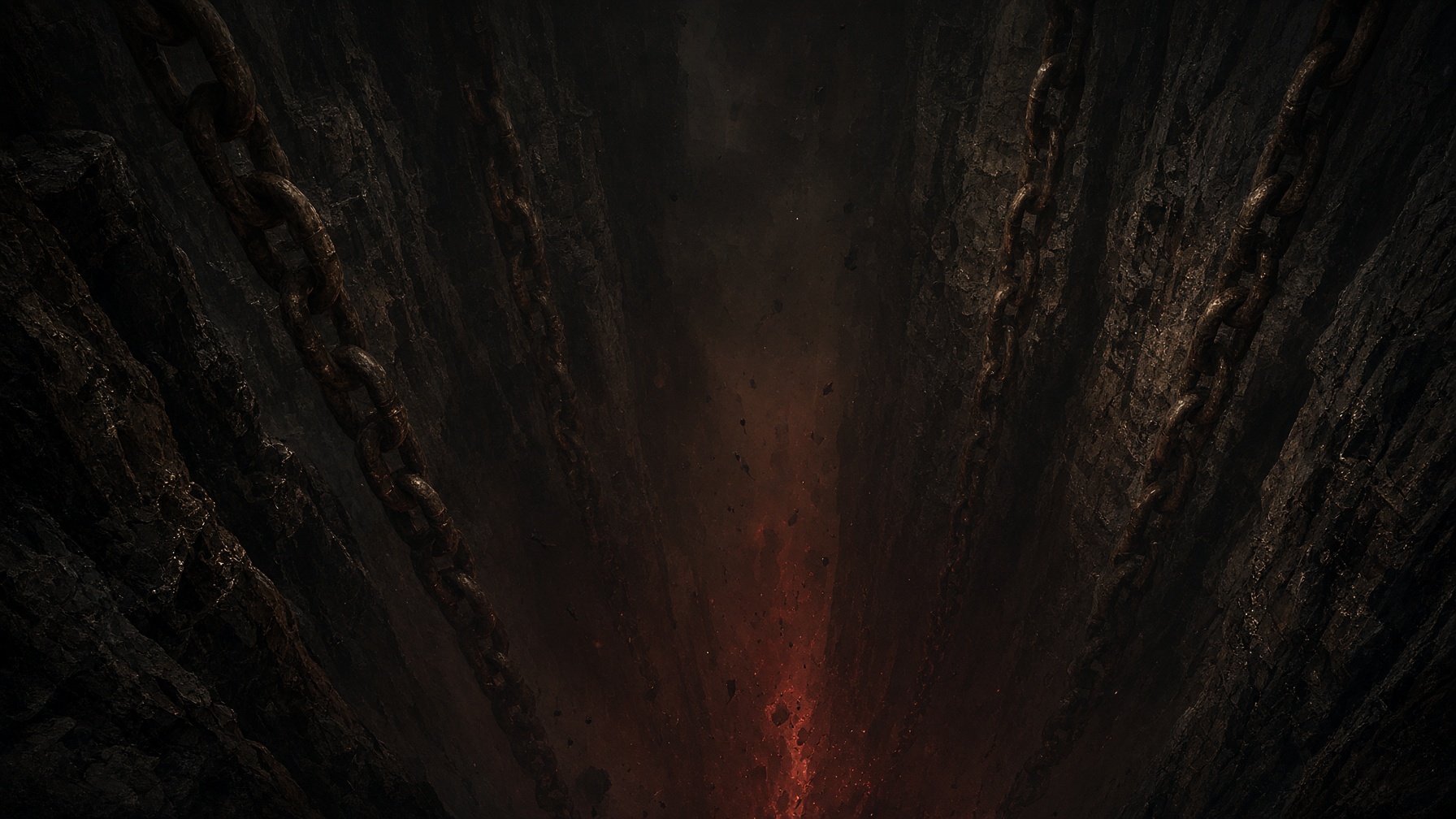
The first thing to know about Chaos is that it was never supposed to mean a mess. Hesiod's word, khaos, comes from a verb meaning to gape or to yawn. It is a gap, an opening, the space you get when two things are pulled apart. The idea of chaos as noise and disorder came much later, mostly from Roman writers who needed a word for it. In the Theogony, which is our main source, the first thing that exists is simply a space. Nothing is in it yet. I find that more unsettling than any monster, and I think it explains a lot about how the Greeks thought the world was put together.
Four things and no author
Hesiod lists them in a hurry, as if he were ticking off a shopping list. First Chaos. Then broad-breasted Gaia, the firm seat of everything that would come. Then Tartarus, a misty pit deep underground. And then Eros, who is love, or really the pull that makes things join. Nobody makes any of them. Hesiod never says who. They are just there, one after another, like a countdown.
That absence matters. A lot of the world's creation stories begin with someone making something: a voice, a hand, a decision. The Greek one begins with things being born. The poem is called the Theogony, the birth of the gods, and it takes that word seriously. The universe is not built. It is begotten. And once you start with birth, you have already decided that the world is a family, because everything that is born has a parent and a brother.
So here is my first point. The Greek cosmos is kinship from the very beginning. By the time anyone sits on a throne, the whole of reality is already a set of relatives. That is why later quarrels between gods never feel like politics between strangers. They always feel like family trouble, with all the resentment and the long memory that implies.
The minimum for a story
Now look at what the four things add up to. A gap, so that anything can be separated from anything else. A floor, so there is somewhere to stand. A pit, so there is somewhere to fall. And a want, so there is a reason to move. If you were designing the smallest possible stage for a story, I don't think you could do it with fewer pieces.
I like to think the poet knew exactly what he was doing. Take away the floor and no one can build. Take away the pit and no one can be punished, and every later tyrant uses Tartarus. Take away the gap and nothing can ever be told apart. Take away Eros, and no one would want anything, which means there would be no children, no wars, and no myths. The first age is a toolkit, and each later age borrows from it.
What comes out of the dark
Next the poem does something I rarely hear mentioned. From Chaos come Erebus, the dark, and Night. Night then has children without a father, and the list is long and grim: Doom, Death, Sleep, the tribe of Dreams, Blame, Pain, the Fates, the Keres, Nemesis, Deceit, Old Age, and Strife. Every unpleasant thing about being alive appears in that list. It reads like the contents page of a human life, and it is all unfathered.
There is an odd tenderness in it, though. Sleep sits next to Death in the same family. Dreams come out of the same dark as old age. Nemesis, the feeling that someone has had too much luck, is born among them. The Greeks didn't treat these as separate departments of a moral universe. They treated them as siblings, and siblings who share a mother and can't be disowned.
Then Strife has children of her own: Toil, Forgetfulness, Famine, the Pains, Battles, Murders, Lies, Disputes, and finally Oath. I stopped reading when I got to that last one. Oath, the thing that is supposed to hold the world together, is the child of Strife. It makes terrible sense. You only need a binding promise in a world where people quarrel, and the thing that guards promises, Horkos, in the poem is said to be the worst plague for those who swear falsely. Trust is born out of conflict. It is the answer to a problem that someone else created.
The cast of the early world
The pieces you will meet again and again in the other ages show up here first. Gaia gives birth to Uranus, the starry sky, to cover her, and to the long hills, and to the sea. Then she lies with Uranus, and out come the Titans and the Cyclopes and the Hundred-Handers. By the end of this age the world has a ceiling, a floor, an ocean and a large family, and the family is already restless.
Uranus, as the poem tells it, is the first ruler, and he is a bad one. He hates what he has made, and he pushes his children back into the earth as they are born. That is the end of the first age and the beginning of the second. A reign that starts with nothing and ends with a sickle lasts, in the poem, only a few pages.
The other versions
I should be honest that Hesiod's version was not the only one, and the Greeks knew it. In the Iliad, Hera says that Oceanus is the origin of the gods, and Tethys their mother, which suggests a world that begins with water. The Orphic poems, which survive in fragments, put Night first and then a great egg out of which a shining, double-sexed figure called Phanes hatches. In Aristophanes' comedy The Birds, Eros hatches from an egg laid by Night, and the whole thing is rewritten for the birds' benefit.
I find the variety reassuring. It means nobody thought the question was settled. Greek religion had no single book and no authority to tell you which beginning was correct. People chose the version that suited the occasion, and the beginnings were as local as the temples.
Why I think it matters
If you want one sentence for this age, I would say that it is the age before power. No one is in charge because nobody has a throne yet. The beings that exist are conditions rather than persons: a gap, a ground, a pit, a pull, a darkness. You couldn't invite them to dinner. You couldn't bribe them either. They are simply how things are.
And that is the contrast the rest of Greek mythology plays against. Every later age is about people, or things like people, trying to take charge of those conditions, with a throne, a trident, a thunderbolt. They never quite manage it. Death is still born of Night and is still in no one's pocket. Oath is still the child of Strife, whoever sits on Olympus. The gods may get to argue about the rules, but the first things were there before the argument, and they are still what the argument is about.