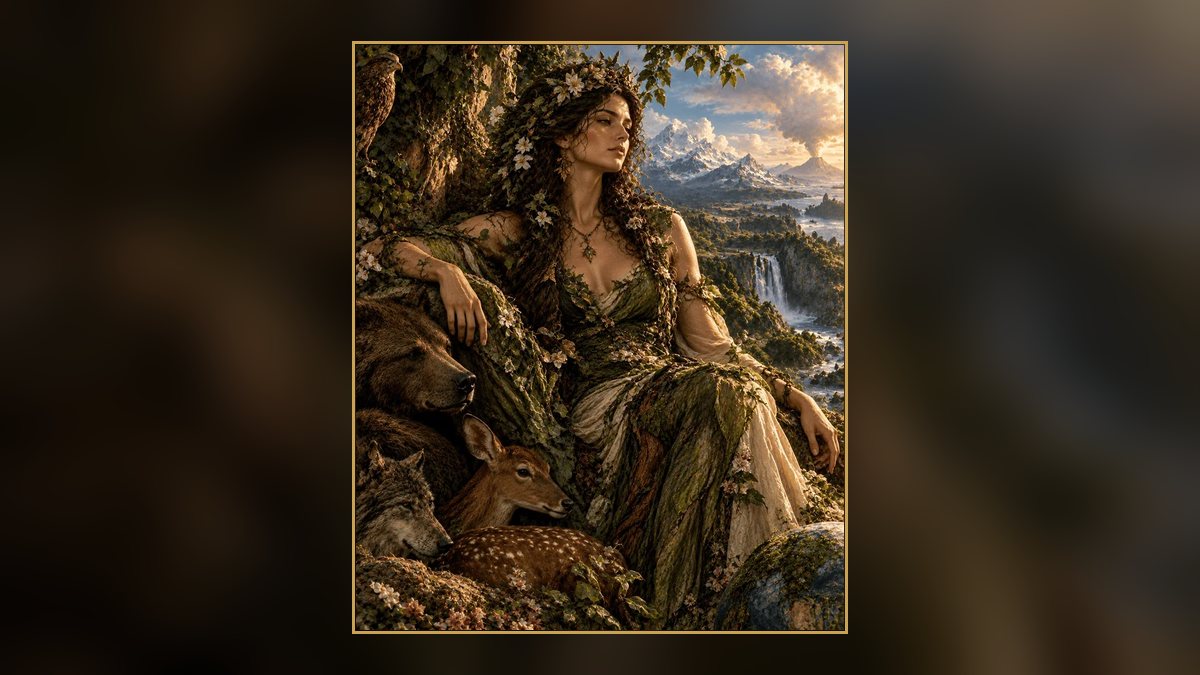
If you tried to draw Gaia's loyalties on a chart, you would give up quickly. She helps Cronus overthrow his father. She helps Zeus overthrow Cronus. She later raises up Typhon and the Giants against Zeus. Whose side is she on? For a while I assumed the poets had just collected her from different local traditions and stapled them together. Then I noticed that she always does one thing, in every version. Whoever is currently sitting on the throne, she is quietly helping whoever is trying to get him off it.
Before there was a ground
In Hesiod's Theogony, the first thing that exists is Chaos, a gap or a yawning. Right after it comes Gaia, and Hesiod describes her as the firm seat of all the immortals who live on the peaks of snowy Olympus. That phrase has always struck me. Before there was a throne, there was something to put a throne on. Olympus is built on her. The gods are, in the most literal sense, her tenants.
She then does something that no other figure in the poem manages: she makes the sky without help. Uranus is born from Gaia alone, along with the high mountains and the barren sea, Pontus. After that she lies with her own son Uranus, and together they have the twelve Titans, then the Cyclopes, then the three Hundred-Handers. It is a huge family, and almost all of it is her work.
Burying her own children
The problem begins when Uranus decides he hates what he's made. As each child is born, he pushes it back into Gaia, into the hidden places of the earth, so that none of them can see the light. Gaia, groaning with the weight, makes the sickle and calls on her sons to use it.
Here is the first appearance of her habit. She isn't rebelling against a bad ruler out of principle. She is rebelling against a ruler who is putting her children back inside her. Look at who she picks as an ally: Cronus, the youngest, who asks no questions. And look at what happens after. Cronus does the same thing as his father, on a slightly different schedule, and Gaia changes sides again.
The advice for Rhea
When Rhea is pregnant with Zeus, she goes to her own parents, Gaia and Uranus, for advice. They send her to Crete and tell her how to hide the baby. It is Gaia who takes the infant Zeus and hides him in a cave on Mount Aigaion, the hill that later made it into the Cretan stories.
Notice something quite subtle here. By this point Gaia and Uranus are working together. Uranus is wounded, powerless and a distant sky, but his grudge against Cronus is still useful. The earth and the sky, who once couldn't stand each other, agree on one thing: that the new king should not last. It is an odd little reconciliation, and it happens purely because they have a common target.
The help that won the war
The Titan War lasted ten years and didn't move. Then Gaia told Zeus something that changed it: that victory would go to the side that freed the Hundred-Handers from Tartarus, where Cronus had left them. Zeus did, and they started throwing three hundred rocks at a time, and the Titans were buried under the barrage.
So the plan that destroyed Cronus was Gaia's. And in return for it, what did Zeus do? He locked the Titans, her children, under the earth. That is the second act of burying. Zeus, who was saved by Gaia's advice, did to her children exactly what Uranus had done. You can probably guess what happens next.
The last two rebels
Hesiod tells it plainly. When the Titans were beaten and the gods had their honours, Gaia, as Hesiod says, bore her youngest child, Typhon, with Tartarus, a creature with a hundred snake heads who had to be destroyed before he became king of gods and men. Zeus beat him with thunderbolts and threw him into Tartarus. Other traditions add the Giants, born from the drops of Uranus's blood, who stormed Olympus and were beaten with the help of Heracles.
Put these together and you get my theory. Gaia is not loyal to any king. She is loyal to the idea that nothing should be buried. When a ruler locks someone away, she supports the one who breaks them out. And when that one becomes the new ruler and locks up a new group, she supports the next. She is a built-in opposition party. The Greeks put checks and balances into their cosmos, and the check is a goddess.
It's a cold sort of loyalty, and it makes her scary. Gaia is not on your side. She is on the side of whoever is being pressed down. If you are the one doing the pressing, it doesn't matter how well she has treated you. And if you're pressed, she is the one you should pray to.
What the Greeks swore by
This might explain the slightly strange place she holds in oaths. In the Iliad, when the Greeks and Trojans make a truce, they call on Zeus, the Sun, the rivers and the Earth, and, below the earth, the powers who punish those who swear falsely. Earth is there because she is the one who sees everything that goes into her. Every buried promise, every buried body, goes to her. She remembers what has been put down.
That is also why, in the old stories, she was the first oracle at Delphi. Aeschylus opens the Eumenides with a priestess who lists the line of prophets there: Gaia first, then Themis, then Phoebe, then Apollo. The earth spoke first, from a crack in the ground. It makes a certain sense. The thing that has swallowed the most knows the most.
In Athens there was a precinct of Ge Olympia, near the later temple of Olympian Zeus. Pausanias says the Athenians told of a crack in the earth there, where the waters of the great flood in Deucalion's time drained away. I love that detail. The great flood, which nearly ended humanity, went back into her, as if she were the original drain on the world.
What stays with me
I think Gaia is the most honest figure in Greek myth about how power works. She says out loud what the later, more polite gods don't: that anyone who sits on a throne is sitting on something, and that the something has a memory. She doesn't hate kings. She just can't be owned by them, and she keeps a long list.
If I were writing the chart again, I wouldn't draw lines between Gaia and her allies. I would draw a single line, running through the whole poem, connecting every character who was put under the ground at one point or another. Following that line is the quickest way to understand what she does.