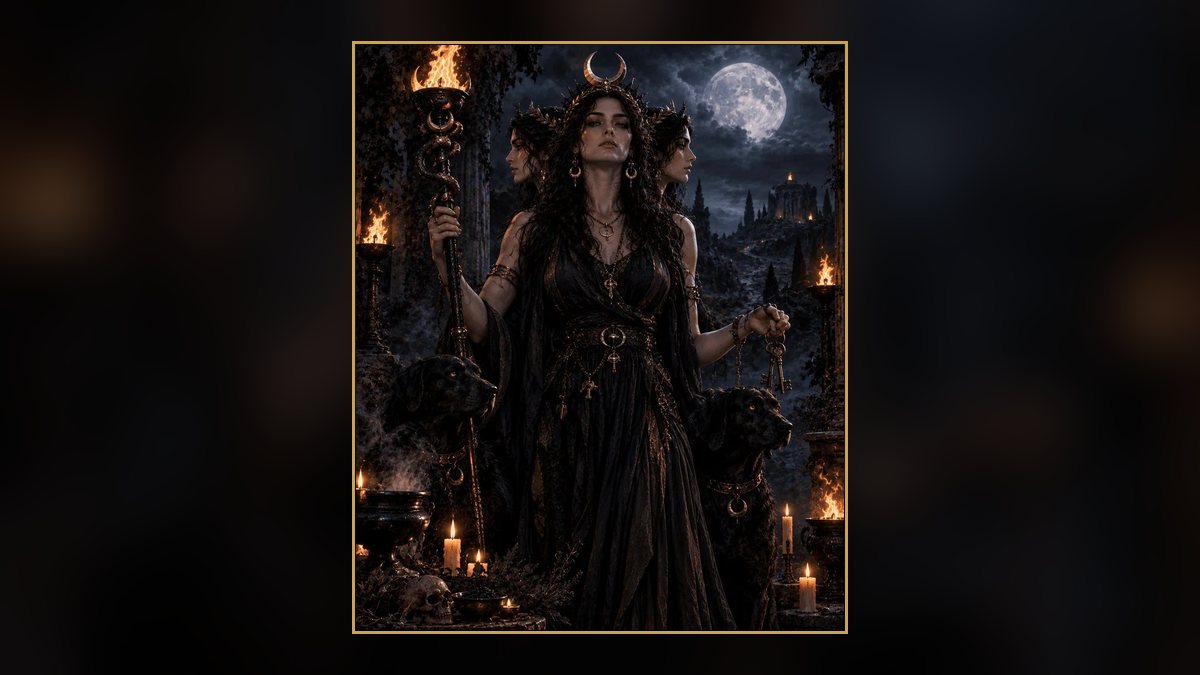
Hecate is one of those figures people think they already know. Dark goddess, witches, midnight, hounds. That summary comes mostly from later centuries, and if you go back to the oldest sources the picture is much more surprising. In the earliest Greek poetry she is an honoured, generous, widely respected goddess, and the thing that links all her roles is not darkness at all. It is the idea of the in-between place, the spot where one path turns into two, one state becomes another, or the living meet the dead. I think that single theme explains almost everything about her.
The goddess Zeus kept honouring
The earliest detailed description comes from Hesiod's Theogony, and it is startling. He gives Hecate a long passage of praise, far longer than he gives most gods. She is the daughter of the Titans Perses and Asteria, and when Zeus took power he did not take her privileges away, as he did with some of the older generation. He confirmed them. She keeps a share of the earth, the sea and the starry sky, and she is allowed to help anyone she wishes.
Hesiod says that if a person prays to her sincerely, she hands out success: victory in contests, good luck in battle, a good catch for fishermen, fat herds for the people who keep them. She also looks after the young, as nurse of children, whom she helps to grow up. It is a very broad list, and not a single item is sinister. For a goddess with a spooky reputation, the first big portrait of her reads like a patron saint of getting things done.
Why would Zeus honour a Titaness so much? The poem does not explain, which gives us room to guess. One thought I find convincing is that she did not threaten the new order. She had no interest in a throne. Her power lay in access, in who could pass through a gate and who could not, and a king always benefits from a figure who keeps gates working.
The torch in the Demeter story
The best-known early scene with Hecate is in the Homeric Hymn to Demeter. When Persephone is carried off by Hades, she cries out, and only two beings hear her: Helios, the sun, who sees everything, and Hecate, who is in her cave. When Demeter wanders the earth in grief for nine days with torches in her hands, Hecate comes to meet her carrying her own torch, and she tells Demeter what she heard but not who did it. Together they go to Helios to learn the truth.
After Persephone is found, Hecate greets her warmly and, from then on, becomes her escort and attendant. Think about what that role means. Persephone travels between the world above and the world below every year. Hecate is the one who goes with her, who knows the road both ways. A goddess of thresholds becomes the guide for a girl who has to cross the greatest threshold there is, and does it again and again.
The torch is not a decoration. It is the practical tool of someone who walks at night in the places where others cannot see. When you picture her with it, picture a guide rather than a spectre.
Why the crossroads
Her strongest later association is with the crossroads, the point where three roads meet. For the Greeks, a crossroads was not just a piece of geography. It was a place with its own mood: uncertain, exposed, a spot where you had to choose and where strangers met. People set up small shrines there, and often a pillar with a head carved on top, and left offerings at the base.
A particular custom was the so-called Hecate's supper. At the time of the new moon, households would leave food at a crossroads for her and the spirits who travelled with her. Writers who report this mention it with a mixture of respect and wry commentary, noting that poor people would take the food afterwards, which is a nice reminder that gods were part of a working economy. The offering was both a gift and a way of keeping unsettled forces away from the house.
Here is my interpretation. The crossroads is the place where you stop being sure. You can go left, right or straight on, and every option cuts off the others. A culture that attached a goddess to that spot was admitting that decisions are emotionally weighty, and that something is watching over the moment when you commit. Hecate is the patron of the moment before the choice.
Doors, dogs and the dead
The same logic covers her other duties. She was a guardian of doorways and gateways. Small statues of Hecate stood in front of houses, and a door is exactly the same kind of spot as a crossroads: two spaces joined, with a boundary between them. Dogs were sacred to her, and it is easy to see why. A dog is the household's guard at the entrance and also a creature that roams at night and howls at things people cannot see.
Because the boundary between the living and the dead was also a crossing, she was linked to ghosts. Later writers imagined her leading a procession of restless spirits and hounds through the night, which is the image that fed the modern witch-goddess reputation. But look at the sequence: the early sources give us protector of doors, patron of crossings, and nurse of the young, and only after centuries does the darker procession emerge. It is a gradual shift of emphasis, not a different goddess.
The three faces
Another change over time is her appearance. Later statues often show her with three bodies or three faces, standing back to back, so that she can look down every road at once. That is a clever way to make a visual statement about the crossroads. It is a picture of someone who is never surprised by where a path leads, because she is facing all the options at the same time.
It also fits with the idea that she has power over three realms, as Hesiod says, over land, sea and sky. Whether the three bodies come from that or from the three roads is debated, and it may well be both. I am fine with an image that carries more than one meaning, since that is exactly what a symbol of crossings should do.
Medea and the move toward magic
Where did the magical reputation come from, then? Part of the answer is literature. In the story of Jason and the Argonauts, the sorceress Medea is a priestess of Hecate, and in Apollonius' epic she makes an offering to the goddess at night and uses her power to help Jason with the tasks set by her father. Greek and Roman authors who wrote about magic more and more placed Hecate at the centre, since a goddess of thresholds is easy to imagine as the one who opens the way between the ordinary world and the hidden one.
Whether people in real life called on her in that way is harder to tell. Some surviving curse tablets and magical texts mention her, which shows she was invoked. But a god who watches over every kind of crossing was bound to attract people who wanted to cross a line, for good reasons or bad. The reputation grew because the role was flexible, not because her nature changed.
What she says to us now
If you look at Hecate this way, she stops being a gothic mascot and becomes much more relatable. We all live among doors, thresholds and decisions. Moving house, changing jobs, starting school, leaving a relationship, saying goodbye to someone: every one of these is a crossroads in the Greek sense. The goddess who stands there with a torch is not promising that the choice will be easy. She is simply promising that you will not stand there in the dark.
I think that is why she kept her honours even as the stories around her changed. People never stop needing someone to hold a light at the place where the road divides.