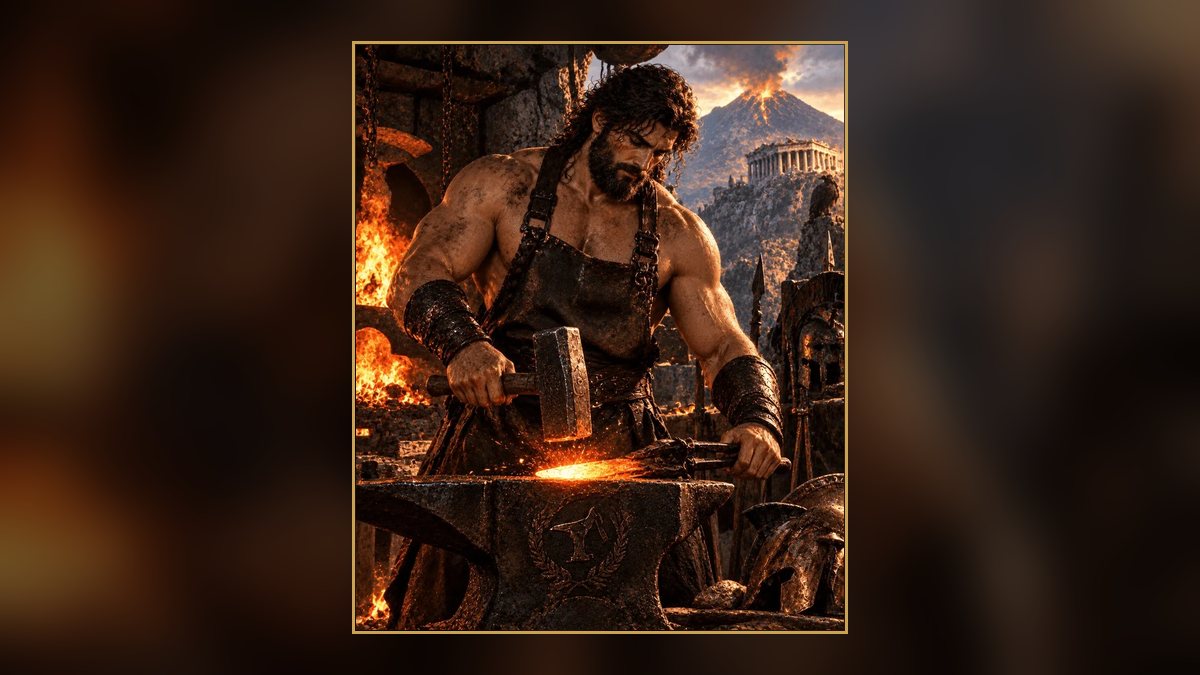
Think about what the other Olympians do all day. Zeus rules and sleeps around. Apollo plays music and shoots plague arrows. Aphrodite wanders. Dionysus throws parties. Hermes carries messages, which is the nearest anyone gets to a real job. Then there is Hephaestus, who spends his time in a smoky workshop with a hammer, building the furniture, the weapons, the jewellery and the locks. He is, as far as I can tell, the only god in the Greek pantheon who actually works for a living. I think that detail is the key to everything else about him.
The fall from heaven
The tellings disagree on why he is lame, which is typical of Greek myth. In the Iliad, he tells one story himself. Once, when he tried to defend Hera against Zeus in an argument, Zeus grabbed him by the foot and flung him out of heaven. He fell all day, from sunrise to sunset, and landed on the island of Lemnos, where the Sintians, a local people, took care of him. In another passage of the same poem, he says it was Hera who threw him out, because she was ashamed of his crippled foot, and that he was rescued by the sea nymphs Thetis and Eurynome. He lived with them for nine years in a cave beneath the water, making jewellery.
Think about that second version for a moment. A mother is so embarrassed by her child's disability that she throws him off a mountain, and he turns the experience into a trade. There is something very stubborn and very human in it. The sea nymphs pay him in attention, and he pays them back with brooches and necklaces. He learns the craft where nobody can see him, and then he returns to Olympus carrying something the gods will want.
The throne and the trap
My favourite story about him is not in Homer. It comes from later sources, and it is a revenge piece. Hephaestus sends his mother a beautiful golden throne as a present. Hera sits down, and the throne locks around her, and no one can free her. The gods try one after another to persuade or force him to come back and let her go. He refuses. He says he has no mother.
The god who finally gets through is Dionysus, who sits down with him, gets him drunk and leads him back to Olympus on a mule. That scene was popular with Greek vase painters, and you can find it on a good number of surviving pots, with Hephaestus swaying along with a lopsided grin, surrounded by dancing satyrs. I like that the solution is not threats or arguments. The offended craftsman is brought home by a friend who understands that he wants to be asked properly.
Whatever the exact details, the point of the story is clear. Hephaestus does not fight his battles with muscles. He fights them with objects. The throne is a weapon, but it is also a message: I can make things that you can't get out of, and it was you who taught me to.
The net
The best-known story about him is told in the Odyssey, and it is shockingly funny. Hephaestus is married to Aphrodite, which is already a puzzle, since she is the most beautiful goddess and he is the least conventional-looking one. She is having an affair with Ares, the god of war. The sun god Helios sees everything, and he tells Hephaestus.
Hephaestus says nothing. He goes to his forge and makes a net of bronze threads so fine that nobody can see them, and so strong that nobody can break them. He hangs it over the marriage bed, pretends to leave for Lemnos, and waits. When Ares and Aphrodite are in bed together, the net drops. Then, instead of killing them, he does something worse. He opens the doors of the palace and calls all the gods to come and look.
The male gods come to stare, and the goddesses stay at home out of modesty. Apollo asks Hermes whether he would trade places with Ares even under the net, and Hermes says he would, even if the net had three times as many chains. The gods roar with laughter. Hephaestus has won the argument in the only way available to him, which is public humiliation. And yet the story does not make him a hero. He is made a bit pitiful by it. He wants his wife back, and Poseidon eventually has to stand surety to get the lovers released. A man who can build anything cannot build his way into being loved.
The workshop
Homer gives us a short tour of his forge in the eighteenth book of the Iliad, and it is one of the strangest passages in Greek literature. Thetis arrives to ask for new armour for her son Achilles. Hephaestus is working on twenty three-legged tables with golden wheels that roll into the gods' assembly by themselves and roll back out again. He also has golden maidens who help him walk, and who are described as looking like living girls, with minds and voices and skill in handiwork.
Stop and read that again. Around 700 BC, the greatest poet of the Greek world described self-moving machines and artificial servants who can think and speak. Whatever Homer had in mind, it is the earliest robot in European literature, and it is attached to the god of the forge. I do not think it is an accident. If you are going to imagine a technology that reaches beyond the human, you give it to the god who makes things.
And then there is the shield. Hephaestus spends a night making Achilles a new shield, and Homer spends more than a hundred lines describing what is on it: the earth, the sea, the sky, two cities, one at peace and one at war, a field being ploughed, a vineyard being harvested, a dance, a river around the rim. It is the whole world compressed into a single object. The smith is the one god who can make a model of everything, because making is how he understands it.
The god the others quietly depend on
A lot of the objects that define the gods came from his hands. The thrones on Olympus, the palaces, Zeus's thunderbolts in some tellings, the necklace of Harmonia, the scepter of Agamemnon. In the Theogony, he makes Pandora, shaping her out of earth and water on Zeus's orders, to be the first woman and a punishment for humanity after Prometheus stole fire. Even in the cruelest job he is given, the work itself is beautiful.
He is also given the unpleasant tasks. In Aeschylus, it is Hephaestus who has to chain Prometheus to the rock, and he does it unwillingly. He tells the Titan he is sorry. He says he is just following orders and is too closely related to his victim, and he hates the job as he is doing it. It is a short scene, and it gives him a conscience in a pantheon that doesn't often show one.
The volcano and the cities
His workshop moves around, depending on who is telling the story. Olympus has one, but Lemnos has one, and so does the volcano Etna in Sicily, where the Cyclopes work the bellows. The Greeks saw a mountain with fire in it and assumed that somebody was at work inside. Volcanoes are what you get when the smith is busy. That, to me, is a more interesting idea than a god of destruction: the fire under the earth is not rage, it is production.
His main cult centre was Athens, where he shared a temple with Athena above the old marketplace. The two of them were patrons of craftsmen, potters and metalworkers, and Athenians did not look down on the trade. In some stories, he even tried to assault Athena, failed, and a child, Erichthonius, was born from the earth anyway and raised by her to be one of the first kings of the city. The Athenians described themselves as the descendants of the lame smith and the virgin goddess of wisdom, which is a very odd family tree to choose, and a very telling one.
What I think the Greeks were saying
Here is my reading. The Greeks admired skill, and they were also uneasy about it. A craftsman has real power: he can make a weapon that wins a war, a lock that stops a thief, a trap that holds a queen. But he is usually not a nobleman, and he works with his hands, which in a warrior culture put him at the bottom. So they gave their greatest craftsman a damaged body and a place at the table that he had to earn by being necessary.
The gods laugh at him in the Iliad, a long unquenchable laugh, when he limps around pouring wine. They laugh, and then they ask him to make things for them. I find that quietly true of every society I know. People mock the one who fixes the pipes, right up until the pipes break.