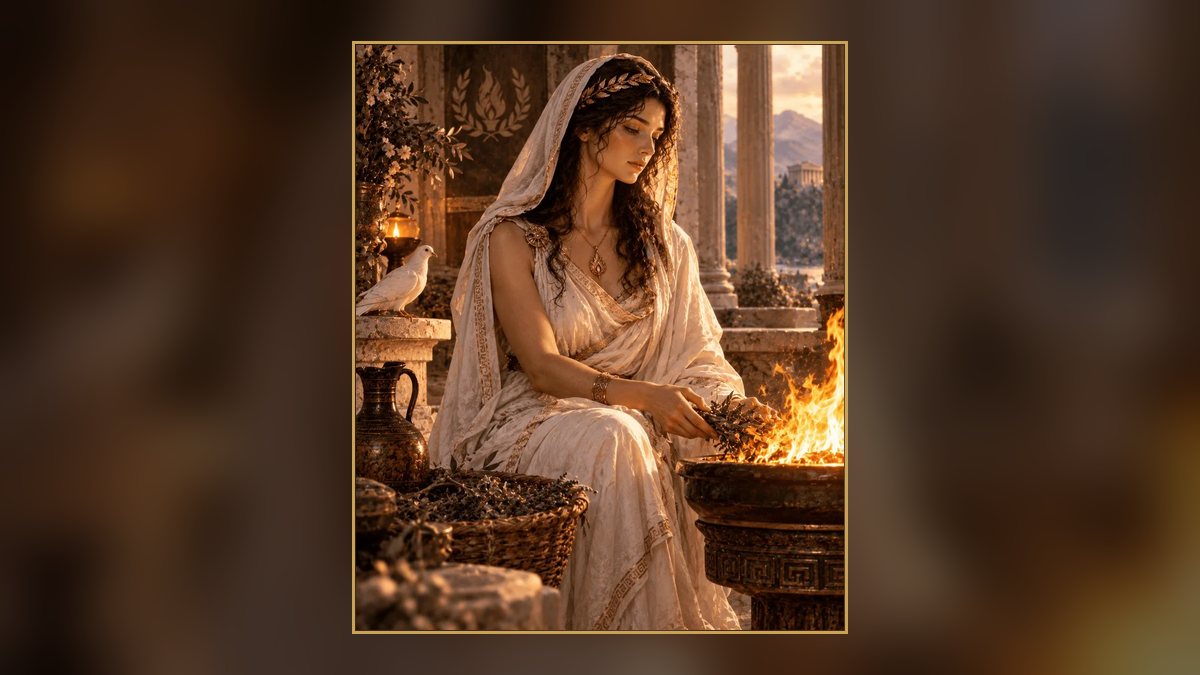
Try to name a myth where Hestia does something. I'll wait. Most people come up empty, and the ones who don't usually land on a single line about her giving up her throne. For one of the twelve great Olympians she is strangely quiet. No wars, no affairs, no monsters, no quarrels with Hera. For a long time I read that as neglect, as if the poets just forgot her. Now I think it was the other way round. The Greeks left her out of the stories on purpose, because the stories are about things that move, and she is the goddess of the one thing that is supposed to stay.
First in, last out
Start with her place in the family. Hesiod makes her the eldest child of Cronus and Rhea. That detail has a nasty side effect, because the eldest was swallowed first and, in the order of the retching, came out last. So Hestia was the first of the siblings to vanish into the dark and the final one to see daylight again. Nobody comments on this. Nobody tells you how she felt about it. But when you notice it, you start to see the shape of her whole character: first and last, the one at both ends.
That shape follows her into cult. The Greeks had a saying about beginning a sacrifice with Hestia, and plenty of rituals gave her the first portion and sometimes the last as well. When a prayer list got long and complicated, she opened it and closed it. It is an odd sort of honour, because it is not a position of rule. It is the position of the frame around the picture.
The seat she gave away
The line people half remember is that Dionysus took her seat among the twelve. Some late sources say she stepped aside willingly so that the family wouldn't have to quarrel over the place. I should be honest that this is a thin tradition, and the older evidence puts her on the list of twelve quite comfortably. But I like it anyway, because it shows how the Greeks imagined her. If you had to pick which Olympian would quietly step down to keep the peace, it could only be the one who never wanted the attention in the first place.
The swap is also neat in a way I doubt was planned. Dionysus is the god of the crowd, the festival, the roaring street. Hestia is the god of the single fire in the single room. Putting one in place of the other is like swapping a stadium for a kitchen, and yet both are, in their own way, where people gather.
The two suitors and the oath
The one story we do have comes from the Homeric Hymn to Aphrodite. It says Aphrodite can bend the minds of almost every god, but there are three she can't touch: Athena, Artemis and Hestia. Poseidon and Apollo both wanted to marry Hestia. She refused them and swore a great oath, touching Zeus's head, that she would remain unmarried forever. Zeus, in exchange, gave her the middle of the house to sit in, and the richest portion of every offering.
Read it slowly and you will notice what she is actually given. Not a kingdom. A place. Her reward for refusing marriage is to be fixed at the centre of every home, which is the one position that isn't threatened by a husband, a rival or a war. I find that a clever piece of mythic bookkeeping. The goddess of the household is the one who can never be married off, because if she were, the household would belong to someone else.
A god you could carry
Here is where I think Hestia becomes properly interesting. Every Greek city had a public hearth, usually in the town hall, called the prytaneion, where a fire was kept alight in her name. When a group of colonists left to found a new city overseas, they carried fire from the mother city's hearth with them, and used it to light the first hearth in the new place. A city was not really founded until the fire was alive there.
Think about what that means. Her fire is a kind of passport. The same flame that burned in Athens could burn in a Black Sea colony a thousand miles away, and the colonists would still be, in a real sense, at home. Hestia is the only goddess who could be literally carried across the water, and unlike her brother Poseidon, who rules the water, she could survive being moved over it.
The reverse was also true. After the Persians were beaten at Plataea, Plutarch tells us, the Greeks decided that every fire in the region had been polluted by the invaders and had to be put out. A fresh flame was brought from the shrine at Delphi and used to relight them. The fire was treated almost as a living thing that could be contaminated and then reborn.
The baby and the circle
One of my favourite pieces of evidence is a small domestic ritual. When a child was born, some families held a ceremony, which later sources call the Amphidromia, in which the baby was carried around the household hearth. It sounds like a sweet family custom, but think of what is being said. The child isn't fully part of the house until Hestia has been walked around. The goddess is not watching from above. She is the thing the baby is introduced to, the first member of the household to meet it.
Why there are no stories
So, my theory. A story needs motion: someone leaves, someone returns, someone is chased, someone is tricked. Hestia is the opposite of all that. She is the fixed point from which every journey starts and to which every journey returns. And the Greeks, who were great travellers, traders and warriors, knew perfectly well that none of that movement meant anything unless there was somewhere to come back to.
That is why I like pairing her with Hermes. In one of the short Homeric Hymns, the two are praised together, almost as a set. He stands at the door and on the road. She sits inside by the fire. One is the god of leaving, the other the god of arriving, and neither would make sense without the other. It's very likely that people really did make offerings to both at the same meal.
The Romans took her over as Vesta, and her fire became the famous one tended by the Vestal Virgins, whose job was to never, ever let it die. When it did go out, the story goes, it was treated as a disaster for the whole city, and the priestess responsible could be punished severely. For a goddess with no myths, that is quite a lot of anxiety to attach to a flame.
I think that tells the real story of Hestia. Everything else in mythology is about what the gods do. She is about what keeps going while they do it, and the quiet terror of what happens to a household, or a city, when it stops.