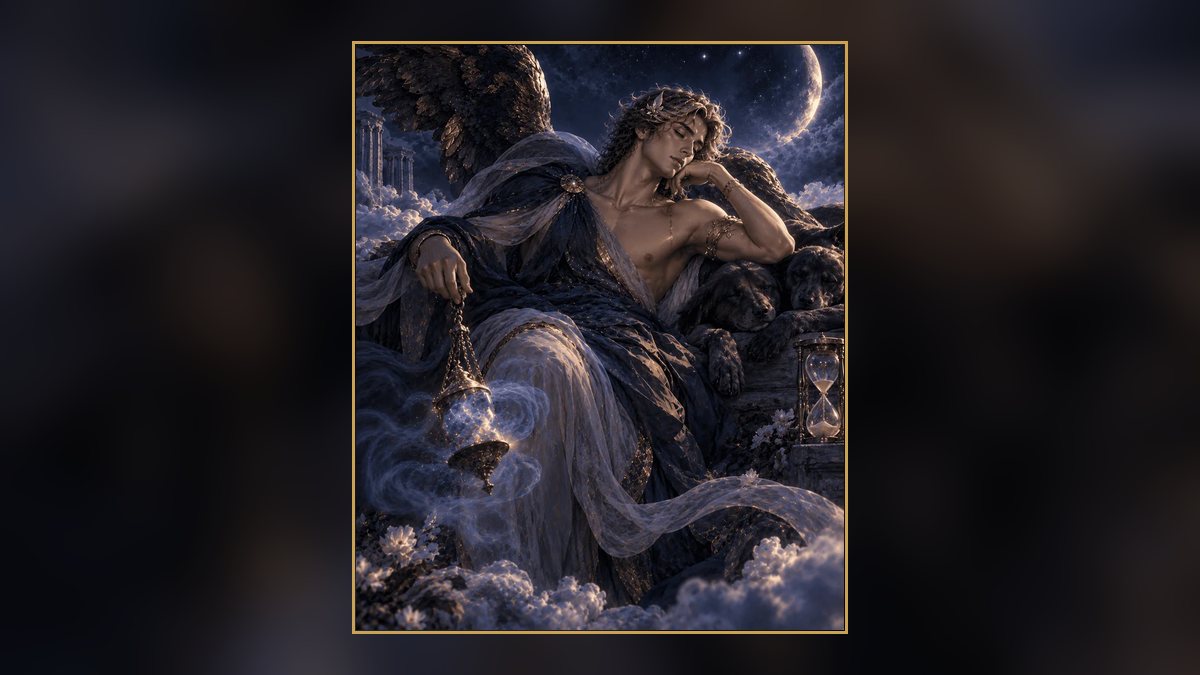
Of all the gods who ever outmanoeuvred Zeus, Hypnos is the one who did it most easily. Not with strength, not with a plan, not with an army of monsters. He just waited in a tree, in the shape of a bird, and let the king of the gods get tired. It happens in book fourteen of the Iliad, and it is one of my favourite scenes in the poem, partly because it's funny and partly because, the more I think about it, it seems to be saying something quite serious about power.
Night's quiet son
Hesiod gives Hypnos a very specific home. He and his twin brother Thanatos, Death, are the sons of Night, and they live in her house at the edge of the world, beyond the place where the sky rests on the earth. The sun never looks on them, he says. The two are different in one important way. Sleep is gentle and calm to men, while Death has an iron heart and a pitiless spirit.
What I love is the picture Hesiod draws of them meeting at the threshold of Night's house. As one comes in, the other goes out. They greet each other, he says, as they cross. It's a lovely, mundane image. Two brothers swapping shifts at a doorway, one gentle and one terrible, handing the human race back and forth. If you watched a person fall asleep and a person die, you might imagine the same thing.
The trick on Mount Ida
Here's the story from the Iliad. The Greeks are losing, and Poseidon wants to help them, but he can't do it openly while Zeus is watching. Hera, who is firmly on the Greek side, comes up with a plan. She'll distract Zeus and put him to sleep. First she dresses herself up as beautifully as possible, and borrows from Aphrodite a charm that makes anyone fall in love with the wearer. Then she goes to find Hypnos.
She finds him on the island of Lemnos and calls him lord of all gods and men. She asks him to close Zeus's shining eyes once she has lain with him, and promises a golden throne made by Hephaestus. Hypnos hesitates. He has done this before, he says, when Hera asked him to put Zeus to sleep so she could attack Heracles on his way home from Troy. Zeus woke in a rage, hurled gods around the halls of Olympus, and was looking for Sleep to throw him into the sea.
And then comes the line that I think saves Hypnos's life, and also reveals something. He escaped, he says, because he fled to Night, the subduer of gods and men, and Zeus held back. Even though he was furious, Zeus didn't want to do anything to displease swift Night.
Hold onto that. Zeus, who can throw other gods off Olympus, is nervous about annoying Night. She is older than he is. Her sons are Sleep and Death. In a poem where Zeus's authority is rarely questioned, this passing detail shows there is an older power he won't touch.
What Hera offers
Hypnos still wants a better deal. He asks for one of the young Graces, Pasithea, a lovely girl he has always wanted to marry, and Hera swears a solemn oath by the river Styx to give her to him. Then, satisfied, he disguises himself as a bird, a clear-voiced mountain bird, and perches in a fir tree on Mount Ida.
The scene that follows is among the most unexpectedly tender in the Iliad. Hera approaches Zeus, who is overcome with desire, and the two lie down on a bed of soft hyacinth and clover under a golden cloud. Then sleep takes him, and Hypnos darts off to tell Poseidon that now is the time to help the Greeks. When Zeus wakes, the battle has turned.
The way it's presented, there is nothing the king of the gods can do about it. He wasn't beaten. He was just tired. Every one of Zeus's famous powers, the thunder, the beard, the authority, can't help him against a nap. The Greeks, who loved their king, were also clearly willing to laugh at him.
My theory: sleep as the great equaliser
So here is what I make of it. I think the Greeks were using Hypnos to say that every power has a limit, and that the limit is not another power but a need. Zeus can crush an army of Titans, but he can't stay awake forever. Hera knows this, and exploits it. She doesn't try to beat him. She gets him to lie down.
It also gives Hypnos an odd moral weight. He isn't a hero or a villain. He's a service. He will do the thing you ask, for a price, and he'll do it with perfect impartiality, whether it's to a mortal or the lord of the sky. The fact that he bargains, asks for a bride and then hides in the tree shows how nervous he is about the consequences. He is the least ambitious of gods, a kind of freelancer who just wants to be paid and left alone.
Carrying the dead
Later in the Iliad, he's called again, this time with his brother. When Sarpedon, a son of Zeus, is killed at Troy, Zeus asks Apollo to rescue the body, wash it, and give it to Sleep and Death, twin brothers, to carry back to his homeland in Lycia for burial. The two lift the body and fly it across the sea.
I find that an extraordinarily gentle image of death. The Greeks put a fighter who had just been killed in the arms of Sleep and Death, as a pair. It treats the two as almost interchangeable, and Greek art often follows suit, showing them as two winged young men, sometimes identical, carrying a body. Sleep is a rehearsal and Death is the performance, and they come from the same family.
The cave and the poppies
Later writers added a home for him. Ovid describes a cave in the land of the Cimmerians, where the sun never shines. At its mouth grow poppies and countless herbs from which Night collects sleep and scatters it over the darkening earth. No cock crows, no dog barks. Before the door, a river of Lethe, forgetfulness, trickles over the stones, making a murmur that sends people off. In the middle is a bed of ebony, and on it lies the god himself, surrounded by thousands of dreams.
It's a gorgeous passage, and it explains why Hypnos has such a restful afterlife in art. There's also a famous bronze head of him in the British Museum, with little wings in his hair. He has the expression of someone who is just about to nod off.
There's one more thing I want to say about him. We tend to think of sleep as the absence of something. For the Greeks, it was a god, with a family, a home, a price and a temper. If you treat sleep as a person, you can bargain with it, feel grateful to it, and fear it when you are tired. And you can imagine, as Homer did, that even the king of heaven has to give in to it in the end.