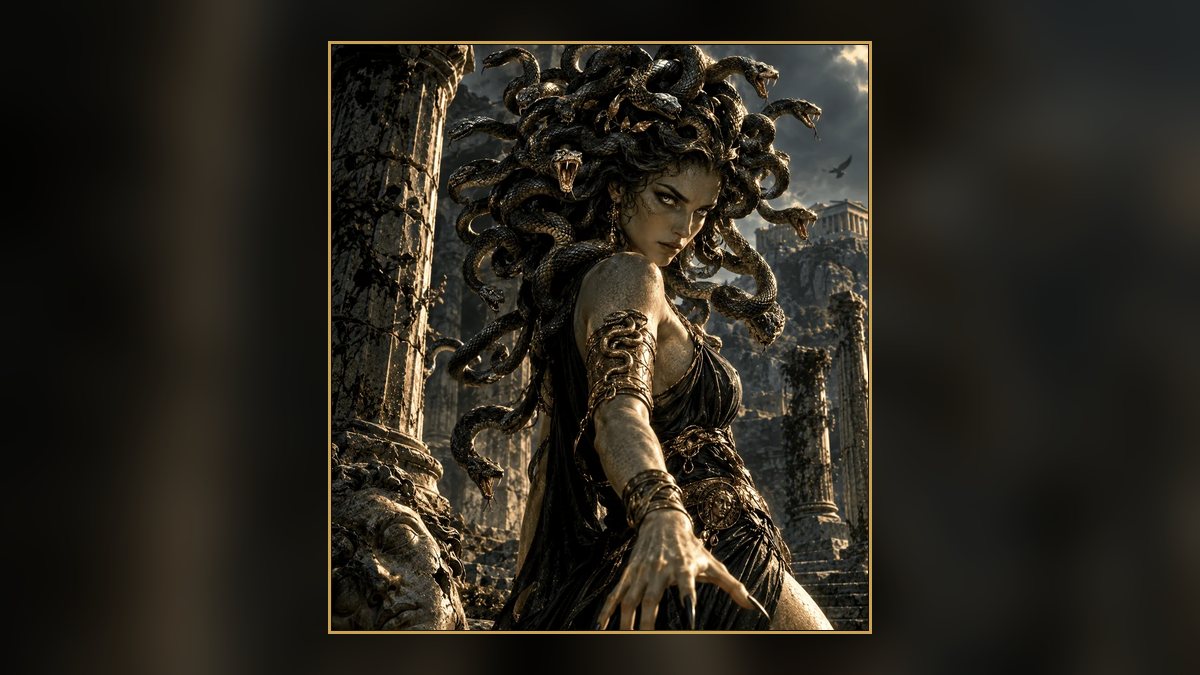
Everybody knows Medusa's story, or thinks they do. A beautiful girl is cursed by a jealous goddess, turned into a monster with snakes for hair, and killed by a hero who uses a mirror to avoid her gaze. It is a good story. The strange thing is that most of it was not part of the story for the first few hundred years. The more I read about her, the more I think the Greeks did not start with a woman and give her a face. They started with a face and went looking for a woman to explain it.
What the earliest sources say
Start with Hesiod, around 700 BC. In the Theogony, he mentions the Gorgons in a short passage: three sisters, daughters of the sea deities Phorcys and Ceto, living at the far western edge of the world, beyond the ocean. Two of them, Stheno and Euryale, are immortal. The third, Medusa, is mortal. That is almost everything he says about her origins. There is no beauty, no curse, no temple. She is simply the one of the three who can die, and so she is the one the story needs.
Hesiod also gives us the other half of the myth. When Perseus cuts off her head, two children leap out of the neck: Pegasus, the winged horse, and Chrysaor, a warrior with a golden sword. Their father, we learn, is Poseidon. This is where the story gets most interesting to me, because the birth from the wound is described in a single sentence and never explained. Where did these children come from? Nobody says. The poem simply moves on.
Homer treats her even more briefly. In the Odyssey, when Odysseus visits the land of the dead, he becomes afraid that Persephone will send up the head of the Gorgon against him, and he flees. In the Iliad, a Gorgon's head decorates the shield of Agamemnon and the aegis of Athena. In neither case is it a character. It is an object, a symbol of terror that you put on equipment.
The face on the wall
This is the part that changed my view. If you look at actual Greek art from the seventh and sixth centuries BC, you see the Gorgon face everywhere. It is on the pediment of the temple of Artemis in Corfu, an enormous face with a wide grin, bulging eyes, tusks and a lolling tongue, flanked by two great leopards. It is on shields, on roof tiles, on vases, on pieces of armour, on coins. It is deliberately ugly, and it stares straight out at the viewer, which is unusual for Greek art, where figures normally appear in profile.
The function of the image seems clear. It is what archaeologists call apotropaic, a thing meant to turn away evil. You put it on the front of your temple or your shield so that the ugliest thing imaginable would be looking back at anyone who intended harm. The Gorgoneion, as it is called, worked on the same principle as the carved grotesques that later decorated medieval churches. If the thing that frightens you is already on the door, it has been put to work for you.
So here is my theory. The image came first, as a protective charm, and it was already ancient when the poets got hold of it. A face like that raised a natural question: whose face is it? And the story of Medusa and Perseus was one possible answer. She is the monster whose head was cut off, and the head still works. Even dead, it keeps its power, which is why Athena wears it on her chest and why it turns up on every wall in Greece. The myth is an explanation for the picture, not the other way round.
How Perseus did it
The hero's side of the story is more of a quest than a fight. Perseus, the son of Zeus and the princess Danae, is sent by the king of Seriphos, Polydectes, to bring back the head of the Gorgon. The king expects him to die, since he wants to marry Perseus's mother without interference. But Perseus has divine help. Athena gives him a polished bronze shield, and Hermes lends him a curved sword, an adamantine sickle called a harpe.
He still needs more equipment, and the best part of the story is how he gets it. He finds the Graeae, three old sisters who share a single eye and a single tooth between them, and steals the eye until they tell him where the nymphs live. The nymphs give him winged sandals, a bag called a kibisis to carry the head in, and the cap of Hades, which makes the wearer invisible. This is a heist story, with an inventory. Medusa herself is almost the least interesting part of it.
When he reaches the Gorgons, they are asleep. Perseus flies over them and looks only at the reflection in the shield. He cuts off Medusa's head, drops it in the bag and escapes, with her two sisters howling behind him and unable to catch him because of the cap and the sandals. The most important detail is the method. He never looks at her. The Greeks understood that you cannot confront this thing directly, and the only way to approach it is by an indirect route, with the help of someone wiser.
What he did with the head
The head did not stop working once it was cut off. On the way home, Perseus used it to turn the Titan Atlas into a mountain, according to Ovid. He used it to save Andromeda from a sea monster, and then again at her wedding feast, where he turned the rival suitor Phineus and his followers to stone. And when he returned to Seriphos, he used it to petrify Polydectes and his court. In the end he gave it to Athena, who set it on her shield, which is why the aegis carries the Gorgon's face.
One more small piece of the story stays with me. Athena also gave some of Medusa's blood to Asclepius, the healer. Blood from the left side of the body was a poison, and blood from the right could bring the dead back to life. Even in the stories of the monster there is a hint that the same material can kill or cure depending on which side you take it from.
The Roman rewrite
The version everybody knows today, the one in which Medusa is a victim, comes mostly from the Roman poet Ovid, who wrote the Metamorphoses around the year 8 AD. In his account, she was once a beautiful young woman, famous above all for her hair. Poseidon assaulted her in the temple of Athena. Athena, instead of punishing the god, turned Medusa's hair into snakes and gave her the gaze that turns people to stone.
Whether that was an old tradition or Ovid's own invention is hard to say, since we do not have any earlier source that tells it that way. What I find striking is that it solves several problems at once. It explains why she is a monster, it explains Poseidon's role in the birth of Pegasus, and it places the story in an Athenian setting. It also leaves readers with the uncomfortable fact that the goddess punished the wrong party. Ovid was a sophisticated writer who enjoyed leaving things morally untidy.
The change matters because it turns a face into a person. The Gorgon of Hesiod is something that exists to be defeated. The Medusa of Ovid has a life before the story starts, and a reason to be angry. Modern readers, rightly, have taken that second version and run with it, and Medusa has become a figure of suffering and protest. I think that is a legitimate way to read the myth. It is just worth knowing that it was added later, by someone who was trying to make a question of justice out of a very old image.
Why she never went away
What I take from all of this is that Medusa survived not because of her story but because of her face. Roman soldiers wore her on their breastplates. Byzantine builders reused her heads as column bases in the Basilica Cistern in Istanbul, upside down and sideways, for reasons nobody has ever explained properly. She is on the logo of a modern fashion house. A stare that turns people to stone is, in the end, a very flexible idea. It can be a ward, a curse, a warning, or a way of saying that some things should not be looked at directly.
And the lesson of the story is, perhaps, that you do not need to understand a frightening thing completely to deal with it. You need a good reflection, a clear head and a friend who gives you a sharp sword. That is all Perseus has. It turns out to be enough.