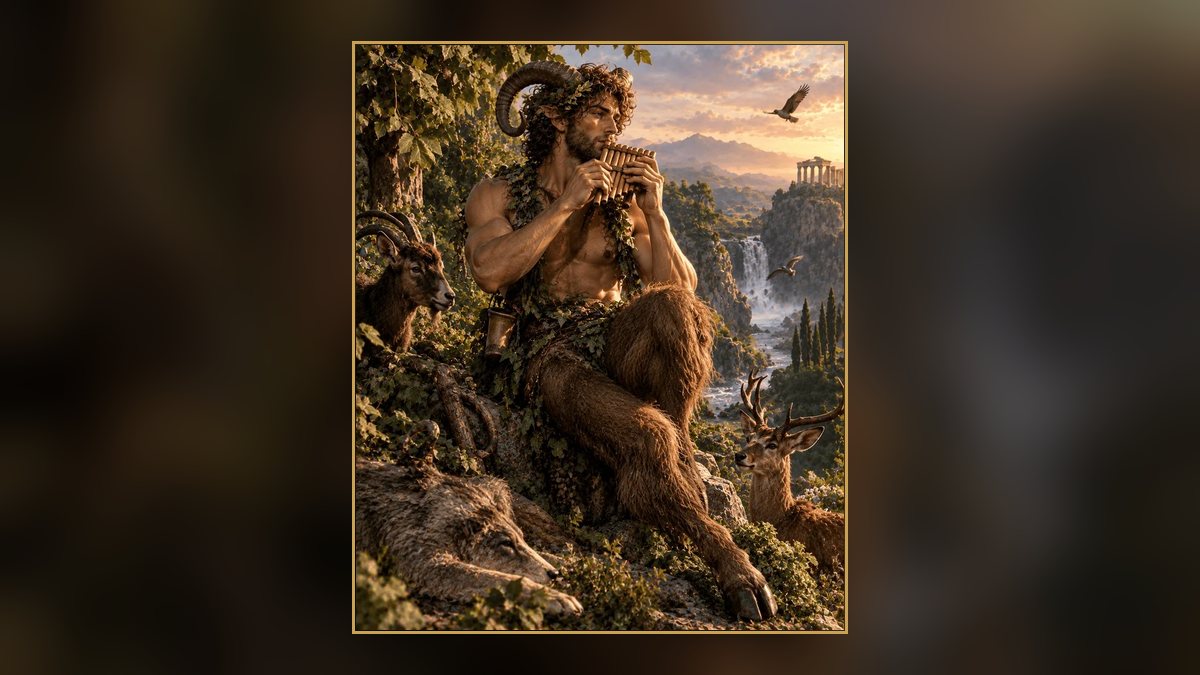
Pan is one of those gods who seems much more modern than he should. A goat-legged man with a pipe, laughing in the hills, he fits almost too well into our idea of nature. But if you actually read what the Greeks said about him, he is odder and more unsettling than the cheerful figure on greeting cards. He's the god of the places where a farmer stops being sure of what's around him. And the word he gave us, panic, is a better clue to his nature than any of the pretty stories.
A baby that made everyone laugh
The Homeric Hymn to Pan is short and strange. It says he was born to Hermes and the daughter of Dryops, a mountain nymph. The baby had goat's feet, two horns, and a noisy, cheerful laugh. His nurse took one look at him and ran away in terror. Hermes, however, wasn't bothered. He wrapped the child in the skins of mountain hares, carried him up to Olympus, and set him down before the gods.
The gods, the Hymn says, were delighted. Dionysus was especially taken with him. And the poet adds that this is why the child was named Pan, because he delighted all of them. In Greek, pan means all. It's probably a pun rather than a real derivation, but it's a revealing one. A creature who was too ugly for his own nurse is, to the gods, the most welcome of guests.
Look at how this story sets him up. He's a half-animal at a table of beautiful people. He is rejected by the humans and welcomed by the gods. That is already a theory of what Pan is: someone who belongs in the world above and the world below and who makes the people in between uncomfortable.
Hermes's son
The Greeks liked to get family ties right, and giving Pan to Hermes tells you something. Hermes is the god of crossings and boundaries, the one who moves between worlds. His son is a creature of one particular boundary, the one between farmed land and wild land, where the last field ends and the unfarmed hill begins. Shepherds lived on that edge all the time, which is why Pan was their god, and why his cult was usually in caves and rocky places rather than in grand temples.
It's also a boundary where something can go wrong. A flock can scatter. A man can get lost. A noise can come from nowhere. Pan is the personification of that unease, and that's where the word panic comes from. The Greeks used it for a particular kind of sudden fear, usually in an army or a herd, which spreads without any obvious cause. Something is heard, someone runs, and everyone runs. Nobody has seen anything. That, they said, was Pan.
The noon rule
There is a tiny piece of evidence I love. In the first of Theocritus's pastoral poems, a goatherd refuses to play his pipe for a friend, saying that it's midday, and Pan is resting from the hunt. If he is disturbed, the goatherd says, he gets bitter and angry at the noise. So at noon, shepherds kept quiet.
Think about what that means. A god of wild noise has a specific hour when you must not make any. The fiercest heat of the day, when the shadows disappear and the hills are completely silent, belongs to him. It's the hour when the countryside feels most watched. Anyone who has stood in a quiet field at midday will know the feeling, and I take it as a sign that the Greeks understood it well enough to give it a name.
The god who turned up at Marathon
Pan had one very public moment. Before the battle of Marathon in 490 BC, the Athenians sent a runner, Pheidippides, to ask Sparta for help. According to Herodotus, on his way, on Mount Parthenion, he met Pan. The god called his name and asked why the Athenians paid him no attention, though he had been kind to them in the past and would be again.
The Athenians believed the story, and after the war they set up a shrine to Pan in a cave under the north slope of the Acropolis, with yearly sacrifices and a torch race. That is a wonderful piece of religious politics. Athens had not worshipped him before. A god of the wild hills was invited into the city because of what happened at the edge of the territory. Later Greeks also credited Pan with helping the Athenians at Marathon by throwing the Persians into panic, which is the kind of tidy explanation that tends to grow around a battle.
Syrinx and Echo
The better-known stories about him, mostly told later and most beautifully by Ovid, are all about wanting something and not getting it. He chases the nymph Syrinx, who turns into a bed of reeds to escape him. Pan cuts the reeds to different lengths and binds them together, and that is the first set of panpipes. In another story, he loves Echo, and she, in some versions, is torn apart by shepherds driven mad by him, and only her voice remains.
Both of these are about sound. A girl becomes an instrument. A girl becomes a voice with nobody attached. In each case, desire ends with something you can hear but not touch, and I think that's the essence of him. The god of the hills is a god of what echoes back. That's why I called this article what I did. You rarely see Pan. You hear a pipe, a rustle, a noise on the slope above you.
The great Pan is dead
The most famous story about him is also the strangest. Plutarch, in an essay on why the oracles have fallen silent, tells of a man named Thamus, a sailor on a ship that was becalmed near the island of Paxi during the reign of Tiberius. Out of the quiet came a voice calling his name. The third time, he answered. The voice told him that when he reached a certain place, he should announce that the great Pan was dead.
When the ship was becalmed there, he shouted it across the water. And there came a great sound of groaning from the unseen crowd, as of many people grieving.
Plutarch doesn't claim it's true, and scholars have suggested the message was actually about a Syrian god, Tammuz, misheard in a noisy harbour. But it stuck. And I think it stuck because it fits what Pan is. If he's a god of the unseen and the half-heard, then of course his death would be announced by an invisible voice at sea. He is the only god in Greek tradition whose death is a story, and he is the god who was always more of a sound than a face.
What he is for
I think Pan is what the Greeks kept for the parts of the world that weren't theirs. Farms, cities, harbours and temples all had other gods. But the hill above the farm, the cave, the empty midday, the dark in the valley, belonged to no one. So they gave it a god who laughs, who has goat's legs, who plays a pipe made of an unhappy girl, and who frightens animals into stampedes. The joke is on us. We think we've organised the landscape. He is the reminder that we haven't.