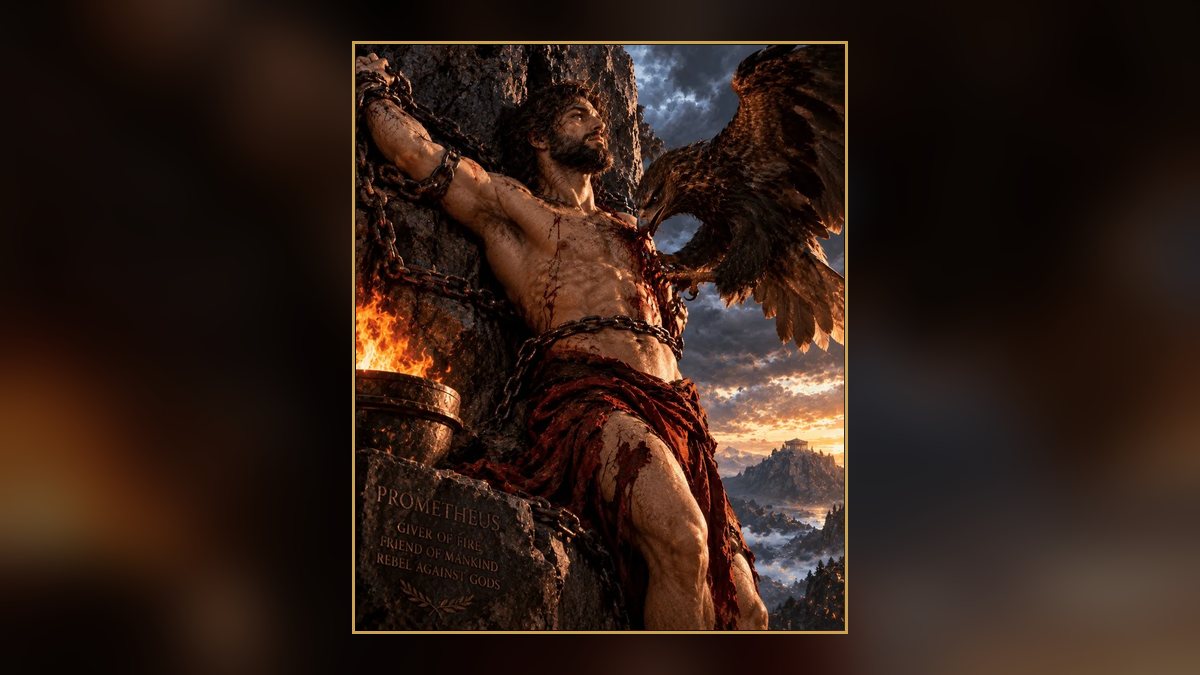
Say the name Prometheus and almost everyone gives the same summary: he stole fire from the gods, gave it to humanity, and was punished forever. That is correct and it is also the shortest possible version. When you read the old accounts closely, the fire is only the most visible object in a longer argument between a clever Titan and a king who was trying to keep the world under control. My own theory, which I will explain as we go, is that Prometheus did not give humans fire. He gave them the habit of planning, and fire was just the proof.
A Titan on the wrong side, or the right one
Prometheus was a son of the Titan Iapetus, which makes him part of the old generation that Zeus fought and buried in Tartarus. Yet when the war broke out, he did not stand with his kin. His name means "forethought", and the story goes that he foresaw how the war would end and joined the Olympians. His brother Epimetheus, whose name means "afterthought", was the opposite sort of mind, the one who understands a situation only once it has gone wrong.
Hold that pairing in your head. The Greeks gave us a pair of brothers who are basically two ways of being human. One looks ahead. The other looks back and wishes he had looked ahead. Most of us are Epimetheus on a bad day and Prometheus on a good one, and I suspect the original audience laughed at that.
The trick at Mekone
In Hesiod's account, the first dispute begins at a meeting at Mekone, where gods and mortals were working out who got what from a sacrifice. Prometheus was set to divide a great ox. He split it into two piles. In one he hid the good meat and the entrails inside the ugly stomach. In the other he arranged the bare bones under a layer of shining fat, so that the pile looked far more appealing.
He then invited Zeus to choose. Zeus, who the poem says saw through the trick perfectly well, picked the fat anyway, and when he found the bones he was furious. Whether the king of gods really fell for it or simply used the moment as an excuse is one of the things scholars still argue about, and I like that Hesiod leaves it open. But the outcome was fixed: from then on, humans burned the bones and fat for the gods and kept the meat for themselves.
This is the first piece of my theory. The Mekone story is not really about meat. It is about the boundary between divine and human, and Prometheus is the one who draws that line in humanity's favour by outsmarting an authority figure. That is the habit he is teaching: you can negotiate with the structure of the world if you think carefully enough.
The fennel stalk
Zeus responded by taking fire away from mortals, hiding it so that people would have to live without it. Prometheus went back up and stole it, carrying the flame in a hollow stalk of giant fennel, a plant whose pith burns slowly, which is a surprisingly practical detail. Notice that he did not steal a weapon or a title. He stole a tool, the thing that lets people cook, forge metal, fire pottery and keep the dark away.
And that matters because fire in these stories is never only fire. In the version told by Aeschylus, the tragedy Prometheus Bound, Prometheus claims that he gave humankind far more than flame. He taught them numbers and writing, how to read the stars, how to build houses and ships, how to treat illness, how to read omens and extract metals from the ground. Fire is the doorway, but what comes through it is the whole technical life of human beings.
Hesiod does not give that long list, so I should be honest that it is the later tragedy that expands the story. But the expansion tells us how the Greeks understood the myth. They did not hear it as a simple heist. They heard it as the origin of civilisation, with all the good and the cost that comes with it.
The price on both sides
The punishment was famous. Zeus had Prometheus chained to a rock in the Caucasus, where an eagle came each day to tear out his liver, which grew back overnight so that the torment would never end. This lasted, in the ancient reckoning, for an enormous span of time until Heracles shot the eagle and Zeus allowed him to release the Titan.
Humanity was punished too, and this is the part we forget. In Hesiod, Zeus ordered Hephaestus to shape the first woman out of earth and water, and the gods gave her gifts. This was Pandora, whose name means something like "all-gifted". She was sent as a deliberate "beautiful evil" to the household of Epimetheus, who accepted her despite his brother's warning never to take a gift from Zeus. Her jar, which later tradition turned into a box, held the troubles that now afflict the world, and only hope remained inside.
Hesiod's treatment of Pandora is, to put it plainly, misogynistic, and I do not think it improves by being dressed up. But the structure of the story is revealing. Prometheus the forethinker warns, Epimetheus the afterthinker ignores the warning, and the consequences come down on everyone. The lesson that survives is not "women are a curse". It is that a gift from a powerful party who has just been tricked is rarely just a gift.
Why the liver?
People often ask why the punishment targets the liver. The Greeks believed the liver was a seat of strong emotion and of life itself, and they used it in divination, reading the shape and condition of an animal's liver to predict outcomes. Think about that in relation to this particular Titan. The god of foresight is punished in the organ associated with reading the future. Every day he is opened and read, and every night he is restored to be read again.
That is my second small theory and I would not claim more than that. But it fits. The myth does not just punish him. It trades on his specialty.
Was Zeus the villain?
Modern retellings tend to make Prometheus the hero and Zeus the tyrant. The ancient sources are less tidy. In Hesiod, Zeus is a ruler maintaining a fragile order after a civil war between generations, and Prometheus is a gifted troublemaker who keeps testing it. In Aeschylus, the sympathy leans much further toward the Titan and his stubborn defiance, though even there the play ends by hinting at reconciliation.
One reason I find the story durable is that both sides have a point. Zeus has just survived a catastrophic war and a father who wanted to eat him. Of course he is jumpy about anything that blurs the gap between gods and mortals. Prometheus, meanwhile, has looked at the weak, cold, hungry creatures called humans and decided they deserve a chance. You do not need to pick a side to see that the conflict is real.
What he gave us, really
So here is where I land. If the gift were only fire, the myth would be a story about a stolen object. But the details, the trick with the bones, the fennel stalk, the long list of skills in the later play, the jar that follows, all describe something else: the beginning of deliberate human planning. Before Prometheus, in this telling, people live from day to day like the other animals. After him they can store, prepare, improve, anticipate. They can think in terms of next year.
That also explains why his punishment is so endless and so personal. Foresight is useful but it is not comfortable. The one who sees ahead pays for it by seeing the consequences first. When we say a person "has a Promethean streak", we usually mean they push for progress and refuse to back down. The old myth adds a quieter thought: the people who bring the new thing into the world are rarely rewarded for it on the same day. Sometimes they are just the first to be chained to the rock.