The Hymn to Demeter is about five hundred lines long, and it was probably composed in the orbit of Athens and Eleusis. That matters. Eleusis was the home of the Mysteries, a secret rite that thousands of people went through, and revealing what happened there was a serious crime. In 415 BCE Alcibiades was accused of mocking the Mysteries at a private party, and it helped drive him out of Athens. So this poem lives in an odd position. It tells a story that everyone could hear, and it hints at a ritual that nobody could describe.
The meadow
Persephone is out picking flowers with the daughters of Ocean when a narcissus appears, a flower of impossible beauty that the Earth has grown at the request of Zeus, to please Hades. She reaches for it. The ground opens, and Hades arrives in a chariot with immortal horses and carries her off. She screams for her father. Only two hear her: Hecate, from her cave, and Helios, the sun. Everyone else carries on as before.
One detail the poem is careful about. Zeus agreed to all of it. He gave his daughter to his brother without telling her mother. The poem doesn't let him off the hook.
Nine days of torches
Demeter hears the scream and tears her veil from her head. For nine days she wanders the earth with a torch in each hand, without eating or washing. On the tenth day Hecate appears and tells her what she heard but didn't see. The two go to Helios, who sees everything, and he tells Demeter the truth. Then he adds, a little awkwardly, that Hades is hardly an unworthy son-in-law, since he is her brother and holds a third of the world by lot. It is a funny moment of tact in the middle of grief. It doesn't help. Demeter is angrier at Zeus than at anyone.
The old woman at the well
She disguises herself as an old woman and sits by the Maiden Well in Eleusis. The daughters of King Celeus find her and take her home, and Queen Metaneira hires her as nurse for her baby son Demophon. In the house there is a servant woman named Iambe, who makes jokes until the grieving goddess laughs. Demeter refuses red wine, but she accepts a drink of barley, water and mint. That drink, the kykeon, later turns up as part of the rite.
Then the nurse starts putting the child into the fire at night, to burn away his mortality. Metaneira walks in, screams, and breaks the spell. Demeter sets the baby down, says that humans are foolish and cannot see their fate coming, and reveals herself. She demands a temple and rites at Eleusis.
The strike
Sitting in her new temple, she brings the year to a halt. Seeds won't grow. Humankind starts to die, and the gods realize they are about to lose their offerings. This is the real pressure in the poem. The gods can ignore a mother's grief but not an empty altar. Zeus sends Iris, and then the gods one after another with gifts. Demeter refuses all of them until she sees her daughter.
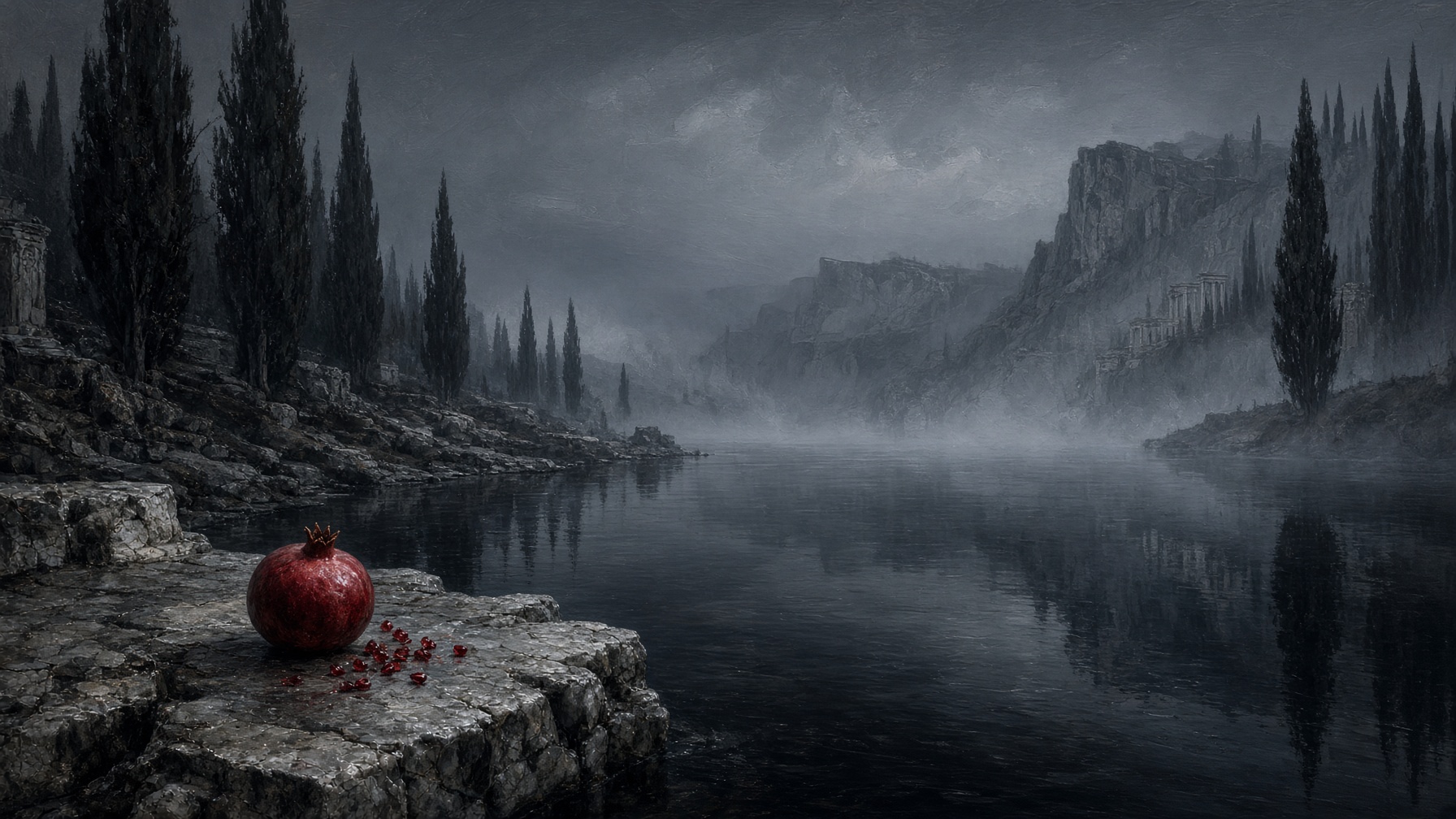
Finally Hermes goes down to fetch Persephone. Hades agrees, but before she leaves he slips her a pomegranate seed. She says later that she was made to eat it. As a result, she must spend a third of each year below, and the rest with her mother and the gods.
What it won't say
Here is something I find interesting. The Hymn never actually says "winter". It tells you she spends a third of the year in darkness and comes back when the earth is full of spring flowers. The seasons reading is natural and it's probably right, but the poem's own attention is somewhere else. It is about honor and exchange. What do the gods owe each other, what do mortals owe the gods, and what does a mother do when the gods ignore her loss?
The ending gives it away. Demeter shows her rites to the princes of Eleusis, rites the poem calls awesome, which no one may break, ask about or put into words, because deep reverence for the gods holds back the voice. And then it says that anyone on earth who has seen them is blessed, while the uninitiated will not have the same lot after death.
That is my reading, and I'm fairly sure of it: the poem isn't really explaining the seasons. It is making a promise about the afterlife, and it makes it in the only way the Mysteries allowed, by telling you exactly how much it can't tell you.