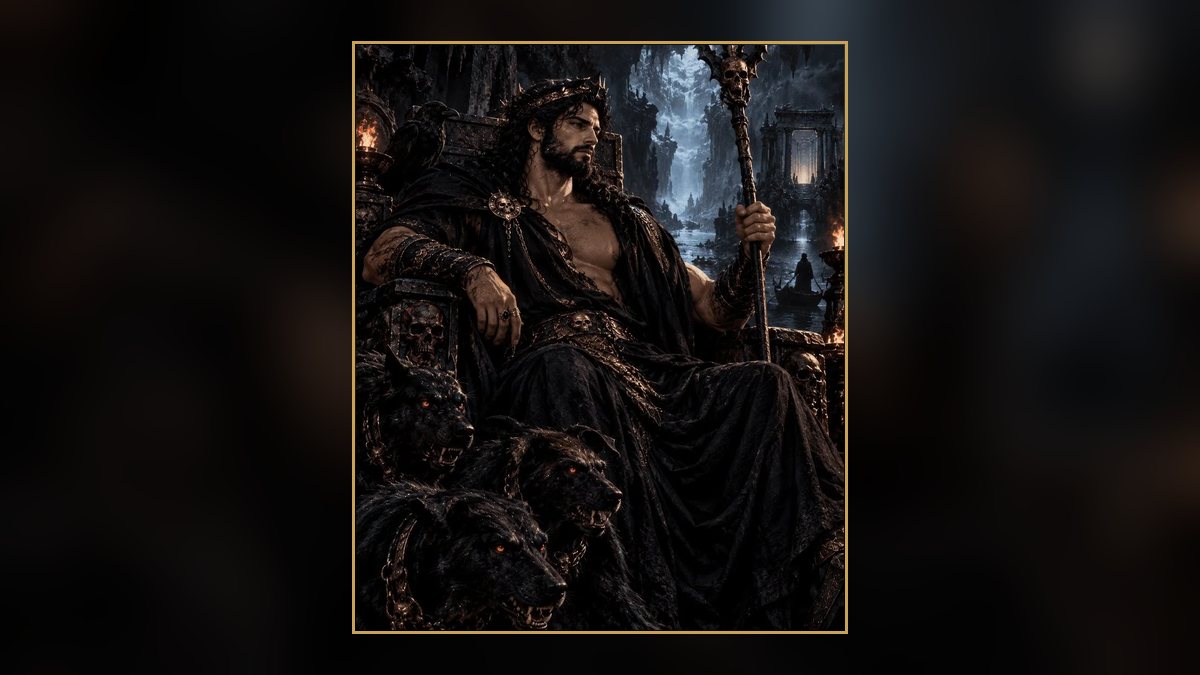
Most people know the god of the underworld as Hades, or sometimes as Pluto, the name the Romans used. What is less well known is that Pluto is a Greek word, Plouton, and that it was at first not a name but a flattering title. It means the wealthy one, the rich one, and the Greeks gave it to the lord of the dead for reasons that say a lot about how they thought about the ground.
Start with the obvious problem. Hades was a god nobody wanted to talk about. His name, which could be taken as the unseen, or the place of the unseen, was avoided in conversation and in prayer. Speaking it aloud might attract his attention, and nobody wished to be noticed by the god of death. So people used substitutes, polite and indirect, and Plouton was one of the favourites. You do not call a feared ruler something threatening. You call him something generous, and hope he lives up to it.
Why wealth
There is a practical logic behind the choice. In the Greek world, nearly everything valuable came out of the earth. Grain grew in it. Fruit trees rooted in it. Silver, gold, iron, copper and marble were all dug from it. Wells and springs rose out of it. If you asked a farmer or a miner where wealth came from, the honest answer was: down there. And if the dead were also down there, then the same ruler might reasonably be thought to govern both.
The philosopher Plato, in a dialogue about names called the Cratylus, puts this argument in the mouth of Socrates. He says the god is called Plouton because wealth comes up from beneath the earth, and the name suits him. It is just a guess at an etymology, and not all scholars would agree. But the idea behind it is consistent with a lot of Greek religion, which linked the soil, the harvest and the dead very closely. A seed goes into the ground and comes up as grain. A body goes into the ground and joins the shades. It is not hard to see them as two sides of the same process.
The god with a horn of plenty
Artists responded to the association. In vase paintings and reliefs, Hades is often shown holding a cornucopia, the horn of plenty that overflows with fruit and grain. It is an unexpected sight for anyone who has been taught to think of him as a gloomy figure. He sits on a throne in his own realm, bearded and grave, with the horn in his arm. He might also hold a sceptre, and the three-headed dog stands by.
The symbol makes a point. The ruler of the dead is not just a jailer. He is a host, one who receives every visitor sooner or later, and who has something to give. The Greeks called him polydegmon, the one who receives many, and polydektes, the host of many. Wealth, in this sense, is the sum of all the people who have come to his hall.
The link with the harvest
Plouton connects directly to the myth of Persephone, the most important story involving him. His niece, the daughter of the grain goddess Demeter, was gathering flowers in a meadow when the ground opened and he drove up in a chariot and took her. Demeter, in her grief, forbade anything to grow, and mortals began to starve. Zeus finally ordered Hades to give the girl back. He agreed, but first he gave her a pomegranate seed to eat, which bound her to return for part of each year.
In this version, the god of the underworld is a kind of agricultural force. When Persephone is with him, the earth is bare. When she rises, it blooms. The name Plouton fits naturally, since the same god who holds her has the wealth that returns in spring.
There is even a minor god named Ploutos, which means wealth as such, who is a child of Demeter. He is a separate figure, shown in art as a boy carrying a horn of plenty. The similarity of the names was not an accident, and the Greeks must have felt the link between them. Over time, Plouton and Ploutos were sometimes treated as almost the same.
In the Eleusinian rites
The best evidence for how seriously this was taken comes from Eleusis, near Athens, where an annual set of secret rites was held for the grain goddess and her daughter. The ceremonies, called the Mysteries, promised initiates a better lot after death. We do not know the details, because the secret was kept, but we know that the rites were about the cycle of loss and return, and that the underworld ruler had a place in them. Plouton was not only a figure of dread. For those who had been initiated, he was something nearer to a benefactor.
The Romans took the name over as Pluto, and sometimes as Dis, from the Latin for rich, which was a straight translation of the same idea. They too knew that death and wealth shared an address.
Words that came from him
The root has travelled a long way. It is the same one behind the English word plutocracy, rule by the wealthy, and it passed into Latin and then into modern languages as a standing joke about the connection between money and power. When astronomers named a newly found world in 1930 they chose Pluto, after the god, because it was dark, distant and cold, and later the element plutonium was named after the planet in turn. A title that began as a nervous compliment ended up on a map of the solar system and in the periodic table.
What the title does
Plouton is a diplomatic word. It is the kind of thing a person says when they are scared and want to be polite. But it is also a deep statement of a belief. The earth gives and the earth takes, and the ruler of the dead is also, in a way, the ruler of the harvest.
If the title seems odd to us, perhaps that is because we have moved so far from the soil. For a Greek farmer, who put the seed in, and the dead too, in the same dark earth, it was just accurate. The wealth was down there, and so was the god, and the only question was how to speak to him with respect.