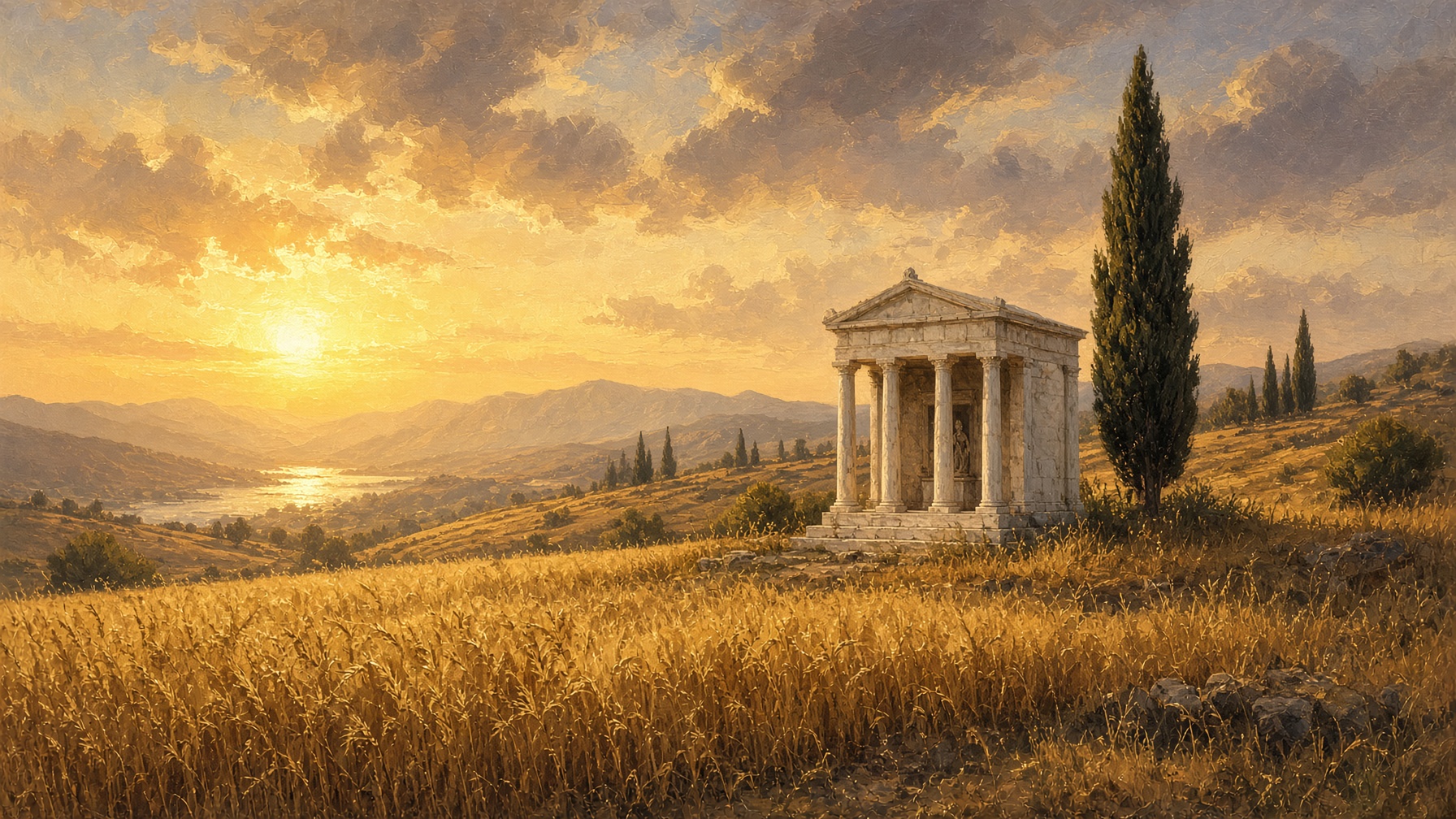
People hear "Golden Age" and picture a glow, a kind of permanent late-afternoon light over a happy field. That is not really what Hesiod gives us. His golden race gets under twenty lines, and the striking thing about those lines is how little happens in them. Nobody fights, nobody conquers, nobody builds anything or loses anything. They live, they feast, they die as though falling asleep. If you were looking for a plot, you would be disappointed. I think that is exactly the point, and it is the idea I want to follow through this article: the Golden Age is the time with no story.
What the poem actually says
Hesiod tells the Golden Age in his poem Works and Days, when he stops to explain to his brother why life is so hard. The first race of people, he says, was made by the immortals back when Cronus ruled in heaven. They lived like gods, without sorrow or toil. Old age never came near them. Their arms and legs stayed the same, and they enjoyed feasts, free from every evil. When they died, it was as if they were overcome by sleep. The grain-giving earth produced its harvest by itself, in plenty, with no one asking. They lived in peace and ease, with all their flocks and the goodwill of the blessed gods.
Read that list slowly and notice what is missing. No weather is mentioned. No danger. No other people to quarrel with. The Golden Age is defined entirely by absences: no labour, no age, no grief, no war, no death that hurts. It is not a society, it is a condition.
That is why I say it has no story. Stories need friction. They need someone to want something and be unable to get it. In Hesiod's golden race, there is nothing to want, because the earth already supplies it. Everything the later ages will fight about is already solved, and so the age cannot be narrated. It can only be remembered, and wistfully, by people who live later.
The problem of Cronus
Here is the part I find difficult, and the sources never quite resolve it. The Golden Age happens under Cronus. And Cronus, in the Theogony, is the god who castrates his father and then swallows his own children one by one to avoid being overthrown. If you read the Titan story in another section of this site, you know what he is like. How can the most paranoid king in Greek myth preside over a paradise?
I have one theory, and I want to be clear that it is mine and not something any ancient writer says. I think both stories are true at once, for different people. Under Cronus, the earth was generous to mortals and monstrous to the gods who happened to be his family. The Golden Age is a view from below, from the people who were not in the palace. Ordinary humans got the harvest. Rhea and her children got the tyranny. Which one you remember depends on where you were standing.
That is, after all, how most nostalgia works. The good old days are good for some of the people, and the rest are left out of the photograph.
They did not exactly die
One of the oddest details in Hesiod is what happens to the golden people afterwards. The earth covered them, he says, but they did not vanish. They became spirits, daimones, living on the earth, wandering in mist, invisible. Their job is to watch over mortal men. They keep an eye on judgements and cruel deeds, and they give wealth. Hesiod calls this a kingly honour.
Think about what that means for how a Greek farmer saw the world. The air around him was thick with the first people, who were still watching. The old golden race is not a distant memory. It is a standing audience, a kind of invisible neighbourhood watch. The first people did not die so much as take a different job.
That fits with something Plato says much later, in the Cratylus, where Socrates quotes the passage and argues that the golden race was not made of gold, but good and noble, and that is why they are called golden. I like that reading. Gold here is not a material, it is a verdict.
An age you could rehearse
The Greeks did not only tell the Golden Age. They acted it out. In Athens there was a festival called the Kronia, held in the summer, in honour of Cronus himself. Our evidence for it is thin, but one detail survives in several writers: during the Kronia, masters and slaves ate together at the same table. The normal order of the household was suspended for a day. The Romans had a similar festival, the Saturnalia, famous for its reversals, with gifts, gambling, and masters waiting on slaves.
I find that unexpectedly moving. A society built on slavery, aware of how unjust that is, set aside one day a year in which everyone pretended to live as the first people had lived, equal and fed. It was an act of imagination, and also a quiet confession. If the Golden Age had no masters, then the ordinary world, the one with masters, is a fall.
The version Plato tells
Plato gives his own, stranger account in the dialogue called the Statesman. In his telling, there was a time when the god himself steered the universe, and the cosmos ran in one direction, and then turned the other way when the god let go of the rudder. During the god's rule, he says, people were born from the earth, not from parents. Animals were herded by lesser divinities, like shepherds. There were no cities, no families, no private property, no wars. There were fruits on trees and soft grass to sleep on, and people lived naked and outdoors in a mild climate.
It is a more philosophical idea than Hesiod's, and I would not claim it is the same myth, but the family resemblance is obvious. In both, the first people are looked after, and the price of being looked after is that they have no history. It is only when the god lets go that politics begins, and with it, the need for laws.
Where the golden people went
There is one more thread worth pulling. Hesiod says that the heroes of the fourth race, the men who fought at Thebes and Troy, did not all die. Some were taken by Zeus to the ends of the earth, to the Isles of the Blessed, where they live with carefree hearts beside the deep-swirling Ocean, and the earth yields honey-sweet fruit three times a year. And who rules over those islands? Cronus. Pindar says so explicitly, in one of his great odes.
So the Golden Age does not end. It moves. It stops being a time and becomes a place, an afterlife for the lucky few. The easy world of the first people is still out there, beyond the sea, reserved for those who deserve it. That seems to me a very Greek compromise: we cannot have the paradise back for everybody, so we promise it, at a distance, to a handful.
Why I think the Greeks needed it
Put it all together and here is what I take from the Golden Age. It is not a prediction, a rule or a lesson. It is a measuring stick. Everything else in Hesiod's account of the ages is a story of loss, and you need something to lose from. The first race is the fixed point that makes the others readable.
It also does a quieter job. A society that believed it was descended from a decline could not feel too smug. Every Greek who heard the poem knew that his own times were measured against an age without toil, and found wanting. That is a humbling thing to teach, and I suspect it helped to keep ambition in check.
I would add one last, personal note. The Golden Age is the only age in Hesiod's list that nobody is blamed for. The silver people are punished, the bronze people destroy themselves, the iron people are hopeless, and the golden people simply are. They are the only ones who get to be innocent, because they were the first, and the poem keeps them that way, with no story, which means no faults.