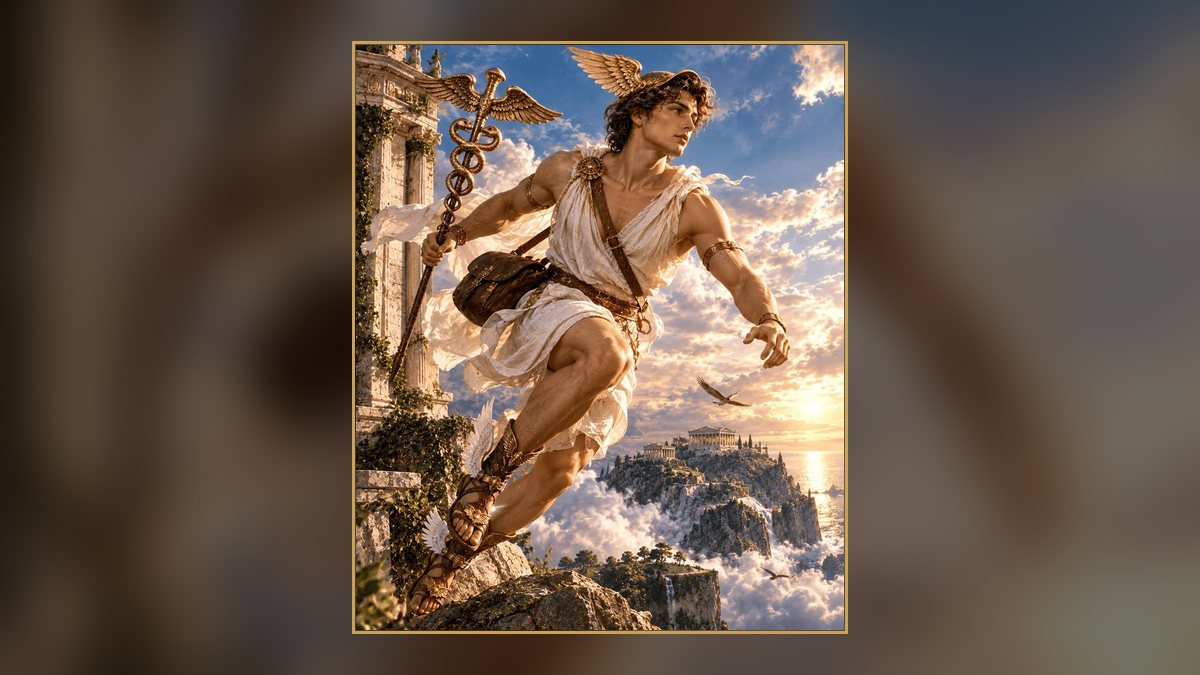
Greek religion has plenty of fearsome gods and goddesses of death, but the figure who is usually shown walking beside the newly dead is not one of them. He is Hermes, the messenger, the god of travellers and merchants and thieves, wearing his travelling hat and carrying a staff. The title that sums up this work is psychopompos, from psyche, the soul or breath, and pompos, a guide or escort. He is the one who takes the soul on its way.
The word as a title is a later one. It is common in writers of the Hellenistic and Roman periods. But the idea is as old as Homer, and the poem that shows it best is the Odyssey.
The suitors’ road
In the opening of the last book of the Odyssey, Odysseus has just killed the men who spent years wasting his house and pursuing his wife. Their souls now have to go to the underworld, and the poet shows us how it happens. Hermes of Cyllene, the god’s mountain home, calls them out. He holds his golden wand, the staff with which he puts men to sleep and wakes them, and he leads them. The souls follow him, squeaking like bats in the corner of a cave, one clinging to the next as they fly.
It is a haunting picture. They travel past the streams of the world-encircling river and the White Rock, past the gates of the sun and the land of dreams, until they arrive at a meadow of asphodel, where the dead live. They go without a murmur. The god says nothing, and the poet does not need him to. His presence is enough.
The detail that stays with me is the bat image. The dead are not mighty or fearsome. They are small, frightened things, and the god is gentle with them. He is not their judge and he does not punish. He just takes them where they have to go.
A messenger between worlds
Why Hermes? It makes sense once you remember what he is for. He is the god of movement between places, of borders, of travellers, of anyone who crosses a line. Heralds carry his staff. Merchants pray to him. Boundary stones, topped with a bust of his head, stood at crossroads and in front of houses, and they were called herms. A traveller adds a stone to the pile beside the road, as an offering, and the pile becomes a marker.
The dead, in this logic, are simply the last travellers. They are going from one place to another, from the world of the living into the world below. It is natural that the god of roads should walk with them. The Greeks had a word for a person who crosses between worlds, and he was Hermes.
He also had a role going the other way. In the Homeric Hymn to Demeter, when Zeus finally decides that Persephone must return from the underworld, it is Hermes whom he sends down. The messenger goes into the dark, speaks to the lord of the dead, and brings her back up. In later art the scene appears on vases: a young god in a travelling cap standing beside a woman wrapped in a veil, her hand in his, rising from the earth.
The god on the grave
You do not have to read texts to find Hermes at the edge of death. He turns up on the objects Greeks actually put in tombs. In Athens of the fifth century BCE, the commonest gift for the dead was a tall, slender oil flask called a lekythos, often painted on a white background. Dozens of them show a quiet scene at a grave, with a woman bringing offerings, a young man at rest, and sometimes Hermes, standing a little to one side with his staff, waiting for the soul. In some, a boatman named Charon appears with his skiff, ready for the crossing.
The paintings are not frightening. The colours are soft, the lines are light. They suggest that the Greeks wanted to imagine the last journey as something that happened with an escort, so that no one went alone.
There is a famous relief from the fifth century, a copy of which can be seen in Naples, that shows Orpheus and Eurydice at the very moment he turns around to look at her. Hermes stands at her side, with his hand on her wrist, ready to lead her back down to the world below. It is a moment of enormous tenderness. The god does not argue. He simply does his job, and the sadness is in how gently he does it.
Offerings to Hermes of the earth
At the festival of the Anthesteria in Athens, which took place in early spring, there was a day on which the city honoured its dead. Families made a pot of cooked grains and seeds, a kind of porridge, which was offered to Hermes of the Underworld, using a title that means he who is in the earth. The pot was not eaten. It was left as a gift for the dead. Earlier in the same festival, the doors of the houses were smeared with pitch to keep out any unwanted spirits.
It is a small ritual, and it shows how ordinary Hermes’s role was. He was not a remote cosmic figure. He was the god a family called on when someone had died and the spirits were abroad, and who could be trusted to carry the message along.
The pattern in other cultures
Scholars today use the word psychopompos for a whole class of figures, not just Hermes. The Egyptians had a jackal-headed god who led souls to judgment. The Norse tradition sends warrior maidens to carry the dead from the battlefield. The Greek boatman, Charon, is a close relative, and so are many saints and spirits in later religions. The idea that the dead need a guide seems to have been felt very widely.
In the Greek case, I think what is distinctive is the tone. The escort is cheerful and young, quick, a little mischievous. He is the same god who stole his brother’s cattle on the day he was born, and who invented the lyre and told so many fine lies. It is a lovely thought that such a god should also be the one to hold the door at the end, with the same easy hands, and the same light, unhurried step.