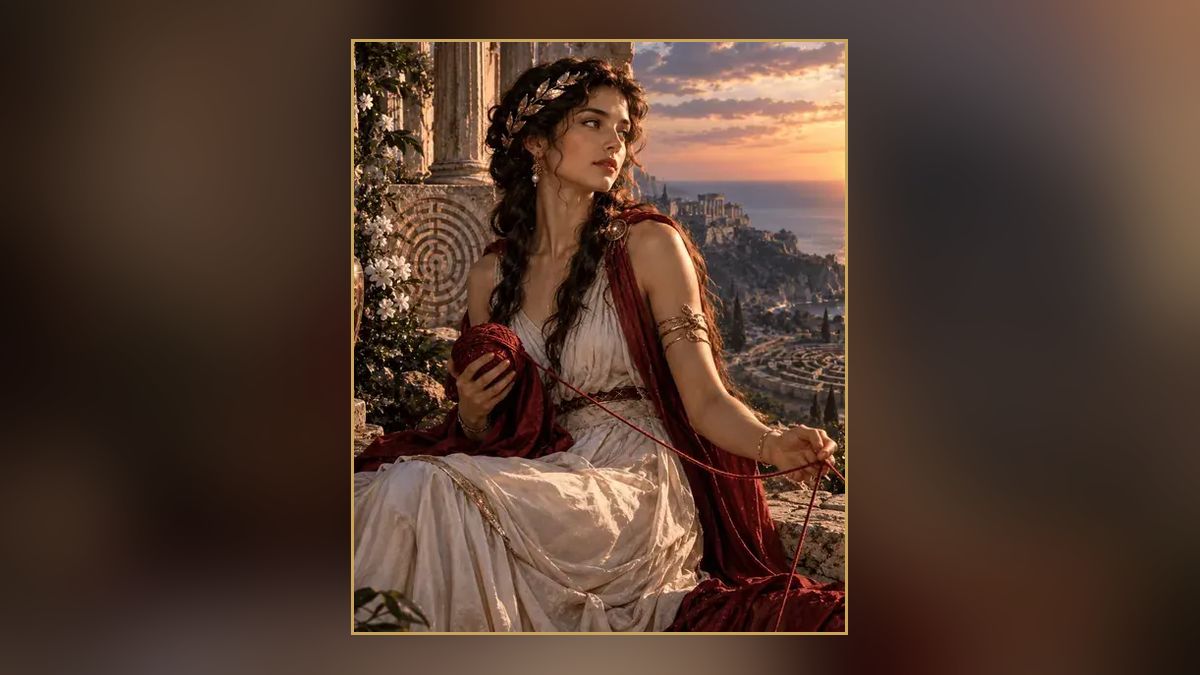
Ariadne is usually remembered as a supporting character in someone else's story. Theseus kills the Minotaur, Ariadne holds the thread. Then he sails off, and she sits on a beach looking sad, which is the part painters like. I think that reading badly undersells her. Look at what she actually does in the story, and then look at how the Greeks handled her afterwards, and you find something stranger. She is the one who supplies the method that makes the whole victory possible. And after she is abandoned, the sources cannot agree on what became of her, so thoroughly that some of them invented a second Ariadne to keep the versions apart. My argument in this article is that the thread is only half of her importance. The other half is that she is the woman Greek tradition could not settle.
The daughter of the house
Start with who she is. Ariadne is a daughter of King Minos of Crete and his wife Pasiphae, which makes her the half-sister of the Minotaur, the creature at the centre of the Labyrinth. That is a detail the telling often skips past. When Theseus arrives as one of the young Athenians sent to be eaten, the person who falls in love with him is the sister of the monster, in the house that built the trap.
She is also one of the oldest figures in the tradition. In the Iliad, in the middle of the description of Achilles' shield, the poet compares the dancing scene to a dancing floor that Daedalus once made at Knossos for Ariadne of the lovely hair. It is only a passing line, but it tells us she was already known as a Cretan princess associated with dance, long before the Theseus story took its famous shape.
Daedalus, the great craftsman, is the key to the next part. He is the one who designed the Labyrinth. According to the mythographer Apollodorus, it was Daedalus who advised Ariadne on how to help Theseus get out alive. In other versions, she simply works it out. But the logic is the same either way. The only person who understands the building is her father's craftsman, and the only person who can pass the knowledge to the hero is a member of the household.
What the thread really is
Now the thread itself. Ariadne gives Theseus a ball of thread, which he ties at the entrance and unwinds as he goes in, so that after killing the Minotaur he can follow it back out. It is such a famous image that we have turned it into a word. We talk about the thread of an argument, or Ariadne's thread, meaning a method for getting through a maze.
What I find notable is how little force is involved. Ariadne does not give Theseus a sword, or strength, or a charm. In some tellings she gives him a sword as well, but the thing everyone remembers is a piece of information turned into an object. The thread is memory made visible. It records where you have been so you can go back.
I wrote in the Theseus article about how his story keeps turning on lapses of memory. He forgets the white sail. In that light, Ariadne's thread is the opposite of his flaw. She is the one who understands that you cannot navigate a maze by courage alone. You need a record of the path. It is a quiet, almost modern idea of intelligence, and it belongs to a woman.
There is a harder side to it as well. To help Theseus, Ariadne betrays her family. She hands the secret of her father's greatest prison to a stranger who has come to kill her half-brother. The story of a king's daughter who betrays her home for a foreign hero shows up more than once in Greek myth. The most famous parallel is Medea, who helps Jason steal the Golden Fleece from her own father in Colchis. In both cases, the woman supplies the crucial method, and the man who benefits goes on to treat her badly.
Left on Naxos
After the Minotaur is dead, Theseus sails away from Crete with Ariadne and the rescued Athenians. They stop at the island of Naxos. And there, Ariadne is left behind. The sources disagree wildly about why.
In one version, Theseus simply abandons her while she sleeps. In another, the god Dionysus appears and tells him to leave her, because he wants her for himself. In the Odyssey, there is a very brief and unsettling line, in which Odysseus, in the Underworld, sees Ariadne among the dead and is told that Theseus took her from Crete but did not enjoy her, because Artemis killed her on the island of Dia, with Dionysus as a witness. The Roman poet Catullus writes a long poem in which she stands on the shore shouting her curse at the departing ship, a curse which, in his version, explains why Theseus forgets to change the sails and kills his own father.
That is a lot of different stories about a single event. In one, she is a victim. In another, she is a bride. In another, she is a corpse. And nobody seems to feel the need to resolve it.
The god who marries her
The version that eventually won out is the one in Hesiod's Theogony, which says Dionysus made Ariadne his wife, and that Zeus made her immortal and ageless. It is a very short mention, only a couple of lines, but it contains the whole transformation. The mortal woman who was left on the beach becomes a goddess. The abandonment turns out to be a promotion.
I find that wonderful. It is as if the myth, embarrassed by the way it treated her, felt it had to compensate. She gave the hero a method, and he left her. The only adequate response was to give her a god. There is a late detail that rounds it off: Dionysus gave her a crown as a wedding gift, and after her time on earth it was set in the sky as a constellation, the Corona, a circle of stars you can still find in the northern sky.
Painters and vase makers loved this version. You can see it on Greek pottery: Dionysus arriving in a procession of satyrs and maenads, finding Ariadne asleep on a rock. It is a scene about being rescued by something wilder than the man who left you.
The two Ariadnes
Here is the part that I find most revealing. Plutarch, in his Life of Theseus, tries to sort out the contradictions, and he does it in a remarkable way. He reports that, according to some writers, there were actually two Ariadnes. One, he says, was the wife of Dionysus, on Naxos. The other, a later Ariadne, was the one Theseus carried off and abandoned, who died on Naxos. He even mentions a Naxian practice that fits. On the island, he says, they held two festivals in her honour, one a gloomy sacrifice of mourning and the other a joyful one.
Two festivals. A day to mourn a dead woman, and a day to celebrate a bride who had become a goddess. The Naxians, faced with two incompatible stories, simply kept both, and gave each a ritual.
Plutarch also gives a third, Cypriot version. In the city of Amathus on Cyprus, he says, locals told a story that Theseus was driven there by a storm, and that Ariadne, who was pregnant and ill, was left on shore, and died in childbirth. The people of Amathus kept a grove for her, called Ariadne Aphrodite, and held a festival each year in which a young man lay down and imitated the cries of a woman in labour. That is a ritual about her death, performed as a kind of acted-out grief.
Put all of it together. She is a Cretan princess, a murdered woman, a goddess, a bride, a mother who died in childbirth, and in some places, two different women. A figure like that is not a character. She is a crossroads where different local traditions meet and refuse to merge.
What I take from her
I want to end with the reading I find most persuasive, though it is only mine. The Greeks could not settle on one fate for Ariadne because she embodies a contradiction they were uneasy about. She does the thing that deserves the greatest reward: she makes the victory possible. And she receives the thing that deserves the greatest guilt: she is left behind. A story that ends cleanly would have to choose between those, and the Greeks refused to.
So they split her. The Ariadne who gave the thread is honoured as a goddess, with a bridegroom, a crown and a place in the sky. The Ariadne who was abandoned is mourned, with graves and groves and ritual cries. Both exist at once, in different towns, on the same island. It seems to me a remarkably honest way of handling a story in which the person who did the most was treated the worst.
Every time someone says "follow the thread", they are speaking her name. What they usually forget is that the thread does not end with the hero's escape. It ends on a beach, with a woman who has just been told that she is not in the story any more, and who, in the end, was given two.
Comments
Sign in to join the conversation.