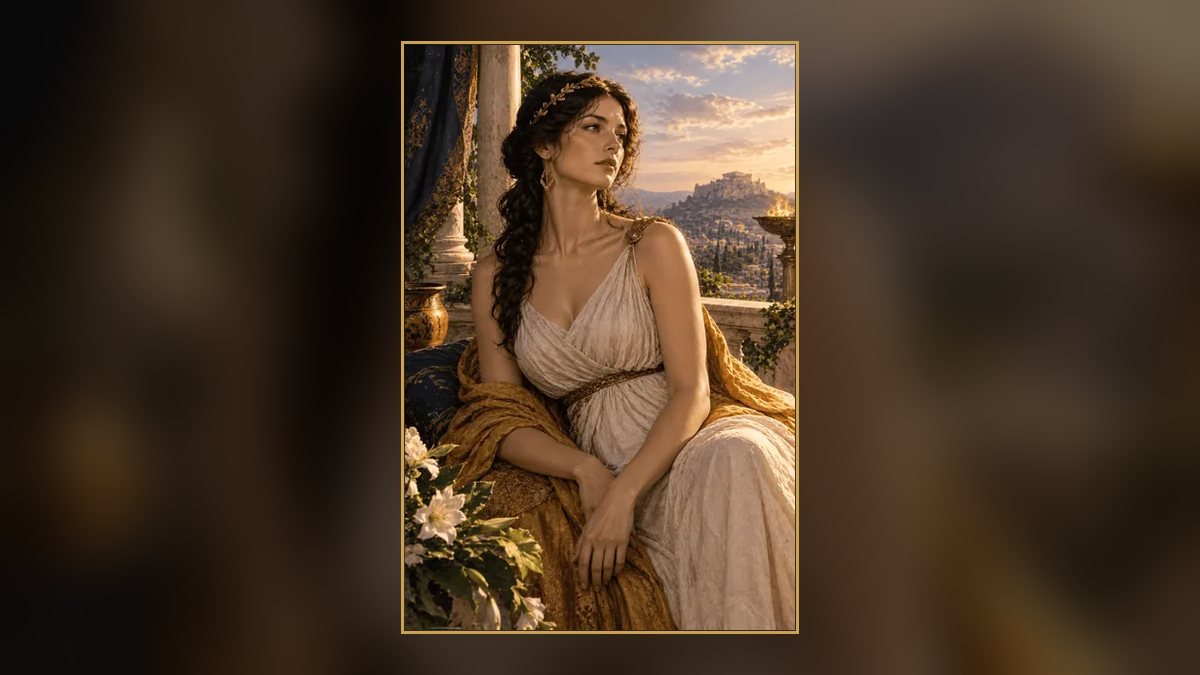
Danae is usually introduced with a picture. A young woman on a bed, a shower of gold coins falling from the ceiling, and a god who has decided that locked doors are only a suggestion. Painters from the Renaissance onwards loved it, and it has been reproduced so many times that the story behind it has almost disappeared. That is a pity, because the interesting part of the myth is not the golden rain. It is what happens before and after. Before, a king builds a prison for his own daughter because of a few words from an oracle. After, that same woman floats across the sea in a wooden box with a baby in her arms, and then spends years protecting him from a man who wants her for himself. I would like to tell her story from the inside of the chest, because that is where the Greek poets chose to look.
A king who asked the wrong question
Her father was Acrisius, king of Argos. Like many kings in myth, he wanted a son. When he went to ask the oracle at Delphi whether he would have one, the answer was a double blow. He would have no male heir, and his daughter's son would be the one to kill him. Notice what that does to a man's mind. The prophecy contains no threat to his daughter. All of the danger is in a child who has not been conceived. And yet in Acrisius's imagination the danger is already a person, and the person is Danae.
So he did what frightened rulers do in these stories. He built a prison. According to Apollodorus, it was a bronze chamber sunk under the ground, with a single opening to the sky, guarded by dogs. Other writers say it was a tower. Sophocles, in the Antigone, has the chorus mention how Danae gave up the light of heaven and lived hidden inside brass walls, in a tomb-like room. The details change but the image is steady: a girl who has done nothing, kept away from sunlight so that her father can sleep.
The irony is as old as the story. A bronze room with a hole in the roof is a strange choice for a man who wants to keep the sky out. The one opening he left for air and light became the way in for the very thing he feared. Greek tragedy is full of men who try to avoid fate and end up delivering it. Acrisius is one of the earliest and neatest examples.
The visitor through the roof
Zeus came to her as golden rain, or a golden shower, pouring through the opening. Whether you find that romantic, comic or disturbing depends on how you read the power gap between a god and a mortal girl locked in a cell, and the ancient authors were not all of one mind about it. What is clear is that Perseus is the result, and that the next scene belongs to Acrisius.
Apollodorus preserves an alternative that I find interesting. He says some people claimed that the father of the child was not Zeus at all, but Proetus, the king's own twin brother and rival, who had already fought him for the throne. In that version, the story of the golden rain was a cover. I do not think the Greeks themselves took that version very seriously, but it shows that the story was always contested. Someone, somewhere, was always asking whether a god had really come, and what exactly it meant to say so.
Later writers used the story in odd ways. In a comedy by the Roman playwright Terence, a young man sees a painting of Jupiter and the golden shower on a wall and uses it as an excuse for his own bad behaviour. If a god could do it, he reasons, why not me? Centuries later, Saint Augustine quoted the same passage in his Confessions, complaining that myths like this gave bad people a divine permission slip. It is a grim bit of reception history. The story of a woman locked in bronze became, for some men, an alibi.
What Acrisius did next
When the baby arrived, Acrisius heard the cry from the chamber. Now he had a problem. Danae said the father was Zeus. He did not believe her, and perhaps he could not afford to. But he also did not dare to kill a child who might really be the son of a god. Killing your own kin was a pollution that the Furies punished, and killing a god's child was worse.
His solution was clever in a cowardly way. He had a wooden chest built, the Greek word is larnax, put Danae and the baby inside, nailed it shut and threw it into the sea. That way, he could tell himself, he had not killed anyone. The waves would do it for him. It is the same kind of reasoning that leads people to leave a problem on a doorstep and say they have no responsibility for the outcome.
I want to stress how unsparing this is. The prophecy had said her son would kill him. In order to prevent that, he locked up his daughter for years and then sentenced her and her baby to drown. At every step he made things worse. And because the myth is a story about fate, the harder he pushed against the outcome the more surely it came.
The song from the chest
Now we come to the part I think is the finest. The lyric poet Simonides, who wrote in the late sixth and early fifth centuries BCE, composed a poem in which Danae speaks from inside the chest. Only a fragment survives, but it is a haunting one. She is out at sea at night, the wind is howling, the waves are breaking, and her baby is sleeping peacefully against her. She speaks to him, saying that he does not know what trouble he is in, that he sleeps in his bronze-nailed bed while the dark water rolls past, and that he is not afraid of the noise. Then she asks him to go on sleeping, and she asks the sea and the trouble to sleep too. And at the end she prays to Zeus for a change of fortune.
What gets me about the poem is the choice of voice. Simonides does not write about the chest from the outside, as an adventure. He writes it as a mother's lullaby, sung in terror, to a child who is too young to understand why. There is no divine light in the poem, no prophecy, no golden rain. It is a woman and a baby and the dark. It makes the myth about a human thing: the strange tenderness you can feel when you are completely afraid and have to stay calm for someone else.
Seriphos
The chest does not sink. It washes up on the island of Seriphos, in the Cyclades, where a fisherman named Dictys finds it in his nets. He opens it, finds a woman and a child, and takes them home. He is, by every account, a kind and ordinary man. I like that the rescue comes from someone with no connection to gods or kings, just a fisherman who looked into a box and did the right thing.
Perseus grows up there. And here is where Danae's story could easily have ended, as it does in some summaries. But the myth keeps going. Dictys has a brother, Polydectes, who is king of the island, and Polydectes takes a fancy to Danae. She refuses. As the boy grows to manhood, the king realises that the one obstacle between him and the woman is her son, and he sends Perseus off on what is meant to be a suicide mission, to bring back the head of Medusa.
Think about what that means for Danae's character. She is not a passive figure. She has survived a prison and a sea voyage and now she is protecting her son from a man who wants to remove him. While Perseus is away, Polydectes presses harder, and Danae takes refuge at an altar with Dictys, claiming the protection that sacred ground gives to suppliants. When Perseus returns with the Gorgon's head and finds her cornered, he enters the hall and shows the head to the king and his friends. They turn to stone.
The prophecy comes true
Perseus then sets out for Argos. Acrisius hears he is coming, and being a man who has never once met his fate without trying to flee, he leaves for Larissa in Thessaly. But the story is not finished. Perseus follows, and takes part in athletic games held there. During the discus competition, his throw goes wrong and strikes an old man in the crowd. The old man is his grandfather. The prophecy is fulfilled, by accident, exactly as foretold.
It is a hard ending, and the Greeks knew it. Perseus is horrified, buries Acrisius with honour, and in the best known version swaps kingdoms with a cousin, because he cannot bear to rule Argos after what has happened. Notice that nobody in this story wanted the outcome. Perseus is innocent, Danae is innocent, and the oracle is not malicious. The whole tragedy comes from a father who could not accept a risk, and who tried to cage it.
What happened to her afterwards
The later tradition gives Danae a quiet old age. One Roman version, in Virgil's Aeneid, says that she sailed to Italy and founded the city of Ardea, which is the home of Turnus, Aeneas's great rival. It is a surprising bit of mythical geography, because it makes the princess of Argos the ancestor of a Latin city. I cannot say how widely that tradition was believed, but it shows how far the Romans were willing to stretch a Greek story to give themselves a connection with it.
The card in this game gives her an endurance score of 80, and I think that is the right word for her. She is not strong in the way Heracles is strong, or clever in the way Odysseus is clever. She is the one who stays alive through the long, unglamorous part of the story: the bronze room, the chest, the island, the king's pressure. She is a survivor of other people's fear.
The golden rain is the part that painters remember. The chest is the part that poets remember. If you ask me which one says more about her, I would pick the chest. Anyone can be visited by a god in a moment of wonder. It takes something else to float through the dark, holding a sleeping child, and sing to the sea until the sea gives you back.
Comments
Sign in to join the conversation.