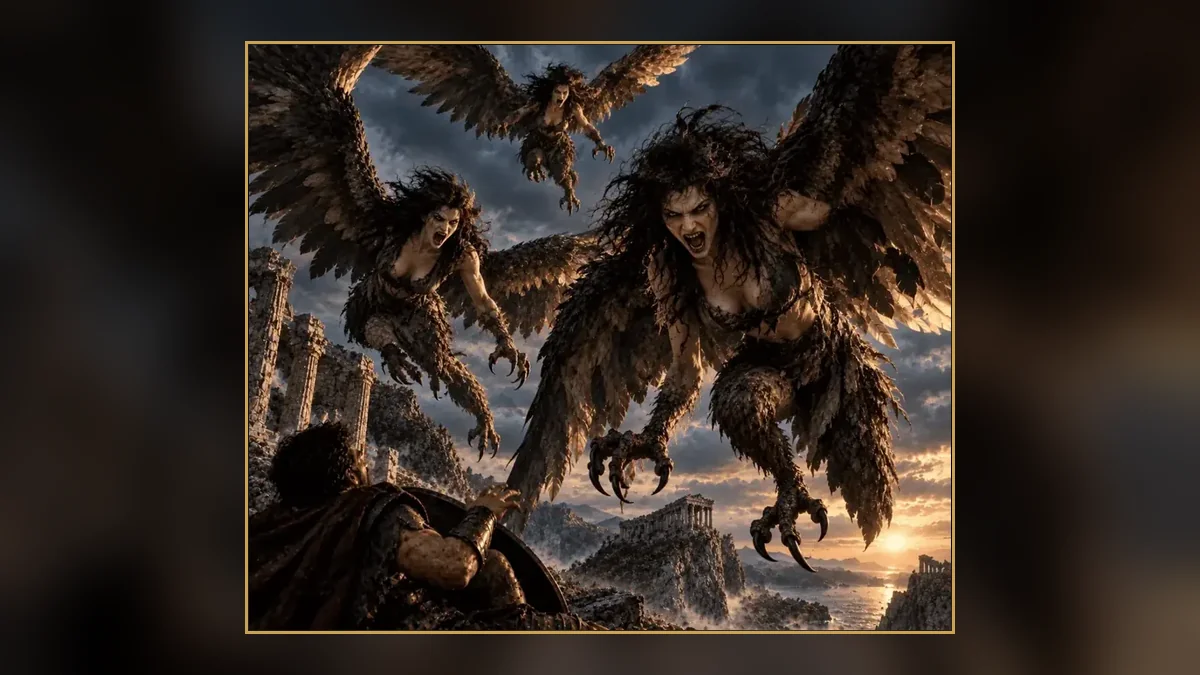
Ask someone to describe a harpy and you will probably hear about a hideous old woman with the body of a bird, flapping around a table and fouling the food. That picture is real, and it comes from late in the tradition. The earliest Harpies are something quite different, and the oldest thing the Greeks said about them has nothing to do with dinner. It has to do with the worst thing that can happen to a person who disappears: nobody knows where he went. This article follows the Harpies back to that idea.
Snatchers
The Greek word is Harpyiai, and it comes from the verb harpazein, to snatch or seize. That is the whole of their job description. They are not defined by how they look or what they eat but by what they do, which is to take things quickly and leave nothing behind. A grabber is a very specific kind of danger, different from a killer or a predator. The victim is simply gone, usually before anyone has seen the hand.
Sisters of the rainbow
Hesiod gives them a family in the Theogony. They are daughters of the sea-spirit Thaumas, whose name means wonder, and the ocean nymph Electra, and their sister is Iris, the rainbow and messenger of the gods. The poet names two Harpies, Aello and Ocypete, and describes them as fair-haired and swift, flying as fast as the blasts of the winds and as the birds.
Think about that pairing. Iris is the bright, beautiful side of weather, a bridge of colour between the gods and mortals. Her sisters are the other side: the sudden gust that snatches a hat, a sail or a person off a cliff. Aello's name means storm-swift. Ocypete's means swift-flier. At this stage, the Harpies are not monsters at all but personified squalls, and their beauty is part of the point. Wind does not look dangerous until it has already hit you.
How many of them
Nobody in antiquity agreed on a number. Hesiod has two sisters. Apollonius speaks of them only as a group, and later lists run to three or four, adding names such as Celaeno and Podarge. That vagueness suits a gust of wind better than a family of monsters. A squall is not a fixed set of individuals. It is a kind of event, and the names are labels the poets attached afterwards to make it easier to talk about.
One more thing to notice before the stories begin. In Greek life, sharing food was the basic act of civilised company. A host who fed a guest was bound to him by hospitality, and a meal was the place where gods, kings and strangers were all expected to behave. A creature that snatches the food from the table is attacking that whole arrangement, which is part of why the scene with Phineus lands as hard as it does.
The mother of Achilles's horses
One of the strangest facts about the Harpies appears in the Iliad, where Homer mentions in passing that a Harpy named Podarge, whose name means swift-foot, grazed in a meadow beside the stream of Ocean and was impregnated there by the West Wind. Her offspring were Xanthus and Balius, the two immortal horses that pulled the chariot of Achilles, the horses that could talk and weep.
That is a very different creature from the screeching hag. Podarge is a mare. The Greeks had an idea, which Virgil repeats in his poem on farming, that mares could be made pregnant by the wind, and the fastest horses in the world were considered children of the gale. Podarge is the Harpy as storm-mare, grazing and galloping and giving birth to something that outruns every other animal. The bird-body came later, and the horse-body is the earlier idea.
Taken by the Harpies
Now to the idea at the heart of this article. In the first book of the Odyssey, Telemachus is talking to the disguised Athena about his missing father. He says that if Odysseus had died at Troy, or in the arms of his friends, the Greeks would have built him a tomb and his son would have inherited his glory. Instead, he says, the Harpies have snatched him away without fame, gone unseen and unheard, leaving only grief behind.
Read it slowly. The Harpies are not blamed for killing Odysseus. They are blamed for the absence of a grave. In a culture that built its idea of the afterlife around memory, a funeral mound and a poem sung over it, the worst possible fate was to disappear without leaving a trace. A death that is witnessed and mourned gives the survivors something to hold. A disappearance leaves them with nothing, and the Greeks gave a name to that nothing.
The same idea returns later in the poem. Penelope, in despair, recalls the daughters of Pandareus, who were orphaned young and raised by the gods until, on the day Aphrodite went up to Olympus to arrange their marriages, the Harpies carried them off and gave them to the Furies as servants. Penelope's own wish, at that moment, is that Artemis would strike her down quickly, or that a storm wind would carry her away along the dark paths to the edge of the world. The poem keeps reaching for the same picture, a person removed in an instant by something the survivors cannot see.
Phineus and the stolen dinner
The version everyone knows comes from Apollonius of Rhodes, in his poem about the Argonauts. On their voyage, the Argonauts come to the home of the blind prophet Phineus, a king of Thrace who had been given the gift of seeing the future and, according to Apollonius, had used it carelessly. He told people too much of what Zeus had planned. As a punishment, Zeus blinded him and sent the Harpies to ruin every meal.
Whenever Phineus sat down to eat, the Harpies swooped from the sky and snatched the food from his hands, leaving behind a smell so foul that nobody could come near. He was starving and nearly dead when the Argonauts arrived. The winged sons of the north wind, Zetes and Calais, who were sailing with the crew, took up their swords and chased the Harpies out over the sea.
Zeus's hounds
Here is a detail I find very revealing. As the Boreads close in, the rainbow goddess Iris intervenes. She tells them not to kill the Harpies, because they are the hounds of great Zeus, and swears an oath by the river Styx that the Harpies will never trouble Phineus again. The brothers turn back. The islands where this happened were afterwards called the Strophades, which means the turning islands.
The Harpies, then, are not rogue monsters. They are an instrument of divine justice, carrying out a sentence, and the sentence has a legal end. They are Zeus's enforcers, in the same way that the Furies belong to the underworld. This is my own reading, but it seems to me that the poet wants us to notice how bureaucratic the punishment is. It has a cause, a method, a set duration and a cancellation clause. Even the cruelty of the gods is organised.
The prophecy of Celaeno
The Harpies had one more famous appearance, in Virgil's Aeneid. Aeneas and his Trojans, wandering west after the fall of their city, land on the Strophades and find herds of cattle and goats grazing unguarded. They slaughter some for a feast, and the Harpies swoop down and defile the food. The Trojans fight back, but their swords bounce off the feathers. A Harpy named Celaeno, whose name means the dark one, perches on a rock and delivers a prophecy: the Trojans will not found their city until hunger forces them to eat their own tables.
It sounds like a curse, and later in the poem it comes true in a harmless way, when the hungry Trojans eat their meal off flat loaves of bread. Virgil's Harpies are speaking monsters, ugly and foul, and he did more than anyone to fix the picture of the screaming bird-hag in the Western imagination.
The Harpy Tomb
There is a real monument that shows the older idea. The so-called Harpy Tomb, from the ancient city of Xanthos in Lycia, in what is now Turkey, was carved around 480 to 470 BCE and is now in the British Museum. It is a tall pillar with a burial chamber at the top, and the reliefs on its sides show large female figures with the bodies of birds and the heads of women, each carrying a tiny human figure in her arms. Scholars argue about whether they are Harpies or Sirens, but the most common reading is that they are carrying off the souls of the dead. In that setting the snatchers are doing something almost tender.
What they are for
Look at the whole range of the Harpies. They are winds, mares, soul-carriers, thieves of a prophet's dinner, and servants of Zeus. What links all of them is the sense of something taken without warning, by an unseen hand, and what the Greeks feared most about it was the silence afterwards. A funeral, a tomb, a poem: those were the ways a person's life was returned to the community. The Harpies stood for everything that took that away. The next time you see one drawn as a screeching bird-woman, remember that the oldest fear in the story was a quiet one.
Comments
Sign in to join the conversation.