Something to read first
Who put the lights up
Before there were telescopes, before there were maps, before anyone had a word for a galaxy, there were people lying on their backs on warm rooftops looking up. The sky was too big to make sense of, so they did what people always do with something too big. They broke it into pictures. A line of stars became a hunter, a scatter of them became a cluster of sisters, and a faint stripe overhead became something spilled. The stories that went with the pictures were not decoration. They were a way of remembering where things were.
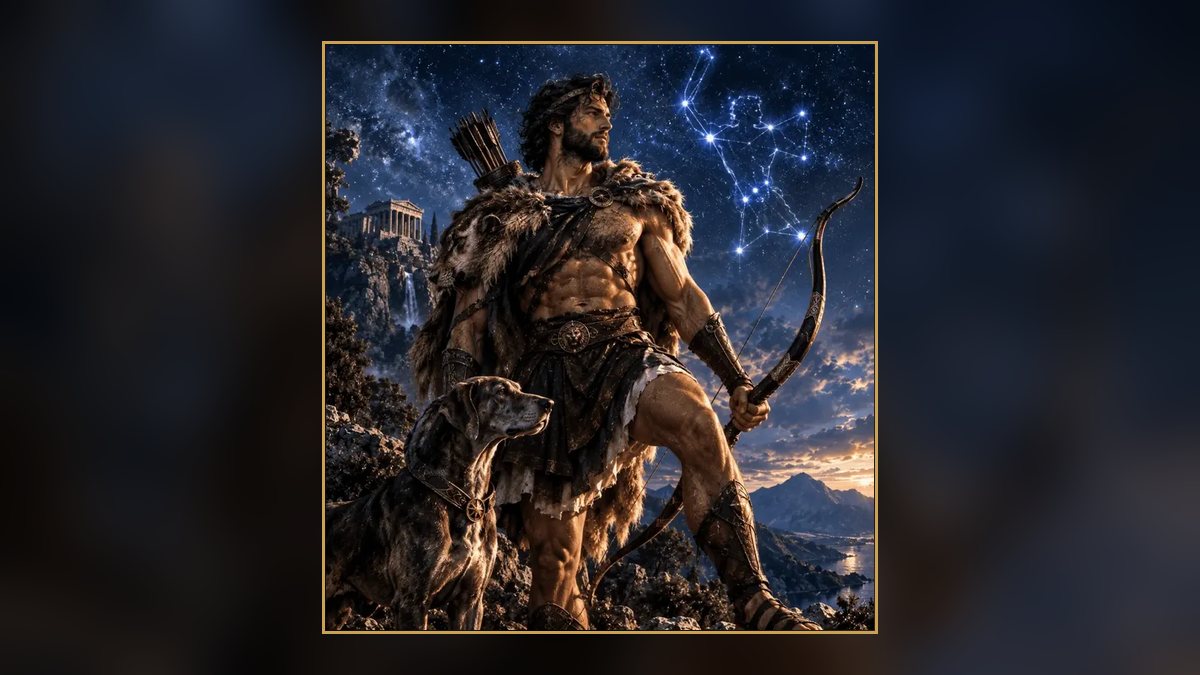
The hunter is the easiest place to start. He strides across the winter sky with three stars at his waist, a bright red one at his shoulder and a bright blue one at his foot, and the old stories said he was a giant who boasted once too often. Something small and many-legged finished him, and the gods, who could not quite bring themselves to forget him, set him up where he could be seen. The thing that killed him was lifted into the sky too, on the opposite side. People noticed that when one rises in the east, the other drops below the western horizon, and they took that to mean the two would never again share a night. In the summer sky, at the creature's heart, there is a red star whose name means rival to a certain planet, because it burns with the same colour as the god of war.
A little way off, a cluster of faint stars huddles together as if for warmth. Seven of them can be seen by the sharp-eyed, and the old stories said they were sisters, daughters of the man who carries the sky on his shoulders. They were being chased, so the stories went, by the hunter, who never quite caught them, and the sky became a long and patient pursuit. If you look at them slightly to one side, they appear brighter. Astronomers call that averted vision, and it is an odd feeling to realise that the way to see these stars better is to stop looking directly at them.
There are bears, too. A large one walks around the northern pole without ever setting, and a smaller one trails behind. The Greeks said the large one had once been a nymph who caught the eye of the wrong god and was changed by his wife into an animal. Her son, grown up, came across a bear in the forest and raised his spear before the king of the gods plucked them both into the sky to stop him. It is a story about almost making the worst mistake of your life, and about someone who stepped in at the last moment.
One whole corner of the northern sky is a family drama. A mother sits on a throne that circles the pole, and she spends part of every night hanging upside down, which is what happens to people who boast about their looks in front of the sea. Her husband stands beside her. Their daughter is chained to a rock at the edge of the water, and the hero who frees her is somewhere above, still holding up the head he carried away from a distant island. One of the stars in that hand dims and brightens every few days, and Arab sky-watchers called it the ghoul. Below them, in the dark water of the autumn sky, drifts the monster that nearly ended the whole family.
Some constellations are animals with job histories. There is a crab that did a small, spiteful favour for a goddess and got a place in the sky as thanks. There is a lion that no weapon could cut. There is a water-snake so long that it needs most of a night to cross the southern sky, which makes it the biggest picture of them all. Near its tail sits a cup and a bird, and the story says that the bird was punished for being late with the water and for lying about the reason. There is a horse with wings, and a ram with a coat that attracted every ship in the east. There is a goat with the tail of a fish, a pair of fish tied together at the tail, and a few small creatures that seem to be running from something that came out of the ground in the south.
And then there is the road. On a clear night, away from the lights of a town, a pale band stretches across the whole sky from one horizon to the other. The Greeks said it was a splash of milk, spilled when a baby who would grow up to be very strong pulled away from the breast of a goddess who did not love him. The Greek word for it, built on their word for milk, is now what we call every great island of stars, including the one we live in.
The best part is that the stories stuck. People who had never read a word of Greek were still looking up at a hunter, a bear and a queen on a throne, long after anyone remembered why. It is a good reminder that the real reason for telling a story is sometimes just to give a person something to point at in the dark.