Something to read first
The question you were not supposed to ask
Start at the bottom of the mountain, because that is where everyone started. The road to the most famous question-and-answer service in the ancient world was steep, dusty and full of people who had saved up for years to be there. Farmers came with a single goat, kings arrived with a fleet of wagons, and every one of them carried the same private fear: that the answer would turn out to be true.
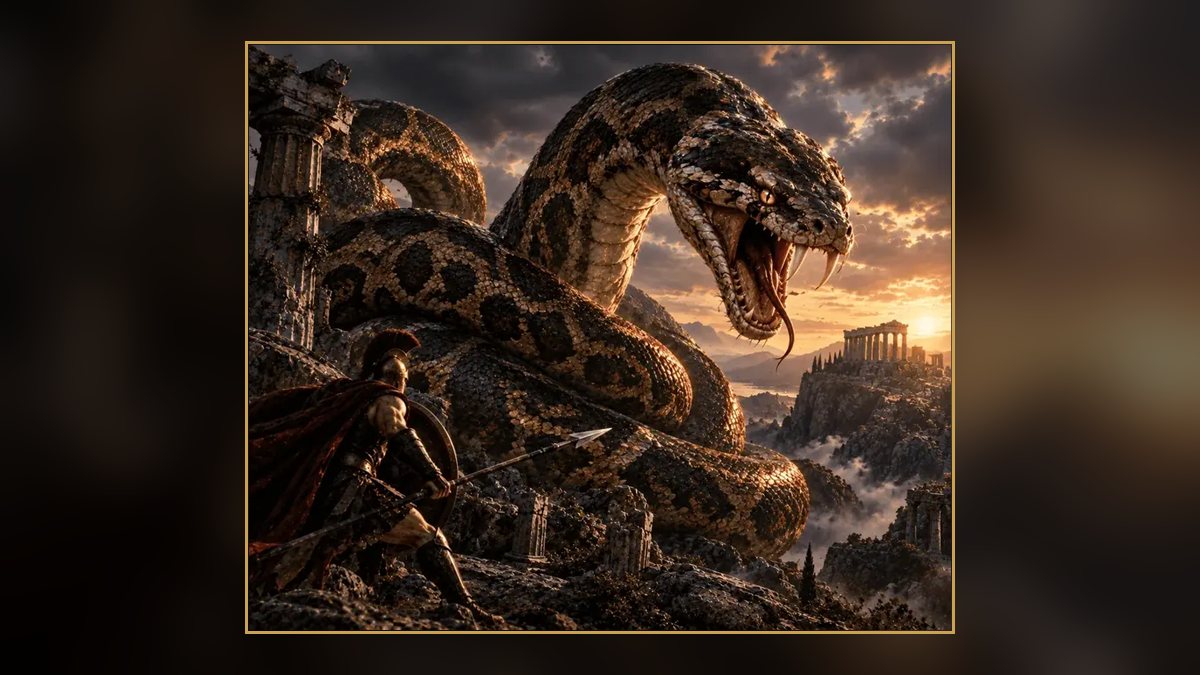
The place sat in a fold of the mountains, under cliffs the colour of old bone, beside a spring of water so cold that visitors were expected to wash in it before they went any further. There were laurel trees, and that was not an accident. The god who looked after the sanctuary had once chased a girl who turned herself into one, and he had never quite got over it. If you looked carefully at the ground, you could still see where something large and unpleasant had once lived. The shrine took its name from that creature, and the whole story of how it came to be there had to do with the killing and the very long apology that followed.
At the centre of everything stood a temple whose most important room was not meant to be seen. A woman sat there, chosen for the job, usually older, usually of plain background, who had given up whatever life she had before. She occupied a seat with three legs, over a crack in the rock. What she said while she sat there, in a state nobody has ever fully explained, was written down by priests and handed to the visitor. The answers were nearly always short. They were nearly always in verse. And they were nearly always true in a way that had nothing to do with what the visitor was hoping to hear.
Take the case of a rich man from the east who asked whether he should cross a river and attack his neighbour. He was told that if he did, a great empire would fall. He went away delighted and crossed the river, and it was only afterwards that someone pointed out that the oracle had never said whose. Then there was the city that asked how to survive a vast invading army and was told to put its trust in wood. Half the population was sure that meant a fence. A sharper mind in the assembly wondered whether it could mean something that floated, and the argument that followed decided the future of Europe.
The visitors learned to be careful with their questions. Over the door, in letters that every pilgrim read on the way in, was a short instruction that had nothing to do with fortune-telling and everything to do with the person standing there. People tended to ignore it on the way in and think about it on the way out.
Delphi was not the only place where the gods could be reached. Far to the north-west, in a clearing in the forest, there was a sanctuary where the priests listened to a tree. Nobody wrote down how it worked, only that it did. In a hillside cave in central Greece there was another, so strange that visitors had to go down into the ground and come back up changed, and they took small sweet offerings with them in case something with scales was waiting at the bottom. In the sands of Egypt a famous young conqueror once crossed an entire desert to ask a single question he refused to share with anyone.
The cleverest thing about the oracles was that they were not the only voices. There were individuals too. There was a blind man in a city of seven gates whose life had been a sort of long experiment in being many people at once. There was a princess from a city that no longer exists, who was given the finest gift a god could offer and then told, as a sort of afterthought, that it would never be believed. There was a woman in a cave near the Bay of Naples who, offered a wish, picked up a handful of sand and asked for as many birthdays as the grains in her palm. It was a clever request. She simply forgot to ask for the one thing that would have made the birthdays worth having.
Perhaps that is the real subject of every story about prophecy. The Greeks did not believe the future was hidden. They believed it was said aloud quite often, by someone, to someone, and that the real difficulty was in hearing it. A seer told a man he would do something terrible, and the man spent his whole life running toward it. A god gave a woman the truth and took away her audience. A priestess told a hero the name by which the world would remember him and sent him off to work for a lesser man. In each case the gods had spoken clearly, and in each case the human being had arranged to understand something else.
So the next time you ask a question, spare a thought for the pilgrims on the mountain road. They knew that getting an answer was the easy part. The hard part was being the sort of person who could stand to receive it.