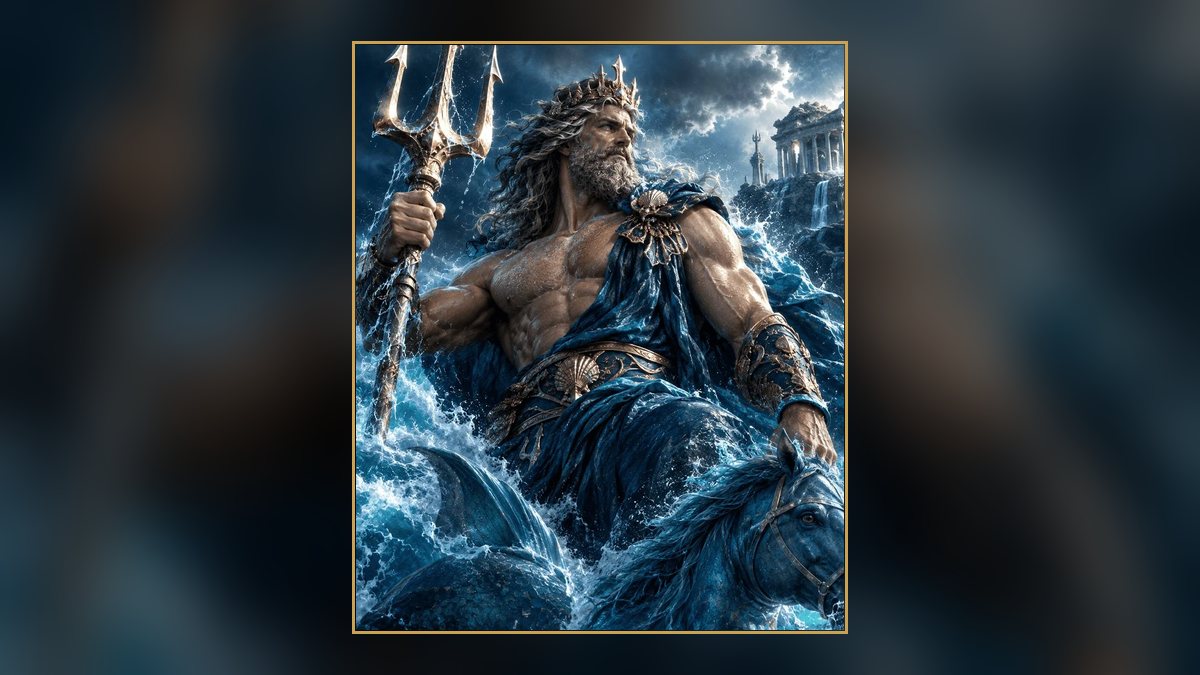
Most people picture Poseidon at sea, with a trident and a wave. Homer picked a different feature when he reached for a standing name. He calls him Enosichthon, the earth-shaker, and Ennosigaios, which says the same thing in a slightly different form. In the poems the god of the sea is, first and most often, the god who makes the ground tremble.
The two halves of the word are plain. Enosis means shaking, and chthon is the earth. It is a short, rough word, and it sounds like something that would be said with a glance at the floor.
When he walks, the mountains move
The best description is in the twentieth book of the Iliad, when the gods take sides at Troy and begin to fight. Poseidon stirs the earth beneath them. Mount Ida shakes from its springs to its peaks, the city of Troy rocks, and the Greek ships shudder in the bay. Down below, Hades, lord of the dead, leaps from his throne and screams. He is afraid that the ground will split open above him and show the gods his hateful, mouldering house, which even they dread.
I like the picture of the god of the dead being the one who panics. It makes clear who is more powerful in that moment, and it also shows what the Greeks imagined was under their feet: a hollow place, with a throne in it, just beneath the grass.
A debt paid in Sparta
The Greeks did not treat earthquakes as a matter of rocks. They treated them as messages. In 464 BCE a huge quake hit Sparta and killed a great many people, and the helots, the enslaved population who worked the land, rose up in revolt. Thucydides says that the Spartans themselves understood the disaster as a punishment. Some time earlier they had dragged helot suppliants out of the sanctuary of Poseidon at Taenarum, at the southern tip of the Peloponnese, and killed them, and they believed that the god had answered.
The point is not whether the explanation was right. It is that a Spartan, standing in the rubble, had a ready-made reason to look for. The shaker had a temple and a grievance, and the trouble was the kind that comes from neglecting him.
A city that went into the sea
The most famous disaster was the loss of Helike. This was a prosperous city on the southern coast of the Gulf of Corinth, and in the winter of 373 BCE, in the night, an earthquake brought down the buildings and a great wave swept over the place. By morning the town was gone, and the sea stood over it. Rescue parties found almost nothing.
Writers afterward gave the god a motive. Helike had a famous sanctuary of Poseidon, and Ionian Greeks from across the Aegean had asked to take a copy of the cult image, or at least a model of the shrine. The people of Helike refused, and the god took his revenge. Pausanias repeats the tale with unconcealed relish. Centuries later, visitors claimed that a bronze statue of the god still stood in the water, so that fishermen had to steer their nets around it.
Modern investigators are still looking for the buried city, in the silt of the Corinthian coast, and the geology suggests that the event was real. A fault runs through the gulf, and it is among the most active in Europe.
Holder and shaker
One more thing deserves attention. Homer sometimes uses a title that sounds like the opposite. He calls Poseidon Gaiaochos, the earth-holder, the one who keeps the land in place. The same god who shakes it also steadies it. Cities that lived near fault lines worshipped him under a title that meant something like the one who makes things secure, Asphaleios, and in Sparta there was a temple under that name.
That is less contradictory than it seems. If one god is responsible for the quake, he is the one you ask to stop it. The Greeks did not have a separate figure for good geology. They had Poseidon, a strong and moody neighbour, and they prayed to him for mercy while the walls still stood.
The scientists answer back
By the fourth century BCE the philosophers had their own explanations. Thales supposedly said that the earth floats on water and rocks when the water moves. Aristotle blamed winds trapped inside caves in the ground, which burst out and shook the surface. Neither of them needed a god. But the temples of Poseidon stayed where they were, on capes and headlands from Sounion to Taenarum, and sailors went on pouring wine to him.
Enosichthon is a very old word, older than the arguments. It remembers a time when a trembling floor was simply the sign of someone walking underneath.