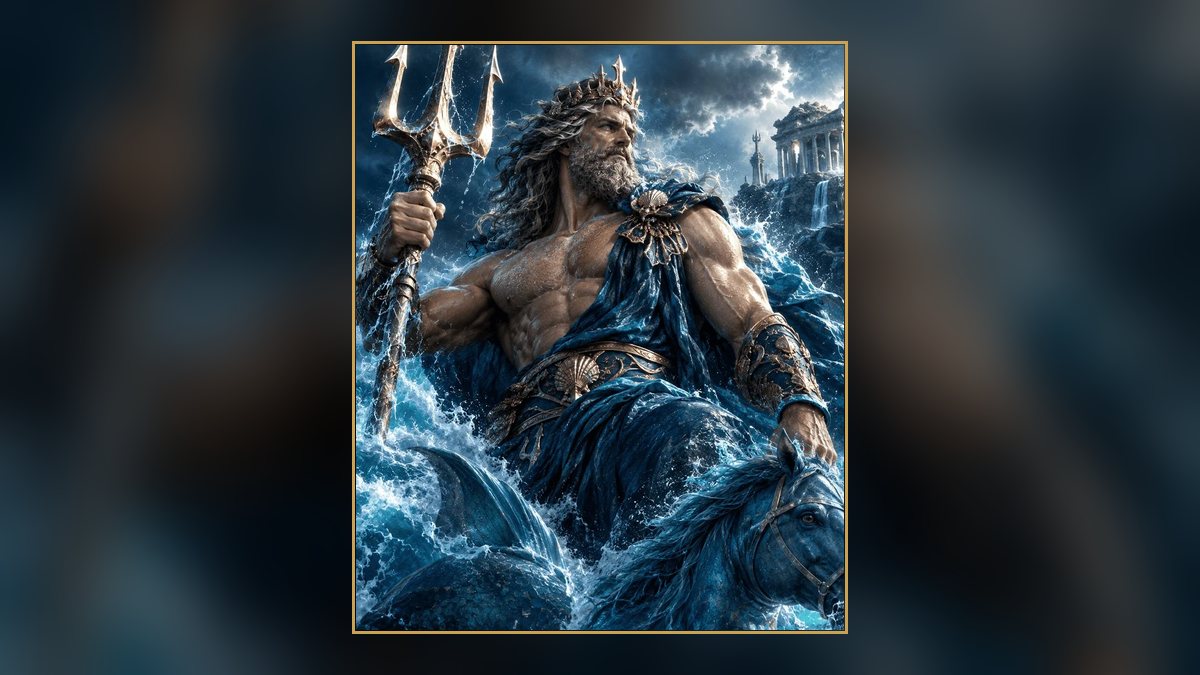
It is a fair question why the god of the sea should be the god of horses. Nothing about a stallion suggests salt water, and nothing about a wave suggests a stable. The Greeks, however, were certain of the link, and they put it into one of Poseidon’s oldest and most widely used names. Hippios means of the horse, or the horse’s lord. Under that title he gave the animal its speed and taught people how to handle it.
The gift at Colonus
The best-known statement of this idea comes from Sophocles, in his last play, Oedipus at Colonus. The old, blind Oedipus has come to a grove just outside Athens, and the chorus of local men sing a song in praise of the place. They call it a white and shining land, full of nightingales and silver olive and dark ivy, and they thank Poseidon for two things he gave it. One was the horse bridle, the bit that tames the animal. The other was the oar, the blade that lets a ship fly over the waves.
Colonus was Sophocles’s home district, so the song carries personal pride. It also carries a pairing that comes up again and again. Horses and ships are the two ways a Greek could move fast, and both belonged to Poseidon. A chariot team and a rowing crew were, in a manner of speaking, the same kind of power turned to two different surfaces.
An altar of Poseidon Hippios stood in Colonus, with a shrine to Athena Hippia beside it. The goddess of the bridle and the god of the horse had settled their old rivalry there, at least in the minds of the villagers.
The stallion and the mare
The strangest horse story belongs to Arcadia, the high inland country of the Peloponnese, where the sea is far away. Pausanias heard it at Thelpusa. When Demeter was wandering the earth searching for her stolen daughter, Poseidon saw her and wanted her. She did not want him, and to hide she turned herself into a mare and grazed among the herds of a local king. Poseidon saw through the trick, took the shape of a stallion, and caught her anyway.
Demeter was furious, and for a time she was known in that region as Demeter Erinys, the angry one. In the end she washed in a river and recovered her temper, and from the union two children were born. One was a daughter whose name the uninitiated were not allowed to say, called only the Mistress. The other was a horse, Arion, who could speak and run faster than any rival, and who ended up in the stable of Heracles and later of Adrastus.
The myth is odd, close to embarrassing, and hard to place. What it does is bind the horse to water, to the earth and to the grain goddess, instead of to the sea alone. The horse in this tradition comes out of the ground, like a spring.
Horses for the water
You can see the same pairing in rituals. At Argos there was a spring called Dine, and Pausanias says the Argives threw bridled horses into it as an offering to Poseidon. Other places offered bulls and rams to the sea itself. Think of what that meant: a costly animal, trained and groomed, given to the water, because the water’s god was also the horse’s.
Waves have been compared to horses in nearly every sailing culture, and English still talks about white horses on a rough sea. Homer got there first. In the thirteenth book of the Iliad, Poseidon harnesses a team with bronze hooves and golden manes, and drives out over the sea. The waves part, and the horses race across the surface without wetting the axle.
The horse that came from a wound
Poseidon fathered one other celebrated horse. When Perseus cut off Medusa’s head, two creatures sprang from the neck, a giant named Chrysaor and a winged horse, Pegasus. Their father was Poseidon, who had once lain with Medusa in a meadow. Pegasus flew to Mount Helicon and struck a rock with his hoof, and a spring came out. The spring was called Hippocrene, the horse’s fountain, and the Muses drank from it.
Once more water and horse come out of the same place. A hoof strikes earth and a stream appears. It is almost a summary of the god’s double character.
Chariots and games
Poseidon also owned the sport. The Isthmian Games, held near Corinth every two years, were sacred to him, and the chariot race was among their showpieces. The old poet Pindar says that Poseidon gave Pelops a team of winged horses so that he could win the chariot race at Olympia and take a bride. In the minds of the Greeks, a victory in the hippodrome came with a quiet debt to him.
When Hippios is spoken, it means all of this at once. A stallion thundering up a beach, a bridle on a boy’s hand, a team in the Isthmus, a spring with a hoofprint in it. The horse had come into Greek life from somewhere, and the Greeks said it came from the water.