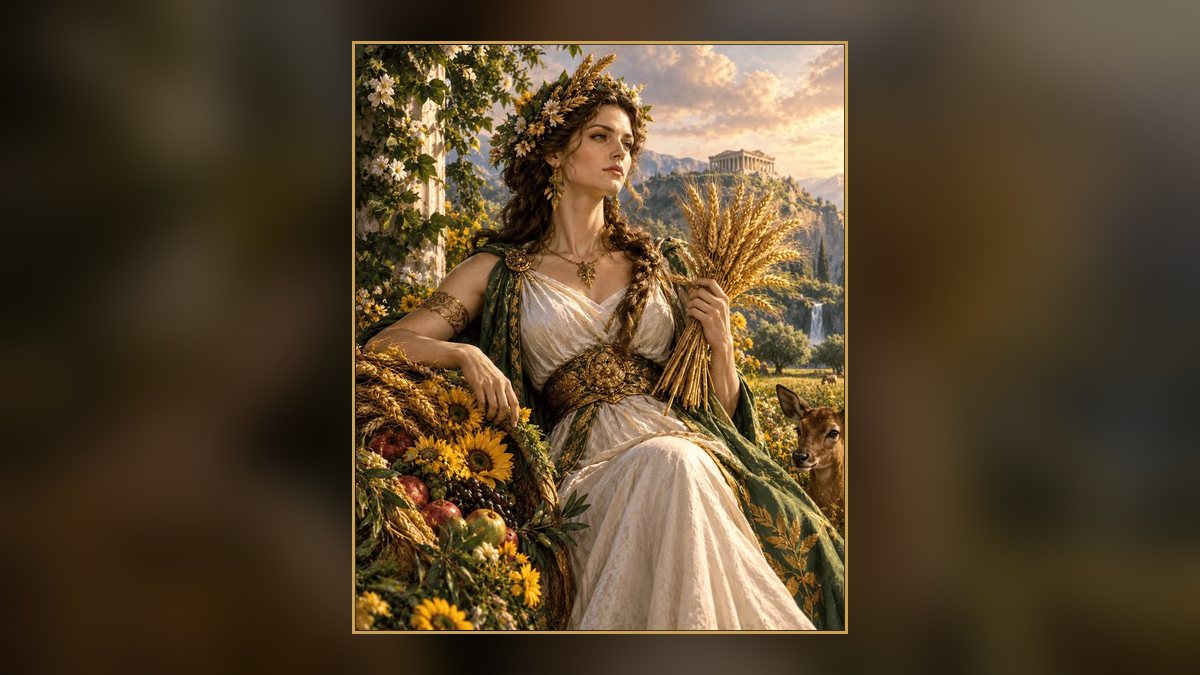
Most people know Chloe as a girl’s name. It began as a plant word. In Greek, chloe is the colour of new growth, a pale, soft green, the green of a blade of wheat that has just pushed through the soil. Applied to Demeter, it names the goddess at one particular point in her year, and not the most glamorous one. This is Demeter before there is anything to harvest.
The thin green weeks
A Greek farmer’s year was built around grain. Hesiod, who farmed in Boeotia around 700 BCE, tells his readers to start ploughing when the Pleiades set in late autumn, and to harvest when they rise again in the spring. Between those two dates the wheat and barley spent months in the ground. In winter they stood as thin blades. By spring they were taller but still green and soft, and everything the household would eat for the next year depended on them.
Those weeks were frightening. A hard frost, a month without rain or a hailstorm could undo a season. Nothing could be done except wait. Hesiod’s advice at the start of ploughing is to pray, and he names the two powers to address: Zeus of the earth, and holy Demeter, so that the sacred grain would grow heavy. Chloe was the name for the second of these when the grain was young and the outcome was not yet known.
A shrine at the gate
Athens had a place for this goddess close to the middle of the city’s life. Pausanias, walking up to the Acropolis, notes a sanctuary by the entrance where Earth the nurse of children was worshipped together with Demeter Chloe. Everyone going up to the great temples passed it. A farmer coming into town with a sheep for sacrifice, or a boy on his way to a festival, walked under the shadow of a goddess whose job was to keep things green.
The pairing is natural. Earth, nursing her children, is the ground that holds the seed. Demeter Chloe is what comes up from it. Between them they cover the whole matter, the soil and the sprouting.
Athenian sacrificial calendars list offerings to Demeter Chloe, and later commentators connect her with a spring festival. The details are patchy, but the timing makes sense. You made your gift to the green goddess when the crop was still green.
Green, and then golden
Greek poets had another word for Demeter, and it was a colour too. Homer calls her blond, or yellow-haired, and in one famous simile he compares the winnowing of grain to the way blond Demeter separates the chaff from the corn as the wind blows through the threshing floor. That is Demeter at harvest, when the colour of the field has turned to straw.
Put the two side by side and the Greek habit of naming becomes clear. They did not have a single Demeter who stood above the calendar. They had a different Demeter for each point in it. Green Demeter in March, golden Demeter on the threshing floor, Demeter the lawgiver at the autumn women’s festival. The farmer did not need to choose. He addressed whichever one was present in the field.
The daughter coming back
There is another way to hear the word. In the old story, Persephone is taken below by the lord of the dead, and her mother refuses to let anything grow until she is returned. The Homeric Hymn to Demeter says that the girl will come up when the earth blooms with spring flowers of every kind. The first green shoots of the year are therefore a kind of reunion. What the farmer sees in March is the daughter on her way back.
Nobody had to decide whether this was a story about a girl or a story about wheat. The two were the same in Greek religion, and Chloe names the place where they meet: the pale green in the furrow that is also a young woman climbing out of the dark.
A name that outlived the goddess
The word kept its charm long after the cult faded. In the second or third century CE, the novelist Longus set his story of two young lovers, Daphnis and Chloe, in the countryside of Lesbos, and he gave the heroine the name of the green shoot. Centuries before that, a woman called Chloe is mentioned in one of Paul’s letters to the Corinthians as the head of a household. Either of them might have been given the name at birth, as a way of wishing a child to grow well.
That is the quiet legacy of the title. A goddess’s name for a few weeks in spring became a name for girls across the Greek world and, much later, across the English-speaking one. Every Chloe is, in her own way, named for something small and green and not yet sure of itself.