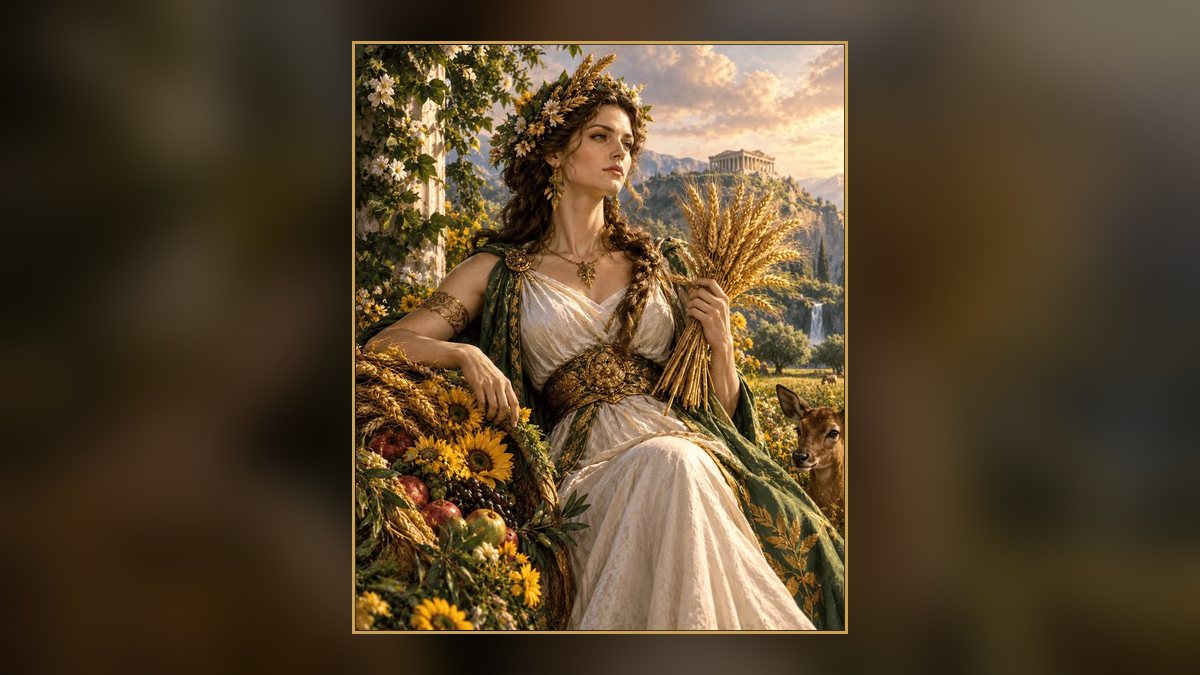
Greek had several words for law. Nomos was the common one, the custom of a place or a people. Thesmos was older and more solemn. It meant something that had been set down, laid in place, fixed. When Athens appointed officials to record its statutes it called them thesmothetai, the ones who lay down the thesmoi. Demeter Thesmophoros combines that word with phoros, bearing or bringing, and her title therefore says she is the one who brings the ordinances.
It is an odd claim for a grain goddess, until you ask what grain does to people. A community that grows wheat has to stay in one place, plan for the next year, share the work, and agree about who owns what. A later writer, Diodorus of Sicily, puts it directly: Demeter gave people grain, and with it laws, so that they could live a settled and just life. In her stories, farming and order arrive together.
The festival
The best evidence for what the title meant in practice is a festival, the Thesmophoria, kept across most of the Greek world and in Athens over three days in the month of Pyanepsion, late October into November. It was timed with the autumn sowing, and it belonged to women.
Only married women who were citizens could take part. Men were kept out completely, and the secrecy was real enough that outsiders knew only pieces. The women left their homes and camped in a sanctuary, the Thesmophorion, sitting on the ground on beds of leaves and fasting. Each local community chose a few of its wives to run the proceedings. For three days, a city of men had handed a state religious occasion to its women and agreed not to ask questions.
The three days had names. The first was Anodos, the going up, when the women made their way to the sanctuary. The second was Nesteia, the fast, which they spent hungry on the ground. The third was Kalligeneia, a word that means fair birth, or beautiful offspring, and which was an invocation to Demeter for healthy children and a healthy crop.
Pigs and pits
The strangest rite was the one with piglets. In the days before the festival, women threw young pigs, along with cakes and branches of pine, into underground chambers called megara. The offerings were left there to rot. During the festival, specially chosen women who had kept themselves ritually clean for three days went down into the pits, collected the decayed remains, and carried them to an altar. They were mixed with the seed grain, and the farmers who received a little of it believed that their crop would thrive.
Our main account comes from a scholar’s note on a dialogue of Lucian, written centuries after the festival was at its height. It is therefore not a firsthand report, but it fits the meaning of the occasion. Bodies go into the ground, they decay, and what comes out is mixed with the seed that goes back in. Death and sowing are a single cycle.
An explanation for the pigs was told in a myth. When the earth opened to take Persephone, a herdsman called Eubouleus happened to be feeding his pigs nearby, and they fell into the chasm along with the girl. The women threw their piglets in to repeat the moment.
A comedy about a break-in
We know a good deal about the atmosphere of the festival because Aristophanes wrote a play about it, the Thesmophoriazusae, in 411 BCE. In it, the tragic poet Euripides learns that the women are planning to vote on his punishment for portraying them so badly on stage, and he sends a relative, disguised as a woman, to speak in his defence. The plot goes wrong, the man is discovered, and a good deal of farce follows. What matters is the setting. The women’s council, their sacrifices and their private oaths all appear on stage, as a joke that the audience could appreciate because the real thing happened a few streets away.
A play like that could only be funny if the festival was truly closed to men. The humour comes from the fact that nobody in the audience had ever been inside.
Why law, why women
The title is odd and appealing at once. The goddess who gives laws is honoured by those who, in most Greek cities, had no role in making them. Women could not vote or speak in the assembly. At the Thesmophoria, though, they held office, ran a sanctuary and kept their own counsel.
One way to read it is that the Greeks understood that law does not begin in courts. It begins with the arrangements that keep a household and its fields going, with marriage, inheritance and the next year’s seed. Those were the things the married women of a city looked after. The title Thesmophoros names that quiet kind of order, the sort that does not announce itself, and it hands the name over to the people who were there before the first law was written down.