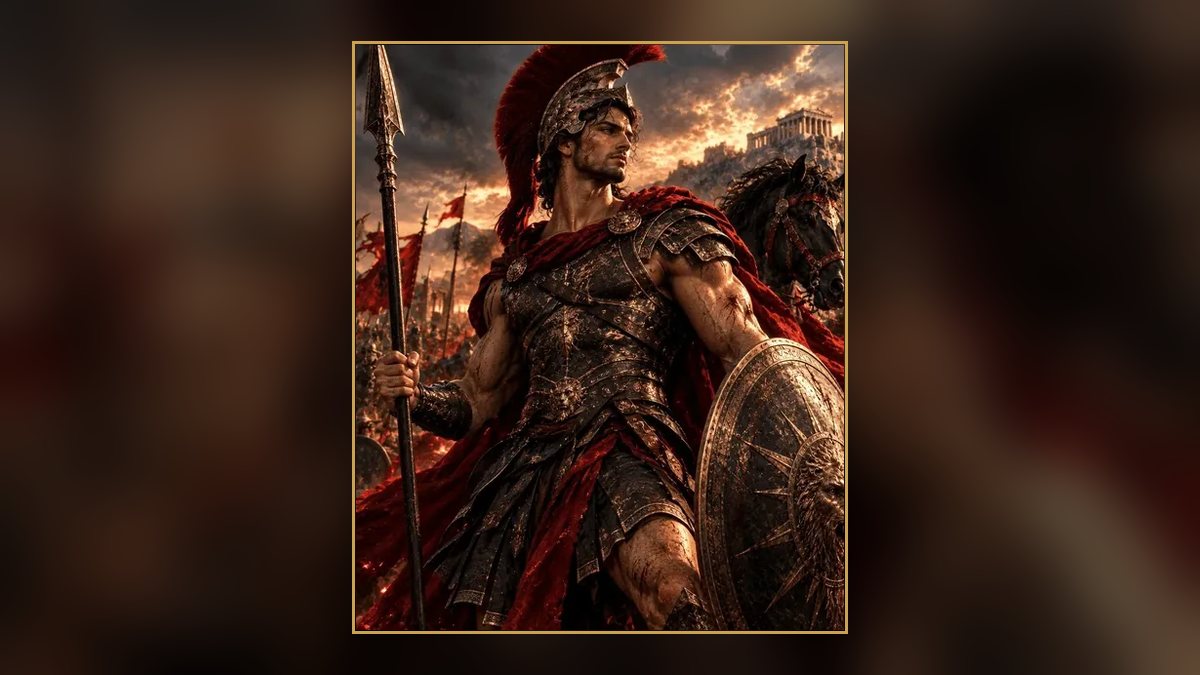
Ares is the war god everyone knows, and Greek writers could not stand him. Homer has Zeus call him the most hateful of the gods, because he loves nothing but fighting. Next to him the Greeks kept another name for a war god, Enyalios, and that name has something of its own. It is old, it is practical, and it was shouted by actual soldiers on actual fields.
A name on a clay tablet
About three and a half thousand years ago, an official at the palace of Knossos in Crete wrote a list on a clay tablet. The script was the one we call Linear B, an early form of Greek that was deciphered in the 1950s. Among the entries is a name that scholars read as Enyalios. If that reading is right, the god was being given offerings in Crete centuries before Homer composed anything.
That does not tell us what the god was like then. It does tell us that the title was not an invention of the poets. The Greeks were worshipping a war god under this name very early.
Homer’s two names
In the Iliad the two are interchangeable. A warrior is compared to Enyalios, the man-slayer, in the same way that another is compared to Ares. Both are used for the god himself. The name looks like it has a connection to Enyo, the goddess of war and the sacker of cities, who appears next to Ares on the battlefield, and who has a similar sound.
Some later writers drew the distinction more sharply. They made Enyalios a separate god, usually a son of Ares and Enyo, and the Greeks of the classical age were not entirely certain whether they were naming two gods or one. The oldest sources suggest one. For poets and soldiers alike, Enyalios was simply the name you used when the fighting was close enough that you could hear it.
Shouting it across the field
The clearest picture of this comes from Xenophon, an Athenian who marched with ten thousand Greek mercenaries into the heart of Persia. In his account of the battle of Cunaxa, in 401 BCE, he describes how the Greek line advanced. The men sang the paean, the battle hymn, and then, as they began to run, they raised the war cry to Enyalios and clashed their spears against their shields to scare the enemy.
That is Enyalios at his most direct. He was a word that a soldier shouted, a sound to take into a charge. It did not need a theology.
Rites for the young
In Athens, the official who handled military ritual, the polemarch, made yearly sacrifices to Enyalios and to Artemis Agrotera, as Aristotle records. It is a pairing that appears elsewhere, and the huntress who had once received the Marathon vow shares the altar here with the war god.
The god also stood witness to a boy’s first duty. When young Athenian men reached eighteen and enrolled for military service, they swore an oath in the sanctuary of Aglauros. They promised not to disgrace their weapons, not to desert the man next to them, and to leave the country better than they had found it. The gods called as witnesses included Aglauros, Enyalios, Ares and Zeus. Enyalios, in this list, is a separate name, which suggests that Athenians kept the distinction even when it was blurred in the poems.
The Spartans honoured him too, in their own severe way. Pausanias says the young men of Sparta sacrificed puppies to Enyalios, at a shrine outside the city, before a ritual fight between teams of boys. The reasoning he gives is that the dog is a tame creature and a fierce one at once, and so a fit gift for a god of war.
The statue in chains
The oddest object connected to the name was in Sparta. Pausanias saw an old statue of Enyalios there, and it was bound in fetters. The Spartans, he says, believed that the god would never run away from them as long as the image was tied down. He compares it to the Athenian shrine of Wingless Victory, where the goddess was shown without wings for the same reason.
Nothing else recorded about this god says as much. A war god was something a city needed and could not trust, so the Spartans bound him to the floor, where he would be present for the next battle. Courage, in their picture, had to be kept in place. The name that soldiers shouted on the field was also the name of the thing that the city did not want to lose.