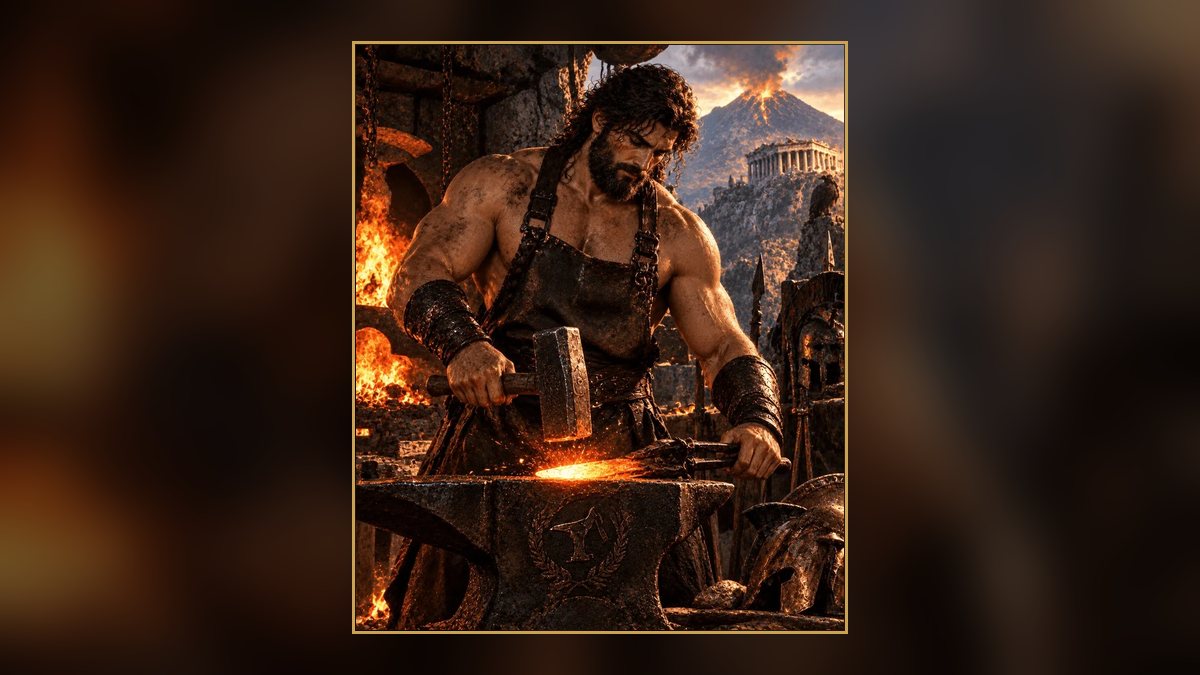
Hephaestus was the god of the forge, and a forge needs fire, smoke, noise and a place to put them. Mainland Greeks mostly kept him in a workshop in the sky, or on the island of Lemnos where he first landed when he was thrown out of heaven. The Greeks who moved west, to Sicily and the islands off its northern coast, found something better. They found a mountain that did the job itself.
Etna is the largest volcano in Europe, and it dominates the east coast of Sicily. Anyone who has lived under it describes the same things: a plume of smoke by day and a red glow at night, a low grumble that can be felt through the ground, ash on the washing, and now and again a river of fire coming down the slope. Greek settlers arrived there in the eighth century BCE and, within a generation or two, were saying that Hephaestus lived inside.
The poets put him at work
The tragedy Prometheus Bound, which comes down under the name of Aeschylus, brings the idea into verse. He describes the monster Typhon, whom Zeus defeated and buried under Etna, lying beneath the mountain while Hephaestus hammers on its summit. Someday, the chained Titan warns, Typhon will recover his strength and rivers of fire will pour out and devour the fields of Sicily. The mountain, in this picture, is a prison with a forge on top.
Pindar says something similar, in a victory poem for the tyrant Hieron of Syracuse written about 470 BCE. He describes the pillar of the sky, white with snow, and the smoke that rolls out by day, and the red flame that carries rocks down to the sea by night. Under it lies Typhon, hundred-headed, and the scene is so vivid that readers have long suspected Pindar had been there during an eruption.
Hieron had his own reason to love the mountain. In 476 BCE he took over the nearby city of Catane, drove out its inhabitants, settled it with new colonists of his own, and renamed it Aitna. The title Aitnaios, of Etna, was then used of the new city’s people and of the god Zeus, who had a sanctuary on the mountain. The tyrant even had Aeschylus write a play for the occasion, called Women of Aitna. A volcano had been turned into a civic brand.
Smiths in the islands
To the north of Sicily lie the Aeolian islands, a string of volcanic cones in the sea. Thucydides, writing about the Peloponnesian War, mentions them in passing and adds a local belief. The people of Lipari, he says, held that Hephaestus worked in one of the islands, which they called Hiera, the Sacred one, because it smoked by day and glowed at night. We still call it Vulcano, from the Roman form of the god’s name, and the word has since given us the general term for such mountains.
Poets filled out the workshop. Callimachus imagined the Cyclopes there at Lipari, beating iron on an anvil, and Virgil, writing for the Romans, gave the smith’s crew their old names, Brontes, Steropes and Pyracmon. The Cyclopes were the one-eyed craftsmen who had made Zeus’s thunderbolt, and they needed somewhere to work. The Sicilian volcanoes fitted.
When the legend caught up
Greek writers did not have to look far for proof. Etna erupted in the 470s BCE, when Pindar and Aeschylus were writing about it. Thucydides records another eruption in 425 BCE, in the middle of the war, when a stream of lava came down the mountain and burned land belonging to the people of Catane. Such events renewed the sense that the god was awake.
The story illustrates something that is easy to forget about Greek religion. Gods were not floating above the map. They were located. Hephaestus was in Athens, in a temple beside the metalworkers’ quarter, and on Lemnos, and, for a generation of settlers who had never heard of either place, inside the mountain that kept them up at night.
A god who was a neighbour
Aitnaios makes me think about how different a smith’s god looks from the inside of a volcanic landscape. In Homer, Hephaestus is a limping, comic figure whom the other gods laugh at when he hobbles through the hall. In Sicily, you can see why someone might not want to laugh. The fire in the mountain was the real thing, and it came down the slope at its own speed.
The title took a god who was mostly a figure of fun and gave him the one thing the Greeks always respected, which was a force that could not be argued with. Etna made Hephaestus formidable by being what a forge looks like when it is too big to move.