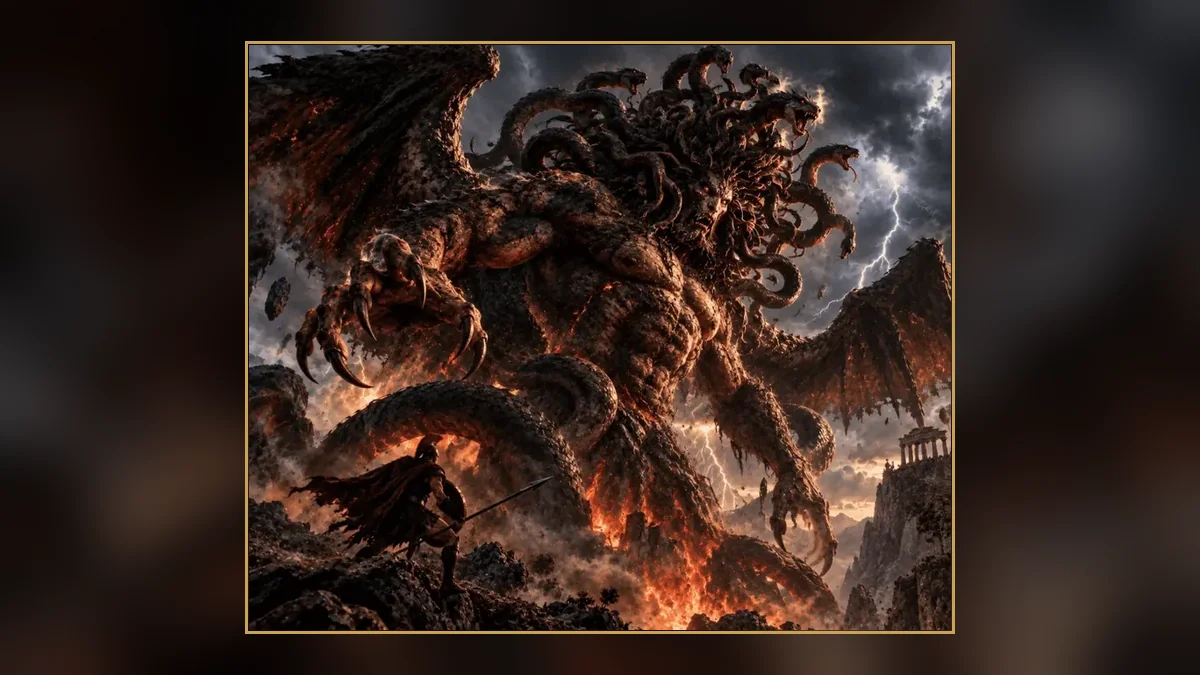
Most Greek monsters are a hero's problem. Somebody has to be found to kill the lion, somebody has to be sent to the marsh, a king has to be given an impossible errand. Typhon is different, because the people he threatens are the gods themselves. He arrives after the Titans are chained and the Olympians have drawn lots for the world, at the exact moment when Zeus is starting to look like a king whose work is finished. Then the earth produces something that makes the whole settlement look like a rumour. This article follows his story and then makes an argument about what he was for.
Three births and one grievance
Nobody in antiquity agreed on where he came from, and the disagreement is revealing. In Hesiod's Theogony, Gaia bears him last of all, her youngest child, by Tartarus, the deep pit under the world. Hesiod adds a strange detail: it happened with the help of golden Aphrodite. The goddess of desire stands at the birth of the thing that will almost end the reign of the king of the gods, and the poet does not explain why.
The Homeric Hymn to Apollo gives a different mother entirely. There, Hera is furious that Zeus produced Athena from his own head without her, so she strikes the ground with her hand and prays to Earth, Sky and the Titans for a child who will be stronger than Zeus. She gets Typhon, and she hands the baby to the she-dragon who lives at Delphi to be raised. Later writers such as Apollodorus go back to Gaia, but now she is angry about the Giants, whom Zeus had just defeated.
Look at the pattern. In every version except Hesiod's, a goddess has a grievance and Typhon is the answer to it. He is an instrument, built to someone else's specification. Even in Hesiod, where nobody is named as angry, he is simply the last product of an earth that keeps producing challengers. At no point does Typhon want anything. I will come back to that, because it turns out to matter.
What he looked like
Hesiod's description is one of the great pieces of monster-writing in Greek. His hands do deeds of strength and his feet never tire. A hundred snake heads rise from his shoulders, each with a black flickering tongue, and fire flashes from under the brows of every pair of eyes. Apollodorus, writing centuries later, scales him up until he is bigger than any mountain, with a head that brushes the stars, one arm reaching to the sunrise and the other to the sunset, wings on his back and coils of vipers where his legs should be.
But the detail that I find most unsettling is in the voices. Hesiod says that in all those heads there were voices, and they made every kind of sound. Sometimes the sound was speech the gods could understand. Sometimes it was a bull bellowing. Sometimes a lion, sometimes puppies, sometimes a hiss so loud that the mountains rang with it. Keep that list in mind. It is the key to everything else.
Version one: a single blow
In Hesiod, the fight is short and total. Zeus hears the monster coming and answers with thunder. The whole cosmos shakes: earth, sky, sea, the streams of Ocean, even Tartarus underneath, where the Titans cower and Hades himself trembles on his throne. Zeus uses everything, thunder and lightning and the fire of the bolt, and the earth begins to melt like metal in a smith's crucible. Typhon is scorched, crippled, thrown down. In a rage, Zeus hurls him into Tartarus.
Then Hesiod says something that is easy to read past. He says that on that day something irreparable would have happened, and Typhon would have become king over mortals and immortals, if the father of gods and men had not noticed quickly. The whole victory hangs on the speed of one glance. For a poet busy praising Zeus, that is a remarkable admission.
Version two: the god with his tendons cut
The longer story survives in Apollodorus, and it is much stranger. This time the gods see Typhon coming and run. They flee to Egypt and disguise themselves as animals, which is, as it happens, one of the ancient explanations for why Egyptian gods have animal heads. Zeus stays and fights. He pelts the monster with thunderbolts from a distance, then closes in with an adamantine sickle, and chases him as far as Mount Casius in Syria. There, in close combat, it goes wrong.
Typhon wraps him in his coils, tears the sickle away and uses it to cut the sinews out of Zeus's hands and feet. Then he picks up the helpless king, carries him across the sea to Cilicia and dumps him in the Corycian cave. The sinews he hides in a bearskin, and sets a half-woman, half-beast called Delphyne to guard them.
The way the king gets his body back is the best part. Hermes, the god of thieves, and Aegipan, a goat-footed spirit, steal the sinews and fit them back onto Zeus without being noticed. Recovered, Zeus returns in a chariot drawn by winged horses and drives Typhon from mountain to mountain. At Mount Nysa the Fates trick him into eating the so-called ephemeral fruits, with the promise that they will make him stronger. They do the opposite. He flees on through Thrace, tearing up whole mountains to throw at Zeus, until the bolts drive them back onto him. Blood gushes out onto the range, which is how Mount Haemus, the bloody mountain, gets its name. Finally he runs for the sea off Sicily, and Zeus drops Mount Etna on top of him.
What the longer story admits
Put the two versions side by side and a difference appears. Hesiod's Zeus wins because he is Zeus. Apollodorus's Zeus wins because a thief and a goat-spirit break into a cave, and because the Fates cheat on his behalf. The king of the gods is rescued by subordinates, by theft and by destiny itself, not by strength.
I read that as the Greeks quietly letting some realism into a flattering story. The official line is that power wins. The version people told once they had lived through some real politics is that power survives by having clever friends and the cosmos on its side. Notice also who does the rescuing. Hermes is the god of boundaries and of things taken without permission. The order of Olympus is saved by exactly the kind of act that order is supposed to forbid.
My reading: a voice with no job
This is the part that is my own interpretation, not something an ancient author says in so many words. Go back to the voices. Typhon is the only monster in Hesiod who can speak in a language the gods understand, and he can also bellow and roar and bark and hiss. He has every voice, which means he has no particular one.
Now think about how Zeus rules. The whole Olympian settlement in Hesiod is a distribution of honours. Each god receives a domain, a title, a function, and a place in the sequence of who speaks after whom. Zeus's genius, as the poem presents him, is that he does not simply crush rivals. He assigns. He gave the Titans who sided with him their honours, he gave Hecate hers, he divided the world into three lots. Order here means everyone having a voice and a role, and knowing whose turn it is.
Typhon has no lot, no honour and no office. He is sound that does not belong to anyone, speech that has not been assigned to a speaker. If he had become king, as Hesiod says he would have, the result would not have been a worse ruler. It would have been a rule in which nothing is distinguished from anything else, where a god's word and a bull's bellow carry the same weight. That, I think, is what he really threatens. Not defeat, but the loss of difference.
And look at what Zeus does with him afterwards. He does not simply destroy him. He gives him an address. Typhon becomes a volcano, a source of storm winds, a place on a map. It is the same method Zeus uses on every enemy: the Titans go to Tartarus, Atlas gets the sky, Prometheus gets a rock. Typhon, the voice with no job, finally receives one. He is the thing that rumbles under Sicily.
Where he lies
The Greeks took this literally, and they pointed to the spot. The poet Pindar, in an ode written around 470 BCE for Hieron, the ruler of the new city of Aitna, describes Etna as the pillar of heaven that pins the monster down. By day the mountain pours out rivers of smoke, and by night red flame rolls rocks into the sea. Pindar says the monster's shaggy chest is pressed down by Sicily and by the rocky shore near Cumae, which is why some ancient writers also put him under the island of Ischia in the Bay of Naples.
Hesiod adds a last note that I like very much. All the damaging, unpredictable winds, he says, come from Typhon. Only three winds, Notos the south, Boreas the north and Zephyros the west, are the children of gods, and they are a blessing to sailors. The Greeks sorted the weather into the winds that work for you and the winds that do not, and then wrote the sorting into a family tree. The English word typhoon has a tangled history, but the Greek typhon, whirlwind, is certainly one of the threads.
An older story underneath
Many scholars think the story of Typhon is not originally Greek at all. The setting gives it away. In Apollodorus the battle begins at Mount Casius, on the Syrian coast, and the monster is born in Cilicia, in southern Anatolia. Those are exactly the lands where older storm-god myths were told. In a Hittite tale, a storm god is beaten by a serpent, who takes his heart and eyes, and he only wins them back by a trick. In the Syrian stories of Baal, a storm god fights the sea. The Greek version, in which Zeus loses his sinews and gets them back by theft, looks very like a local retelling of that pattern, carried west and fitted onto Zeus.
Husband of Echidna, father of problems
Typhon's other role is as a father. With Echidna, the half-woman, half-snake who lives in a cave in the land of the Arimoi, he is said to have fathered most of the monsters that later heroes would have to kill: Cerberus, the Hydra, the Chimera, Orthrus, and in several tellings the Sphinx and the Nemean Lion. The Iliad, notably, puts his bed in the same land of the Arimoi where Hesiod puts Echidna's cave, as though Greek storytellers all agreed where this household was, even if no one could say where on earth it was. Every labour of Heracles and every riddle at Thebes traces back to this couple, which makes Typhon the grandfather of the whole heroic age.
What he is for
Typhon shows up in nearly every account at the same narrative position, right after the settlement of the world and just before the stories of heroes begin. He is the final exam of the divine order. Before the gods can hand the world over to human beings and their problems, they have to prove that their order can survive an enemy who is not a rival, who does not want the throne for its own sake, and who cannot be bargained with because he has nothing to bargain for.
They pass, but only just, and only by help. That seems to me the honest centre of the story. The Greeks believed in a cosmos with a king, but they never pretended the king was invincible. They told the story where he loses his tendons in a cave, and they kept telling it. Under every neat arrangement of honours and titles, there is a voice that has no title, lying under a mountain, and the mountain is not quite heavy enough to make it stop.
Comments
Sign in to join the conversation.