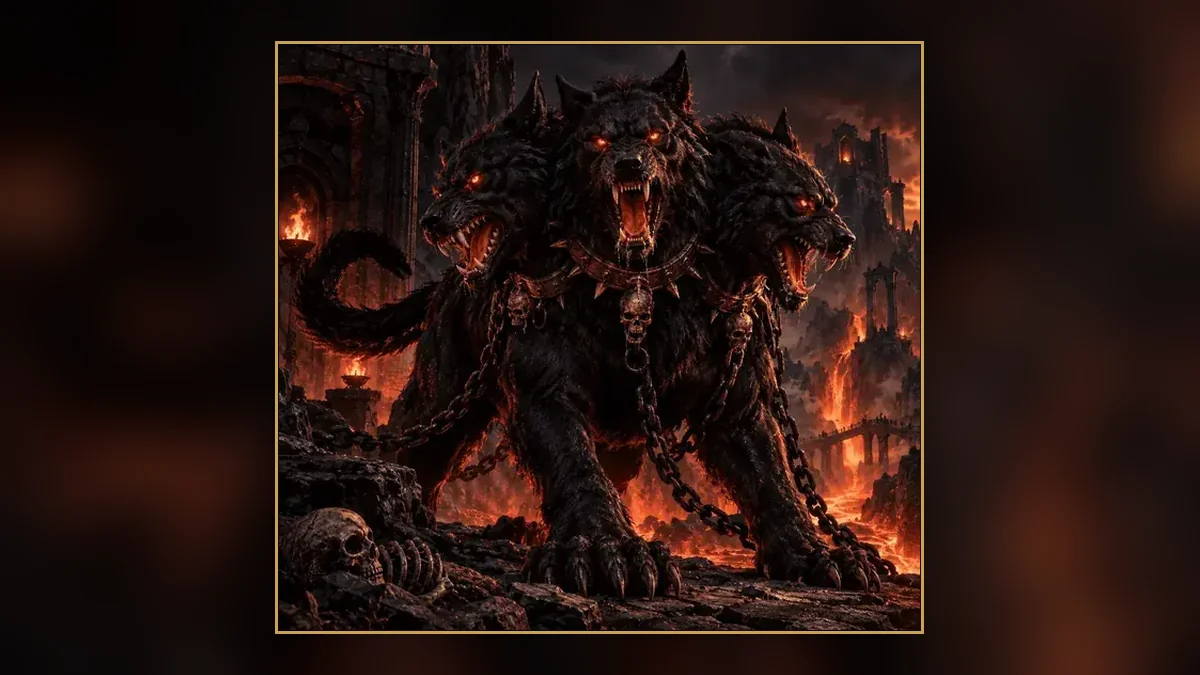
Ask people what Cerberus does and they will say he stops people getting into the underworld. It is a reasonable guess. He is a huge dog with three heads sitting at a gate, and the picture practically writes the job description by itself. The trouble is that the earliest writer who describes him in any detail says nearly the opposite. Hesiod's Cerberus is friendly to visitors. His danger starts at the exit.
Fifty heads, then three, then two
Before we get to what he does, we should deal with what he is, because Cerberus has been redrawn more than almost any creature in Greek myth. Hesiod, our first source, gives him fifty heads and a bronze voice, and says he eats raw flesh. A later poet, Pindar, is reported to have gone up to a hundred. Apollodorus, writing in the Roman period, settles on three dog heads, a serpent for a tail, and a mane of smaller snakes bristling along his back. That version won, and it is the one on every modern poster.
But the artists did not wait for the poets to agree. Greek vase-painters in the sixth century BCE often gave him just two heads and a snake's tail, which is simple enough to fit on a pot and still looks terrifying. The three-headed dog became the standard more because three is tidy than because anyone had decided it was correct. Greek myth almost never had a single official text, and Cerberus is a fine illustration of how a creature gets fixed by habit.
Even his name is not entirely clear. Kerberos might mean something like spotted, and some linguists have set it beside the Sanskrit name of one of the dogs of Yama, the first dead man and lord of the dead in the Vedic hymns. Those two hounds are said to be spotted, four-eyed, and posted on the road to the realm of the dead. The Norse stories have their own hound, Garmr, howling at a cave mouth with a chain that is destined to break. If the resemblance is more than chance, the idea of a dog at the gate of death is far older than Greece, a piece of inherited furniture from long before anyone wrote Hesiod's poem. That is a guess, and the word-link in particular is debated, but the pattern across three cultures is hard to ignore.
A door that opens one way
Now to the passage that I find the most striking. Hesiod, describing the house of Hades, says a terrible dog stands guard in front of it, and that he has a cruel trick. He fawns on those who come in, wagging his tail and flattening his ears. But he will not let them go back out. He lies in wait, and whoever he catches trying to leave the gates, he devours.
Think about what kind of guard that is. A watchdog is supposed to keep trespassers away. This one welcomes the guest and attacks the escapee. Cerberus is not a wall. He is a turnstile.
That fits what we see elsewhere in Greek stories about the dead. The living can reach the underworld. Orpheus walks in with a lyre, Heracles goes in to fetch the dog himself, Odysseus gets to the edge and calls up ghosts, and later Roman stories send Aeneas and Psyche all the way down. Getting in is a feat, but a possible one. What the poets keep insisting on is that coming back is a different matter. My reading is that Cerberus is the physical form of that rule. The underworld is not sealed against entry. It is sealed against reversal. Death is not a locked room but a corridor with a gate that only swings inward, and the dog is there to make sure of the direction.
The twelfth labour
The famous encounter is of course Heracles's last labour. Eurystheus orders him to bring the dog of Hades up into the light, and Apollodorus gives the fullest version. Heracles first goes to Eleusis to be initiated into the mysteries, so that he can face the dead properly prepared. Then he goes down through a cave at Cape Taenarum, the southernmost tip of the Peloponnese, one of several places the Greeks claimed as an entrance to the underworld.
The dead scatter before him, all except two. One is the hero Meleager, who talks to him and asks him to look after his sister, which is how Heracles ends up meeting Deianira. The other is the ghost of Medusa, and Heracles draws his sword on her before Hermes tells him it is only a phantom, an image with no body behind it. Hades himself gives permission, with a condition: Heracles may take the dog if he can master him without weapons.
So he does it with his hands. Wearing the lion skin as armour, he finds Cerberus near the gates of the river Acheron and locks an arm around his throat. The serpent tail bites him repeatedly. He does not let go until the dog gives up. Then he hauls him up into the daylight and through the land to Eurystheus. The king, true to form, wants nothing to do with it, and vase-painters loved showing him diving headfirst into his storage jar while the dog snarls above. The labour is done, and Heracles takes the dog back down to Hades. Nothing in the story suggests Cerberus was kept.
Homer already knew the outline. In the Iliad, Athena complains bitterly that she once had to rescue her favourite from the task of fetching the dog of Hades, which means the story was old enough to be a reference point by the time of the Trojan War poems.
The first labour and the last
Here is something I have not seen emphasised enough. The first labour was the Nemean Lion, which Heracles strangled with his bare hands because weapons would not pierce it. The last labour is Cerberus, whom he subdues in a stranglehold because he has been told to use no weapons. In both stories Eurystheus cowers in his jar, in the texts for the lion and in the vase-paintings for the dog. Both creatures belong to the same monstrous family, the offspring of Typhon and Echidna.
That makes the whole cycle a ring. Heracles begins with a beast on earth that cannot be cut and ends with a beast under the earth at a door that cannot be forced, and in each case the answer is the same: hands, not iron. The point of the twelve labours, on this reading, is not to show how many things a strong man can kill. It is to show that the one weapon that works on the hardest problems is the one you were born with. And the ring closes quietly. After wrestling the dog of death, Heracles gives him back. He is allowed to borrow the underworld's guard, but not to keep him.
The sop
If you cannot wrestle Cerberus, you can bribe him. The most common way of getting past him in later stories is food or music. Orpheus plays his lyre and the dog's three heads fall asleep. In Virgil's Aeneid, the Sibyl who guides Aeneas finds the monster stretched across his cave with his hackles rising and the snakes on his neck hissing, and tosses him a honey cake laced with a sleeping drug. The three mouths open wide, he gulps it down, and he slumps to the floor. In Apuleius, Psyche is told to take two barley cakes soaked in honey to quiet the dog on her way in and out.
English still has the phrase a sop to Cerberus, which means a small bribe offered to quiet a threat, and it comes straight from these stories. Honey cakes were real offerings in Greek religion too. Pausanias says that anyone who went down to consult the oracle of Trophonius had to carry honey cakes to appease the snakes in the chamber. The cake is the oldest kind of diplomacy: you cannot beat the guard, but you can give him something to do with his mouth.
Poison in the grass
One more story, from the Roman poet Ovid, hints at what the dog's presence does to the world above. When Heracles dragged Cerberus up into the light, the dog, which had never seen the sun, shut all his eyes and went mad with rage. As he thrashed, foam flew from his three mouths and fell on the green fields, and from that spittle grew a poisonous plant. It is aconite, the one we call monkshood or wolfsbane, and it is real, and it is deadly. In the same poem, the sorceress Medea tries to use it to poison Theseus.
Another tradition, reported by Apollonius of Rhodes, set the scene at a cave on the Black Sea coast, which was another candidate for the entrance to the underworld. I like the image. The dog takes a single breath of daylight and the world is poisoned for it. What belongs below, when it is dragged up, does not quite stay down.
What he is for
Among the many children of Echidna and Typhon, Cerberus is unusual. The Hydra is a pest. The Chimera is a menace. The Sphinx is a plague. They live in their own places and cause their own trouble, and each of them is killed by a hero. Cerberus has a job and a master. He answers to Hades, he reports to a post, and he does his work competently for as long as anyone tells the story. He is the monster who was taken into service.
I think that is why he lasts. We understand a gate better when it has a guard, and we understand death better when it is a place with a rule. The rule is simple and Cerberus is the rule with teeth: you may go in, and you may not come out. Everything else the Greeks said about the underworld, all the rivers and judges and the ferryman, is a long elaboration of that one sentence, and the dog is where the sentence ends.
Comments
Sign in to join the conversation.