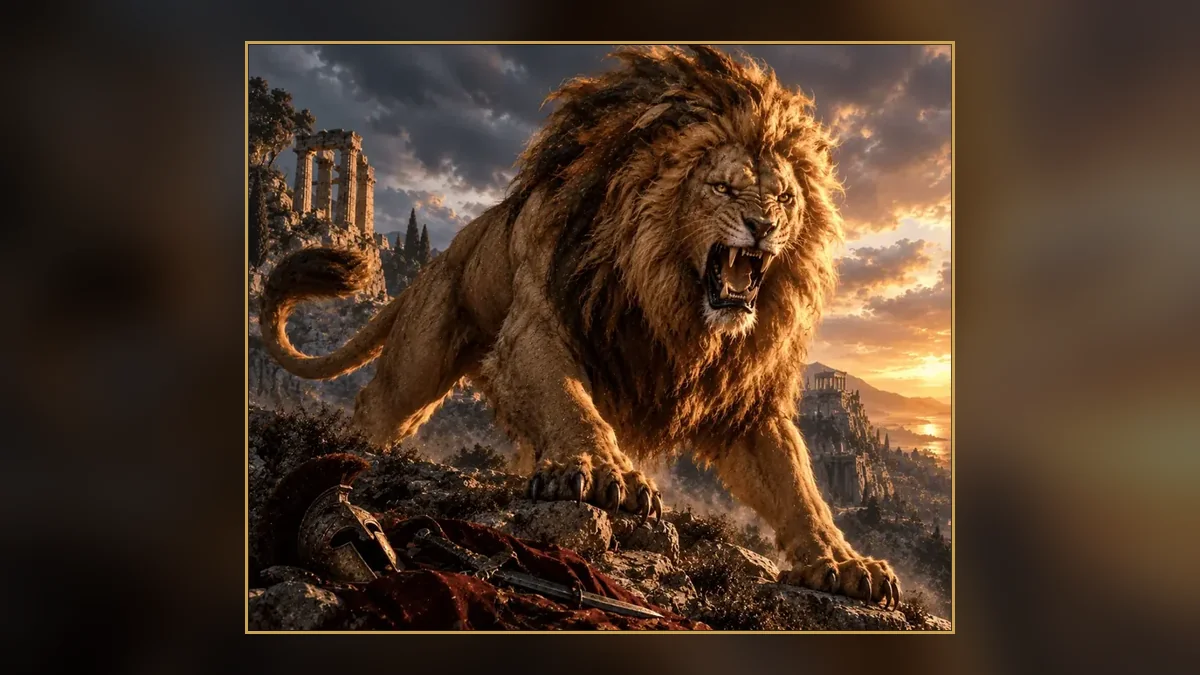
Almost every picture of Heracles shows the same outfit: a club in one hand and a lion's pelt over his shoulders, the head pulled up like a hood. It is such a fixed part of his image that it is easy to forget it had to come from somewhere. Nobody is born wearing a lion. The skin is a souvenir of the very first job his cousin gave him, and the story of how he got it explains a surprising amount about how Greek myth thinks heroes are made.
A pet of Hera
Our oldest account is Hesiod's. In the Theogony, the Nemean Lion is one of the brood of monsters that descend from Typhon, with the Chimera and the dog Orthrus as its parents in the usual reading of the poem. What Hesiod stresses is who raised it. The goddess Hera nourished the lion and set it down in the hills around Nemea, where it preyed on the people of the valley. Hesiod names the nearby heights, Tretus and Apesas, as if his audience knew the country, and then dispatches the beast in half a line: the strength of Heracles overcame it.
That detail matters, because it puts the lion in the same category as the Hydra. Both are Hera's creatures, bred and placed to harm her husband's illegitimate son. The first two labours are, in effect, two rounds of a feud, with Heracles responding to a monster the goddess has been feeding. Apollodorus makes the lion a child of Typhon, plain and simple. Some later writers had a stranger idea, saying that the Moon herself gave birth to the lion and dropped it onto the earth at Nemea. I like that version a great deal, and I will come back to it.
Molorchus and the thirty days
Apollodorus tells us what happens when Heracles receives the order. Eurystheus tells him to bring back the skin of the lion. Heracles sets off for Nemea and comes to the little town of Cleonae, where he stays with a poor labourer named Molorchus. The man wants to sacrifice a ram in honour of the guest, but Heracles tells him to wait thirty days. If he returns safely, Molorchus is to offer it to Zeus the Saviour. If he does not, the sacrifice should be to him, as a dead hero.
I love this moment. The monster hunt begins with a contract between the greatest hero in Greece and a poor man in a cottage, and the terms are a wager on whether the hero will still be alive. It reminds us that the labours happen in a real landscape, among people who will have to live with the result. Molorchus is not a character in the grand story, but he is the one who gets to decide, at the end of thirty days, whether he is making an offering to a god or to a corpse.
Weapons that fail
Heracles finds the lion and does what any sensible warrior would. He shoots at it. The arrows bounce off. He swings his club, and the club has no effect. The animal's hide cannot be pierced by bronze or stone, and it simply turns and walks into its den.
This is the scene that sets the pattern of the whole cycle, and it is easy to underrate. The first thing a hero in a Greek story learns is that his equipment will not work. Heracles is the strongest man alive, with the best bow and the heaviest club, and in his first real fight, his gear is useless. If he is going to win, it will not be by doing what he already knows, only harder.
The cave with two mouths
The lion's lair is a cave with two entrances. Heracles blocks one with rocks, goes in through the other, and meets the lion in the dark. With no room to swing a club in the dark, he grabs the animal around the neck, locks his arms, and holds on until it stops breathing. Many Greek vases show the moment: the hero crouched with his back bent, his arm around the lion's throat, the animal's front legs scrabbling at the air.
The cave is a real part of the tradition. Pausanias, who travelled through the area in the second century CE, mentions that the cave was shown to visitors, and a cave in the hills above the sanctuary is still pointed out as the lair. The mythology and the geography are bound up in each other, which is why the story survives in the place as well as in the books.
Skinned with its own claws
Heracles now has a dead lion and a problem: how do you skin an animal that nothing can cut? Apollodorus says that he struggled with this for a while, and then it occurred to him to use the lion's own claws. They were the one thing hard enough to cut through the hide. He stripped the skin with them, and put it on. It became his armour, and the head became his helmet.
Think about the symmetry. The animal's greatest defence and its greatest weapon are the same thing, and the hero, by wearing the one and using the other, takes both. It is a small, neat piece of storytelling, a puzzle with a solution that arises from the puzzle itself.
The king in the jar
When Heracles carries the carcass back to Cleonae, it is the thirtieth day, and Molorchus is just about to sacrifice to him as a dead man. He sacrifices to Zeus the Saviour instead. Then Heracles takes the lion to Mycenae, and Eurystheus, who has never seen anything like it, is so frightened that he has a bronze jar made and buried in the ground to hide in whenever Heracles comes near. From then on, he gives his orders through a herald and tells Heracles to show the proof of each labour outside the city gates.
This is the beginning of one of the great comic pairings in Greek myth, the mighty hero and the terrified king. It is also the first hint that the labours are not what they seem. Eurystheus thinks he is controlling Heracles. Instead, from the first labour onward, he is hiding from him in a hole in the ground.
My reading: why he wears it
Now to the question I opened with. Why does Heracles keep the skin on? In the story, it is armour, and a lion's hide that no weapon can cut is excellent armour. But it is also much more than that. Almost every other hero is identified by a weapon or a tool: Perseus has his sickle and his mirrored shield, Theseus his sword and sandals, Odysseus his bow. Heracles is identified by a trophy. The thing he wears is the thing he has defeated.
I think that is the point of the first labour, and it is my own interpretation. The lion gives Heracles a visible identity. Before it, he is a strong man with a troubled past. After it, he is the man in the lion skin. The Greeks seem to be saying that a hero is made by what he overcomes, and that he carries it with him afterwards. Every time he appears in a painting or a play with the head hooded over his own, the story of how he started is right there on his body.
And notice the irony. The lion was Hera's creature, sent to harm him. He ends up wearing it in public for the rest of his life, in front of her. It is a small, quiet insult, an enemy's weapon turned into his uniform. The pet becomes the pelt.
A lion from the moon
Now to the strange version I promised. Some later writers said the Nemean Lion was not an earthly beast at all but a child of the Moon, who dropped it onto the earth. I do not think that is an accident. An animal from the sky would explain why nothing made on earth, no bronze, no flint, no arrowhead tipped with earthly metal, can wound it. It is a creature that does not belong to the material the weapons are made of. The only thing that can damage it is something of the same kind: its own claws, or the bare strength of a man who is half a god.
The idea also fits the way the Greeks set the lion in the heavens afterwards. Later tradition says Zeus, or Hera, placed it among the stars, where it became the constellation Leo. It is a simple round trip. The animal came down from the sky to Nemea, and was returned to the sky when its work was done.
An older lion hunter
Scholars have pointed out that lion fighting was a very old image of kingship in the ancient Near East. Assyrian palace reliefs from the seventh century BCE show their kings spearing lions in the royal hunt, and the Mesopotamian hero Gilgamesh is shown wrestling one. A Greek story that begins with a hero throttling a lion and wearing its skin looks like part of that tradition, adapted and passed west. That does not make it less Greek. It only shows that the Greeks, as ever, borrowed an old image of what makes a ruler, and gave it a local habitation: a particular valley, a particular cave, a poor man called Molorchus.
The games at Nemea
The valley kept the story alive in another way. Nemea was home to one of the four great Panhellenic festivals, the Nemean Games, held in honour of Zeus. The Greeks gave two origin stories for them. One said they were founded by the Seven against Thebes, in memory of a baby named Opheltes who died while his nurse was showing the army a spring. The other, favoured by the poet Pindar, said that Heracles himself established them after killing the lion. Winners were crowned with wild celery. The site has been excavated, and you can still walk the tunnel that athletes used to enter the stadium.
What it is for
The Nemean Lion is the first of twelve, and its job in the story is to show you the rules. Strength is not enough. The hero's own weapons will let him down. The answer will have to come from an unexpected direction, from the enemy's own body or from the need to get close in the dark, and when it is done, the victory will become part of who he is. Eleven labours later, at the gates of the underworld, he will meet another monster of the same family, and he will deal with it the same way, with his bare arms. The lion teaches him that, and then he wears the lesson for life.
Comments
Sign in to join the conversation.