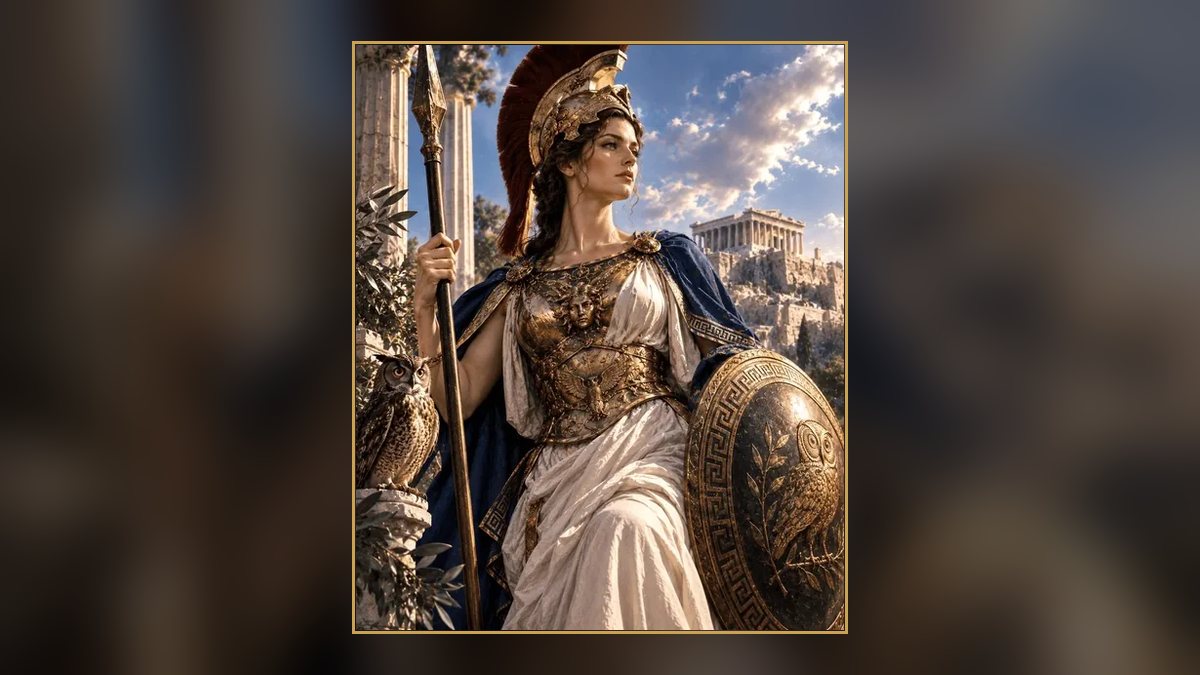
If you read the Iliad or the Odyssey in the original Greek, you will meet a particular phrase so often that it starts to feel like a person’s name. Glaukopis Athene. The goddess is rarely just Athena. She is glaukopis Athene, over and over, in the same position at the end of a line, as if the poet had a little stamp that he pressed whenever she appeared. And almost nobody can say for certain what it means.
That is not an exaggeration. Ancient commentators were already arguing about it, and modern scholars still do. The word is built from two parts. The second is easy: opis, which has to do with the face or the eyes, or looking. The first, glaukos, is the problem, because in Greek it was used for things as different as the sea, the leaves of an olive tree, the shine of a weapon, and the eyes of an animal. It seems to point to a pale, bright colour, something between grey, blue-green and silver, and above all to a shine.
Three honest translations
The first reading, and the most common, is grey-eyed. It is the version in most English translations, and it has the merit of being simple. Athena has pale eyes, and the Greeks, who thought of her as clear-headed, may have liked the idea that her eyes looked like polished metal.
The second reading is bright-eyed, or gleaming-eyed. Here glaukos is taken to be about brightness, not colour. It makes the epithet less of a description of her face and more of a comment on her gaze. She looks at something and it is lit up. It is a very good fit for a goddess of wisdom, who is supposed to see what other people miss.
The third reading, the oldest and the most intriguing, is owl-eyed. The Greek word for the little owl, the kind that lives around Athens, is glaux. It may be related to glaukos, because the owl has large, round, shining eyes. If the epithet really means owl-faced, it could be a very old title from a time when the goddess was imagined partly as a bird. There are other cases in Greek religion of gods and goddesses carrying animal epithets that hint at earlier forms: Hera as cow-eyed, for instance.
Nobody can settle it. And I suspect the Greeks did not need it settled. A single word that could be heard as grey, bright or owl-like suited a goddess who was all three.
The bird
The owl was her bird. That is attested very early, though writers do not agree on exactly how the link was made. What we know is that by the sixth century BCE the owl was on the money. Athenian silver coins, the famous tetradrachms, showed the head of Athena on one face and an owl on the other, with an olive twig and the first letters of the city’s name beside it. They were minted in huge quantities, from the silver mines at Laurion in the south of Attica, and they were trusted across the Mediterranean. A merchant in Egypt or Persia would accept them without question. They were nicknamed owls, and the nickname stuck.
There is a joke in Aristophanes’s comedy about someone carrying owls to Athens, meaning doing something pointless, like carrying coals to Newcastle. The phrase tells you how common the coins were. An owl on a coin, an owl on a vase, an owl on a temple relief, and in the minds of the audience an image of the goddess herself. The bird and the title had fused.
Why an owl? The usual guess is that it was a creature of the night that could see in the dark. A goddess of wisdom needs to see where others cannot. The owl also hunts silently and accurately, taking its prey with a single drop from a branch. It is a fitting emblem for planning and strategy, the quality Athena had in abundance.
A later saying
Many readers know a line that is not Greek at all. The German philosopher Hegel, in the early nineteenth century, wrote that the owl of Minerva, which is the Roman name for Athena, spreads its wings only with the coming of the dusk. He meant that understanding arrives after events, once the day’s work is done. It is a clever line, and it has nothing to do with Homer. But it shows how thoroughly the owl and the idea of wisdom had grown together in the European imagination, a link that goes straight back to the title we are looking at.
What the title does in a poem
The epithet is also a tool. In epic verse, a poet had to fit words into a strict rhythm, and a standard phrase like glaukopis Athene was a ready-made block that filled the second half of a line. There were similar blocks for many characters: swift-footed Achilles, cloud-gathering Zeus, rosy-fingered dawn. The audience heard them as a kind of music. They also gave the poet a moment to think of the next line.
But it would be a mistake to treat them as filler. When the poet reached for glaukopis, he was calling up a whole picture: the pale eyes, the sharp look, the night bird, the helmeted woman who arrives at the right moment. It was shorthand, and each audience member filled it in for himself.
You can see it at work in a famous scene. In the first book of the Iliad, Achilles is furious with Agamemnon and half draws his sword to kill him. A goddess appears behind him, visible to nobody else, and grabs him by his hair. It is Athena, sent by Hera, and the poet calls her glaukopis. Her eyes flash with terrible meaning. She tells Achilles to hold his hand, and he does. Nothing in the scene says the goddess is wise. We know it from the title.
Why it still catches us
There is something deeply appealing about an epithet whose meaning has been lost. It suggests that the Greeks, too, were looking back at something older than themselves, passing down a word they only half understood. A goddess whose eyes might be grey, or bright, or an owl’s, is a goddess who does not stay put. That ambiguity is useful. It lets everyone see what they want to see: a gaze that cuts, a face that glows, a bird that sits quietly in the dark and waits.
If you are ever in Athens, look at the coins in the museum cases. Pick out an owl. It is round, it stares straight at you, and it has been staring for twenty-five hundred years. When you do, think of the poet pressing his stamp at the end of the line, and of the goddess looking back.