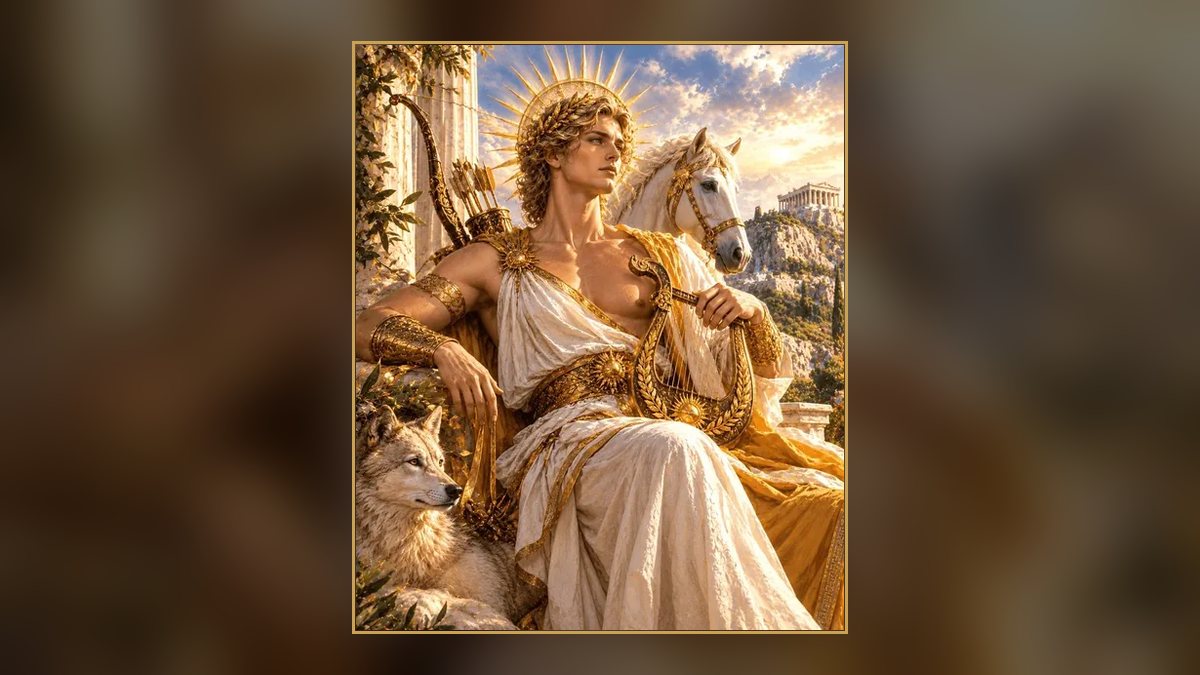
Say Phoebus aloud and it sounds like something from a poem about sunrise. Poets in every century since the Romans have used it that way: Phoebus rises, Phoebus drives his chariot, Phoebus sets in the west. It is such a natural name for the sun that it can come as a surprise to learn that, for a long time, it was not the sun at all.
Phoibos in Greek is an adjective, and it means bright, radiant, pure. It is attached to Apollo in Homer, where it is almost his default name, Phoebus Apollo, as regular as Zeus the cloud-gatherer. Nothing in those poems suggests that the god had anything to do with sunlight in the astronomical sense. The sun has its own god, Helios, who is a different person and appears when the sky needs him. Phoebus is a brightness that belongs to Apollo himself.
What kind of bright
It is worth asking what the quality is. In Greek, things that are phoibos include clean water, purified altars, a person washed of guilt. The word seems to carry the sense of purity, of being free from stain, and that fits Apollo better than any solar picture does. He is the god of purification. The Greeks went to him for rites that cleansed a murderer, a household or a city after a plague. When a killer had to be made fit to rejoin society, the usual place to send him was Delphi.
So the bright one is not the glaring one. It is the clean one. A cold, clear day on a mountain is a phoibos kind of day. A place where something has been washed out and set right is phoibos too. That is a very different image from the yellow disc in a painting, and it explains some of Apollo’s traits that the sun cannot: his link to healing, to law, to the careful ordering of things.
A grandmother and a goddess
The name also has a family. Apollo’s mother, Leto, was the daughter of two Titans, Coeus and a woman called Phoebe, according to Hesiod. That makes Phoebe the grandmother of Apollo and Artemis, and her name is simply the feminine form of the same adjective. The twin sister Artemis is sometimes herself called Phoebe in the poems, which gives the moon goddess the same title of brightness as her brother.
This makes sense if you think of it as a family trait. The Titaness Phoebe has a name that means the bright one. Her grandchildren inherit the word. It is a bit like a surname.
From pure to solar
So when did Phoebus become the sun? The change seems to have happened over the classical period, and gradually. By the fifth century BCE some Greek writers were already hinting that Apollo and Helios could be the same, and by Roman times the identification was common. The Latin poets, and Ovid above all, speak of Phoebus in the sky without a second thought. The Romans, who had borrowed Apollo from the Greeks almost whole, found it convenient to give him a role in the heavens, and the name Phoebus was ready-made.
Part of the reason may have been how closely Apollo and the sun both govern daily rhythm. Apollo was a god of order, of the proper time and measure, and the sun is the great measurer of the day. Once the two were set side by side, they merged easily. By the late empire it was almost impossible to tell them apart, and even writers who knew the history did not always bother to.
The result is that when you see Phoebus in a poem from the seventeenth century, he is the sun in a chariot. When you see him in Homer, he is something else: a young man with a silver bow, the bright, clean, dangerous one.
The silver bow
Which brings us to the dangerous part. Phoebus Apollo is not a gentle god in the Iliad. The poem opens with a priest named Chryses, whose daughter has been taken by Agamemnon, begging Apollo for help. The god hears him and comes down from Olympus, in the poet’s words, like the night. He sits apart from the ships and shoots his arrows at the Greeks, mules and dogs first, and then men. The funeral pyres burn thick for nine days.
It is a frightening scene, and the epithet is right there in the middle of it. The bright one, the pure one, brings plague. In the Greek mind the two were not opposites. The same god who cleans can destroy, and the same arrows that kill can be turned off by prayer. The plague ends when Agamemnon returns the girl and makes a sacrifice. The word Phoebus, bright, is a reminder that purity and terror sit very close together.
The same arrows fall elsewhere. When a queen of Thebes named Niobe boasted that she had more children than Leto, who had only two, Apollo and Artemis shot every one of her children dead. A satyr named Marsyas who dared to challenge Apollo to a music contest was flayed alive. These are not stories about a god of sunlight. They are stories about a god who will not tolerate pride, and about a brightness that can cut.
Why we keep the name
I think the old meaning is worth recovering, even though the solar one has taken over. A reader who knows that Phoebus began as the clean, the radiant, the pure sees more in the god. He is the guardian of a certain kind of clarity. It is the clarity of a spring, of a sharp mind, of a conscience that has been washed, and it comes with a price. You cannot have a clean light without a cold edge.
The next time a poem tells you Phoebus is rising, you can take it either way. It is the sun, and it is also the bright one, whose arrows once fell on a camp of armed men for nine days. Both are true, and the Greeks would have understood why a single word was enough to hold them.