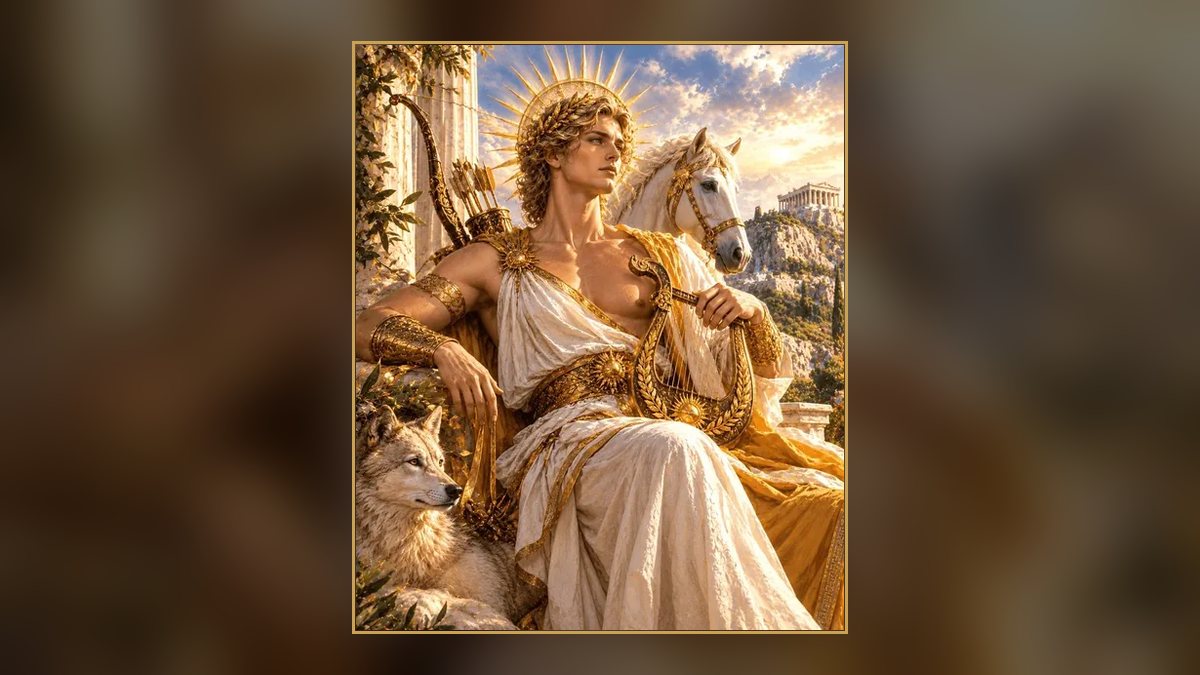
If you walk to the top of the sanctuary at Delphi, past the treasuries and up the long slope to the theatre, you will find yourself looking down on a deep valley and across to the opposite cliffs. It is a dramatic place, and it was the home of the most famous oracle in the ancient world. In it, the god Apollo gave answers to anyone who came to ask. And the name he used for that work was Loxias.
Loxias is a title that seems to come from the Greek word loxos, which means slanting or crooked. Ancient writers explained it in several ways, and the one that stuck was the simplest: Apollo’s answers were oblique. They did not go straight at the question. They bent. And the more famous the oracle became, the more the title was understood as a joke told with a straight face.
How the oracle worked
The mechanics were as follows. The visitor travelled to Delphi, waited for one of the set days when the oracle was open, paid a fee, made a sacrifice and, if the omens were good, was allowed into the temple to ask his question. The answer came from a woman called the Pythia, who sat on a tripod in the inner room, above what ancient writers described as a chasm in the floor. She was an ordinary woman from the town, chosen for the job, and she spoke while the god was thought to be present in her. Priests then shaped what she said into verse or into plain statements and gave it to the questioner.
We do not know exactly what she experienced, and the ancient accounts disagree. What matters is that the answer reached the visitor as a bundle of words that had to be interpreted, and that interpretation was where the trouble began.
The empire that fell
The most famous example concerns King Croesus of Lydia, in what is now western Turkey. He was enormously rich, and he was thinking of attacking the Persians, who were growing in strength to the east. Before he made his move, he sent gifts to Delphi and asked whether he should go to war. The oracle replied that if he crossed the river Halys, he would destroy a great empire.
Croesus took this as a yes. He crossed, he fought, and he lost. The empire he destroyed was his own. When he sent angry messengers to complain, the oracle’s answer was cool. He should have asked which empire, and he had not. Herodotus, who tells the story, treats it as a model of how a god speaks: truthfully, and in a way that you can only understand when it is too late.
The wooden wall
A better ending came in 480 BCE, when a huge Persian army was marching on Athens. The Athenians sent to Delphi in fear and were given a grim reply. They were told to flee to the ends of the earth, because their city was doomed. They went back and asked again, and received a second answer. It was that a wall of wood would keep them safe, and that holy Salamis would bring death to many mothers’ sons.
Nobody could agree on what the wooden wall meant. Some thought it referred to the thorn hedge that had once surrounded the Acropolis, and prepared to fight there. A leader named Themistocles argued that it meant ships. He also pointed out that the oracle called Salamis holy, not cruel, so the deaths would probably be Persian ones. The Athenians trusted his reading. They put their fleet at sea, fought in the narrow strait by Salamis, and won. The oracle had been right both times. The only question was who read it correctly.
The prophecy no one could dodge
A darker story is that of Oedipus. A king of Thebes named Laius was told by the oracle that his child would kill him and marry his wife. He gave the baby away to be left on a mountain to die. The shepherd who took the child could not do it, and the boy grew up in another city. When he was grown, he too consulted the oracle, and heard the same terrible words about himself. He fled from the place he thought was home, and on the road he killed an old man in a quarrel, and later he arrived in Thebes. It was exactly the fate that both father and son had run from.
In this story the answers are not oblique at all. They are brutally plain. But the effect is the same. The prophecy is true, and hearing it does not help. The attempt to avoid it is the thing that makes it happen. That, too, is a kind of slanting. The god tells you the truth, and what you do with it is your own business.
Words carved above the door
Another side of the god is in the sayings that were said to be carved on the temple. Know yourself. Nothing in excess. They are plain, and they were meant as advice from the god to everyone who came. The philosopher Heraclitus, who lived around 500 BCE, summed up the paradox neatly. The lord whose oracle is in Delphi, he said, neither speaks out nor hides his meaning, but gives a sign. That is a fair description of the title.
A name for the cautious
I find Loxias a very comforting epithet, in an odd way. It admits something that most religions try to hide. The gods are not simple. They do not give us what we want, in the form we want it, and a prophecy is not a promise. A person who consults an oracle is asking to be told something about a future that is not fixed. The best he can hope for is a sign, and an obligation to think hard about it.
When the Greeks called Apollo Loxias, they were not accusing him of lying. They were reminding themselves that the truth, when it comes from something larger than you, will probably be at an angle. You are meant to look at it from where you stand, and turn it, and ask which way is straight.