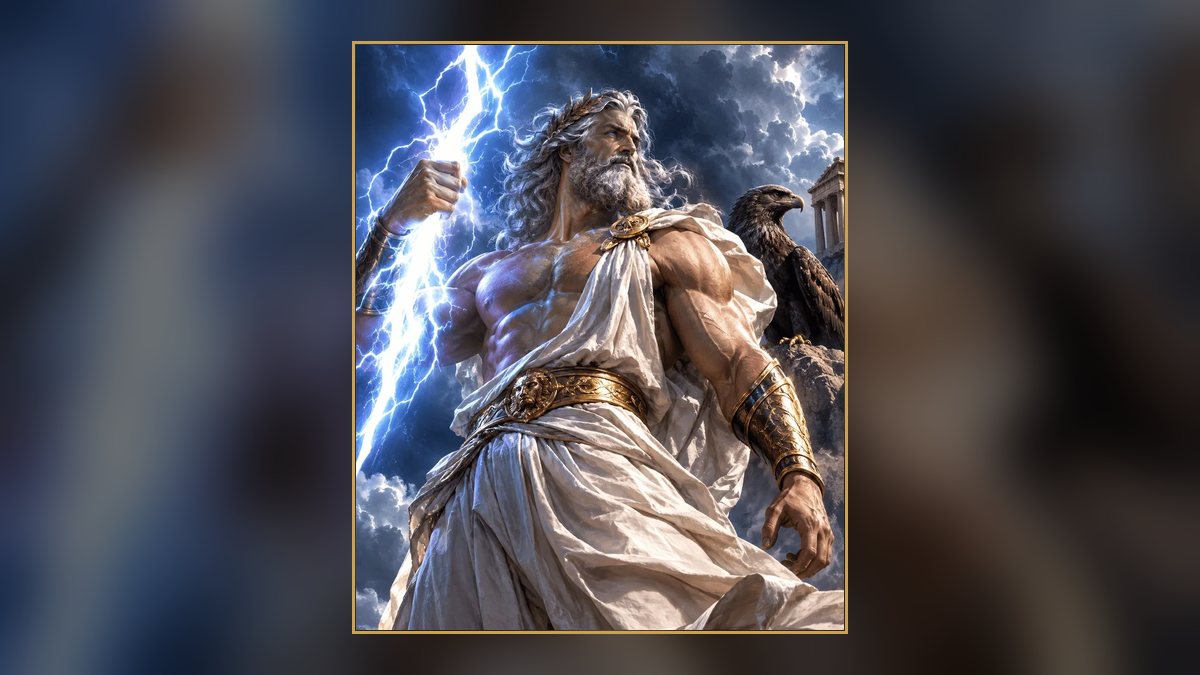
Some titles of Zeus are about what he does. Olympios is about where he is. It means he of Olympus, and it is probably the most widely used of all his names, to the point that the whole family of gods ended up being called the Olympians. If you have ever wondered why that mountain, of all mountains, there is a long answer, and it begins with how the Greeks looked at it.
Olympus stands in the north, on the border between Thessaly and Macedonia, and it is the highest mountain in Greece, at about 2,900 metres. It is not a gentle hill. It rises almost straight from the coastal plain, so that from the sea it looks like a wall, and its summit is covered with snow for much of the year. Clouds gather around its peaks even on days when the sky elsewhere is clear. For anyone living in the valleys below it, the mountain was the place where weather was made. It was easy to believe that the one who sent the lightning lived at the top.
From a peak to a palace
The earliest poems treat Olympus as both a real mountain and a palace in the sky, and they do not worry about the difference. In Homer, the gods have houses there, built by the divine smith. They feast on nectar and ambrosia, quarrel in assemblies, and watch the fighting at Troy from above. A mortal could, in principle, walk to the foot of the mountain. He would not be allowed any further.
As Greek geography grew more precise, the idea stayed. By the classical period people knew that Olympus was a mountain like any other, and that no palace stood on its top. The poets just moved the home upward. It became a place in the high air, above the peaks, reachable only by gods. The name stuck to Zeus, and to a long list of his children, as a shorthand for the divine order. A god was Olympian if he belonged to the ruling circle, and that included some who in fact had little to do with the mountain.
Zeus at Olympia
A confusing detail is that there is another place with almost the same name. Olympia is a sanctuary in the western Peloponnese, in a green valley beside the river Alpheus, far from the mountain. It was devoted to Zeus, and it was where the Olympic Games were held. The Greeks traditionally dated the first games to 776 BCE, and they went on for more than a thousand years.
At the heart of Olympia stood a temple of Zeus, and in it a statue made by the sculptor Pheidias around 435 BCE. It showed the god seated on a throne, with a figure of Victory in one hand and a sceptre in the other. It was made of ivory and gold, and it was so large that visitors said that if he stood up he would take the roof off. Ancient writers counted it among the seven wonders of the world. Nothing of it survives, but the workshop where it was made has been excavated, and archaeologists have found the moulds and a cup with a name scratched on it, which says: I belong to Pheidias.
A truce was proclaimed across the Greek world before each festival, so that athletes and spectators could travel safely. Wars paused. For a few weeks, Zeus Olympios was the god of a peace so well observed that it is almost unbelievable, and his name stood for it. The games were, in that sense, a form of worship. The athletes did not compete for money. They competed for a crown of olive leaves, and for being able to say they had been the best in front of the god.
The temple in the city
Athens had its own sanctuary for Zeus Olympios, the Olympieion, by the river Ilissos, not far from the Acropolis. It has a messy history. A tyrant began it in the sixth century BCE and the project was abandoned when he fell from power. For centuries it stood half-finished, with columns lying around. Roman rulers took an interest, and in the second century CE the emperor Hadrian finally completed it, with the help of some very rich benefactors.
Today only a handful of its huge columns remain upright, each one more than seventeen metres tall. They stand in a quiet park, and if you stand under one and look up it is not hard to imagine why the building took so long. The Greeks wanted to build something that matched the size of the title.
Climbing it
For most of history nobody tried to reach the top of the real mountain, and it is worth remembering how recently it was done. The summit of Olympus was first climbed in August 1913, by a Swiss photographer, a Swiss writer and a local hunter from a village at the foot of the mountain, who led them up. They were not looking for a palace. They wanted the view, and they got it. Even so, the people who live near the mountain still talk about it as if it had its own mind, with its own weather and its own moods, and anyone who has watched a storm gather around its peaks understands why.
Why one name covers so much
What strikes me about Olympios is that it works at three scales at the same time. It is a mountain you can see, a sanctuary you can visit, and an idea that gathers all the gods under one roof. The Greeks were not worried about the overlap. They were comfortable with a god who is everywhere and also at one address.
That flexibility is why the title survived. A Roman could use it, and so could a poet writing a thousand years after Homer. The Olympian gods are still the first thing most people mean by Greek mythology, and the mountain they are named for is still there, with clouds on its head, looking exactly as it looked when the first herdsman glanced up from the plain and decided that something important lived at the top.