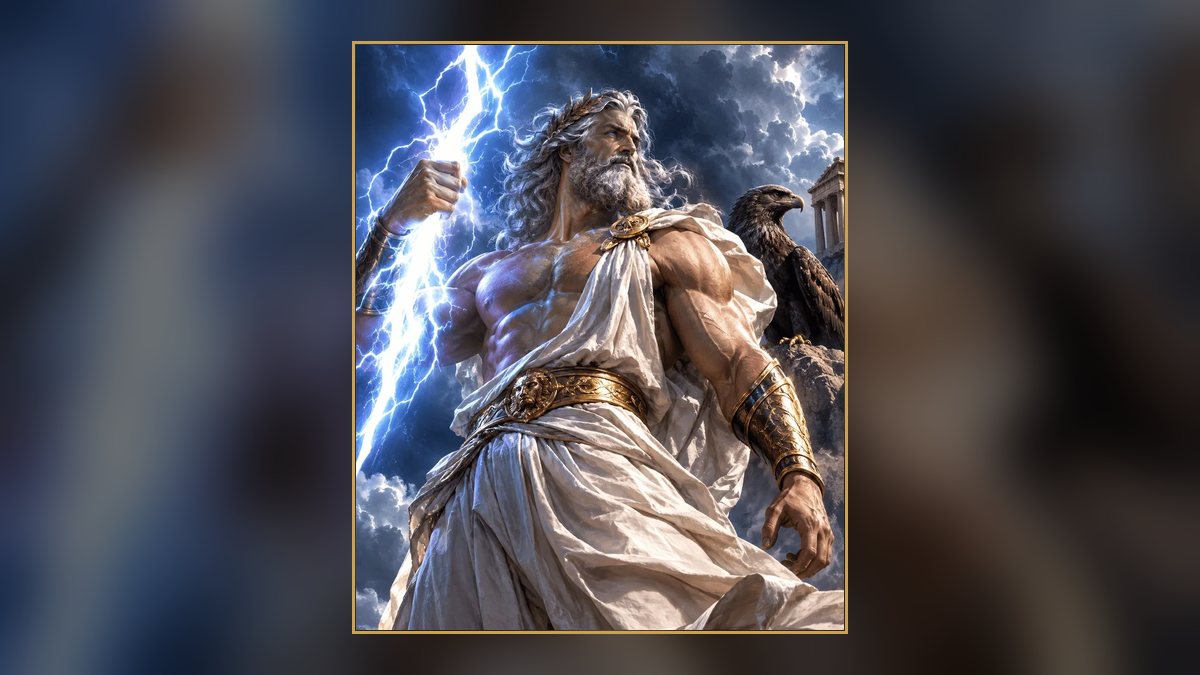
Imagine travelling in a world with no hotels, no reliable roads and no police. You arrive in a town late in the day, hungry and tired, and you know nobody. What stops the first person you meet from robbing you or leaving you to freeze? In ancient Greece, the answer was a god. Zeus Xenios was the protector of strangers, and the rule he enforced was called xenia, a word we can translate as guest-friendship, though it covered more than that.
The idea was simple and the stakes were enormous. A stranger who asked for shelter was to be fed, washed and given a bed before anyone asked who he was. The host owed him that, and in return the guest owed him respect and no harm. The two exchanged gifts, and the bond could pass down through families. A man whose grandfather had once been fed by a stranger’s grandfather might meet him on a battlefield a century later and refuse to fight.
The rule enforced by the sky
What made xenia work was fear. The Greeks believed Zeus himself stood behind every stranger. In the Odyssey, Odysseus, trapped in the cave of the Cyclops, begs the giant for mercy and reminds him that Zeus is the avenger of suppliants and guests. The Cyclops laughs. He says his people do not care about Zeus or any of the blessed gods, because they are stronger. That reply is the poem’s way of showing he is a monster. A civilised person knows that a guest is under divine protection, and a monster does not.
The poem comes back to this idea again and again. Eumaeus the swineherd, who has very little, tells the beggar at his hut that all strangers and beggars are from Zeus, and that a small gift is welcome. The beggar is Odysseus in disguise. When he reaches his own palace, the suitors who have been eating his food and insulting visitors are doing the opposite of xenia, and the whole poem is a countdown to their punishment. It is not simply revenge. It is the god’s law being enforced.
When the rule breaks
The Trojan War itself begins with a violation. Paris is welcomed as a guest in the house of Menelaus at Sparta, eats at his table, and leaves with his host’s wife and a good deal of his treasure. In the eyes of the Greeks this was not just an elopement. It was the worst thing a guest could do. Menelaus himself says in the Iliad that Zeus Xenios will bring ruin on the Trojans because of it, and the whole ten years of the war can be read as the slow working out of that anger.
Other myths are smaller but just as sharp. A king of Arcadia named Lycaon, to test whether Zeus could really tell a god from a man, served a guest a dish made of human flesh. Zeus, who was the guest, overturned the table, struck the house with lightning and turned Lycaon into a wolf. A kinder story is the myth of the old couple Baucis and Philemon, who shared their last food with two strangers who turned out to be gods. Everyone else in the village had shut them out and was drowned in a flood. The couple’s cottage turned into a temple, and they were allowed to serve in it for the rest of their lives.
More than a myth
What gives this epithet its weight is that it was practical. Greek cities had formal arrangements of guest-friendship between families and between states, and a man who held such a bond was called a xenos. A man in Athens might serve as the official friend of a foreign city, looking after its visitors, and he was called a proxenos. Travellers carried half of a broken token, called a symbolon, and a host could match it to the other half held by an old friend’s family. That is where the English word symbol comes from.
Even the rituals of the meal had sacred weight. The first thing offered to a guest was water for the hands and a seat at the hearth, which was itself a holy place. To harm someone who had touched it was a sacrilege that could pollute a whole household.
A scene worth remembering
One of the best moments in the Iliad shows how deep the idea ran. Two warriors, Glaucus and Diomedes, meet in the middle of a battle and are about to fight. Diomedes asks who Glaucus is, and Glaucus gives a long speech about his ancestry. It turns out that Diomedes’s grandfather once entertained Glaucus’s grandfather at his home, and the two exchanged gifts. Diomedes plants his spear in the ground, and says they should avoid each other’s spears for the rest of the war. They swap armour. Glaucus gives gold and Diomedes gives bronze, which the poet says shows Zeus had taken Glaucus’s wits.
It is funny, and it is touching. Two men on opposite sides stop in the middle of a battle because something older and stronger than the war says so.
Who comes in first
There is a detail in the Odyssey that shows how seriously the code was taken in practice. When young Telemachus arrives at Pylos looking for news of his father, the old king Nestor does not ask who he is. He seats the visitors, gives them wine and meat, lets them finish, and only then, after they have eaten, says that now it is proper to ask their names. Menelaus does the same at Sparta. The order is fixed. The meal comes first, because a stranger who is hungry has a claim, and a question about identity might sound like a condition. It is a small piece of etiquette, but it is the same principle as the god’s: you do not make a guest earn his supper.
Why it still matters
The name Xenios tells you that for the Greeks, morality had a gate. It started at your door, and it started with the stranger. Their sense of what it meant to be civilised, to be fully human, was bound up with how you treated someone who could do nothing for you. And the way they kept that idea alive was not a rule on a tablet. It was a god, standing quietly behind the traveller, who remembered who had been kind.