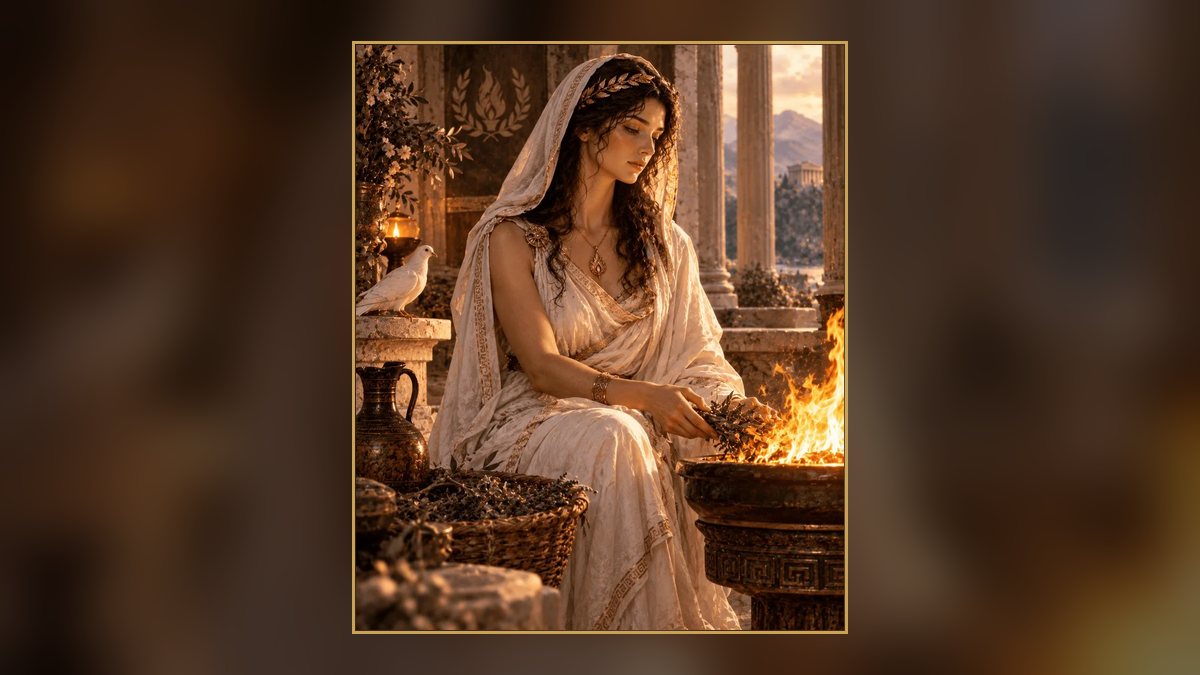
Every Greek house had a hearth, and every hearth belonged to Hestia. The same was true of the city. A Greek town was thought of as a very large household, and like any household it needed a fire at its centre. The building that held that fire was called the prytaneion, and the epithet Prytaneia names Hestia in her role as its keeper. The word is built on prytanis, a chief or presiding officer, so it means roughly the goddess of the presidents’ hearth, the one that the whole community shared.
What happened at the town hearth
The prytaneion was part town hall, part dining room and part shrine. In many cities the magistrates who presided, the prytaneis, ate their meals there at public expense. Foreign ambassadors were fed and entertained there, and the building was where visiting dignitaries first met their hosts. In the middle of the main room was the common hearth, with a flame that was supposed to stay lit all year.
Athens also used the building to honour its heroes. Winners at the Olympic Games, descendants of the tyrant-slayers Harmodius and Aristogeiton, and others the city wanted to thank were granted sitesis, free meals in the prytaneion for life. When Socrates was on trial for his life and was asked to name his own penalty, he claimed in jest that what he deserved was exactly this, meals at the public hearth, as a man who had given the city more than any Olympic victor.
A hymn for a new officer
The clearest early statement of the idea is in a poem by Pindar, his eleventh Nemean ode. It was written to mark the day a young man named Aristagoras took up office as president of the island of Tenedos. Pindar opens, though, with a prayer to Hestia. He calls her the daughter of Rhea, the sister of Zeus, the goddess whose lot was the city’s hearth, and he asks her to receive the new officer kindly.
Nothing else in the poem appears more traditional. Before the speeches and the praise of the man, the poet turns to the fire, because it was the place where all of that would begin.
The fire that was never put out
The best-preserved example of a prytaneion is the one at Olympia. Pausanias describes it. Inside was the hearth of Hestia, with an altar heaped with ash from the burnt thighs of sacrifices. The fire on it was never allowed to go out, day or night, and the priests tended it all year. Olympic victors were feted in the same building, and the ashes were used to make a paste for the greatest altar in the sanctuary, the altar of Zeus.
That endless fire explains a good deal about the goddess. Hestia was the one who stayed in. In Greek myth the other gods roam, and she is the one at home, who never takes sides in a quarrel and never leaves her seat. A flame that must not go out is a good picture of that.
Carried to a new land
When Greeks founded a colony overseas, they took their religion with them, and later writers say that the settlers carried live coals from the mother city’s common hearth to light the first fire in the new town. Historians are cautious about how widespread this was, but the idea shows how the Greeks saw the matter. A colony was a daughter city, and it received its flame from its mother.
The fire was also the origin of other customs. A newborn child was carried around the household hearth when it was a few days old, in a ceremony called the Amphidromia, to receive it into the family. A bride was led around it when she entered her husband’s house. At a sacrifice, Hestia was named first and last. Plato says in the Cratylus that it was usual to begin with her, and one of the Homeric Hymns to her says that no feast among mortals is complete unless a libation is poured to her at the start and the finish.
The night every fire went out
The most dramatic story concerns the war against Persia. After the Greeks won at Plataea in 479 BCE, the oracle at Delphi gave them an order. All the fires in the country had been defiled by the barbarians who had burned temples and houses, and they should be put out. New fire, pure, should be brought from the common hearth at Delphi. Plutarch tells the story, and he adds that a man named Euchidas ran from Plataea to Delphi and back in a single day to fetch it, and then died of exhaustion.
Whatever the details, the tale makes a clear point. If a city’s hearth was a symbol of its life, a polluted flame was a polluted city, and the cure was to start again from the one source all Greeks accepted. The Delphic hearth was the hearth of Greece.
Why a fireplace
Of all the titles in this set, this is the least glamorous, and perhaps the most revealing. It is easy to think of a goddess as a being with powers and a story. Hestia has hardly any story at all. What she has is a place, and the place is a fireplace in a public building, where officials ate lunch and visitors were fed. Prytaneia is the name for that place.
It says that a city begins with a shared fire and a table and a promise to feed whoever comes. Everything else, the laws and the walls and the wars, was built around a small flame that somebody had to keep alight.