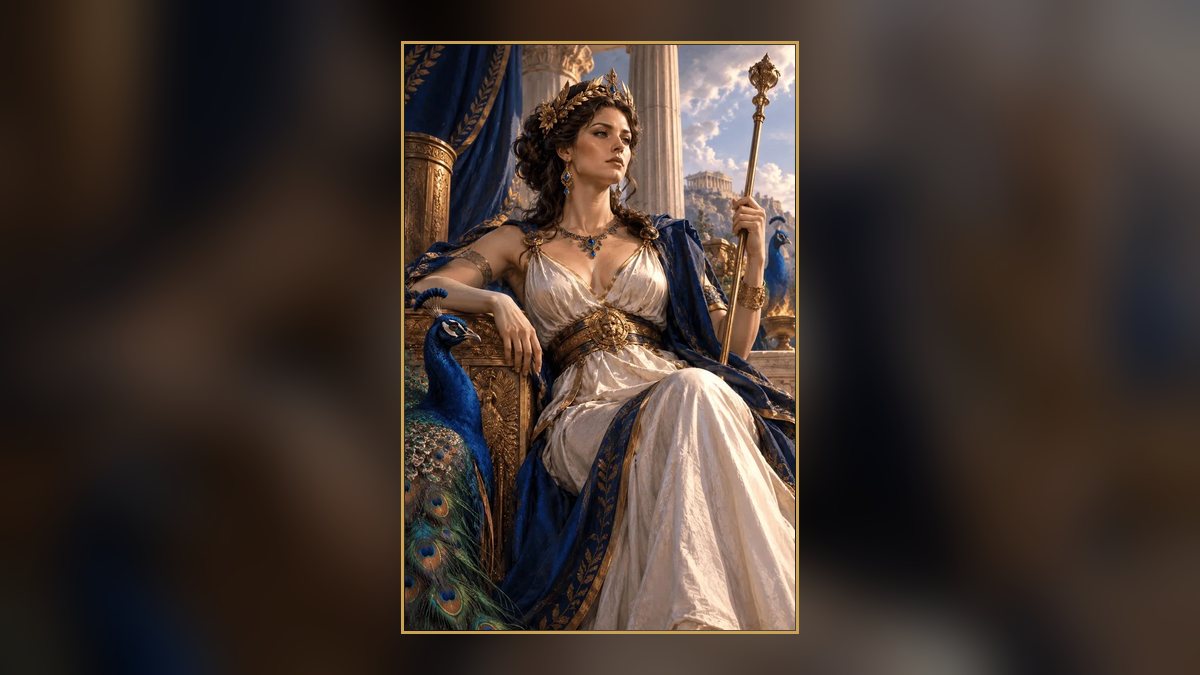
In Greek, the word teleios is used for things that have reached their end and are all the better for it. A full-grown animal was teleios, and so was a perfect offering with no flaw in it. A mature adult was teleios too. It grows from telos, which means an end or a goal, the point a thing was always heading toward. When the Greeks added the feminine form to Hera’s name, they were giving her a title like the one who completes, or the one who brings a matter to its proper end. And the matter in question, nearly every time, was a marriage.
For a Greek girl the road ran in one direction. She was a parthenos while she lived in her father’s house, and she became a full woman when she moved into her husband’s. Hera stood at that threshold. She was not the goddess of love, who belonged to Aphrodite, or of childbirth, who belonged to Eileithyia and Artemis. She was the goddess of the arrangement itself, the lawful union with its vows and its household and its place in the city.
Offerings before the wedding
Our best list of the customs comes from Pollux, a scholar of the second century CE who collected words and rites from older writers. He says that before a wedding the family made preliminary sacrifices, called proteleia, to Hera Teleia along with Artemis and the Fates. A bride might also cut off a lock of her hair or give her childhood toys to a goddess, which marked the end of one life and the start of the next.
Athens even built its year around her. The month of Gamelion, roughly January into February, took its name from gamos, marriage, and a festival of the sacred wedding of Zeus and Hera was kept in it. Plenty of Athenians chose to marry in that month, so the whole city was, in a loose way, marrying with her.
A pledge argued in court
The most striking use of the title is in Aeschylus’s play the Eumenides, where Orestes is put on trial for killing his mother. The Furies, who chase people who shed kindred blood, say they have no quarrel with Clytemnestra, because the husband she murdered was not her blood relation. Apollo, defending Orestes, answers them sharply. By that reasoning, he says, they are setting aside the pledge of Hera Teleia and Zeus, and the marriage bed is something fate itself guards, stronger than any oath.
Whatever one makes of the argument, it shows what the title was understood to cover. Hera Teleia was the guarantor of the marriage promise, the one to whom a broken vow was an offence. Her anger at Zeus’s affairs in the myths looks different once you read it this way. She is the injured party in a case the whole Greek world would have recognised.
Three Heras in one village
Pausanias, who toured Greece in the second century CE, saw something unusual at Stymphalos in Arcadia. A local story said that a king named Temenus raised Hera there, and that the place had three sanctuaries to her at three points in her life. In the first she was called the girl, pais. In the second, after her marriage to Zeus, she was Teleia. In the third she was called the widow, chera, after a quarrel in which she left Zeus and went back to Stymphalos.
The scheme is neat. The goddess moves through a life as a human woman would, from childhood through marriage to a separation, and each stage has its own name and its own house. Teleia sits in the middle, the full adult, neither beginning nor ending.
The doll that fooled a goddess
Near Plataea, in Boeotia, a festival called the Daedala acted out another version of the quarrel. The story goes that Hera, angry with Zeus, had gone off to Euboea and refused to come home. Zeus asked advice from Cithaeron, the local king, who told him to make a wooden figure, dress it in a bridal veil, and drive it through the country in an ox cart, saying that he was about to marry again.
Hera heard the news and came rushing back. She marched up to the cart, tore the veil off the bride, and found a block of carved oak. She laughed so hard that she was reconciled with Zeus on the spot. Plataea kept the memory alive with a procession that carried a wooden figure in a wagon, and later the wooden images were burned together in a great bonfire.
Pausanias says there was a temple of Hera Teleia at Plataea, so the two traditions lived side by side. A city that honoured the keeper of marriage also enjoyed the story of her being fooled at her own wedding.
A bride who stays new
One last strange detail comes from Nauplia in the Argolid. Pausanias reports that there was a spring there, Kanathos, in which Hera was said to bathe each year and become a maiden again. The same goddess who completes brides is renewed every year, as if completion were something that has to be done over.
That is probably how the Greeks heard the word. Teleia did not mean finished and put away. It meant carried through to its proper end, and then ready for the next round. A marriage in this picture is a settled thing with a long future, and the goddess who watches it is both the mature queen of heaven and a bride every spring.