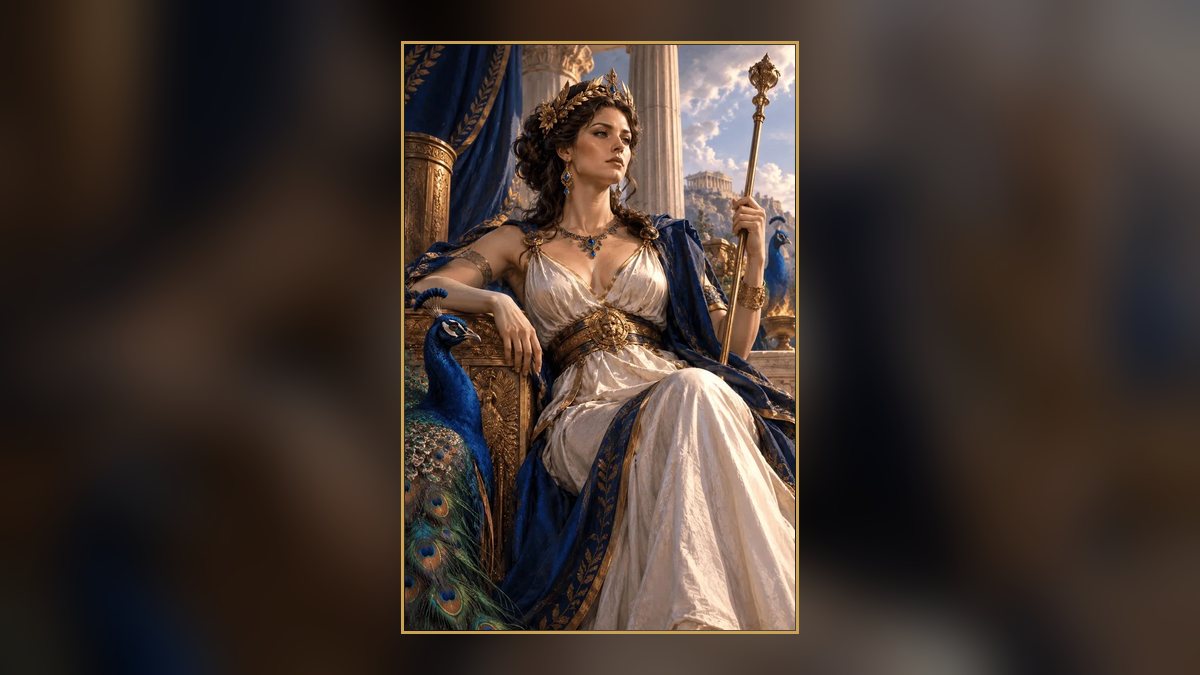
Homer has a habit of calling the Greek army the Argives. He does it so often that it hardly seems to refer to a city anymore. And when Hera speaks in the Iliad, she calls herself Argive Hera, and the poet gives her the same title when she appears on the Greek side. She and the soldiers share a name. In the grandest sense, Hera Argeia is the goddess of the people who sailed against Troy.
But the name comes from a place, and the place is worth knowing. Argos sits in the northeast Peloponnese, on a broad plain that runs down to the sea, and about eight kilometres from the town, on a hill above the fields, stood the Heraion, the goddess’s main sanctuary. It was reached by a road and by procession, and it was the sort of shrine that people travelled to on purpose.
A hundred oxen and a shield
Each year the Argives held a festival for Hera, the Heraia, with a long procession from the town up to the temple. The sacrifice was a hundred oxen, and from that the festival also picked up the name Hekatombaia. There were athletic contests, and the prize was a bronze shield, a fitting thing to win in a city famous for its soldiers. The priestess of Hera made the journey in a cart drawn by oxen.
That detail leads straight to the best-known story about the sanctuary, which Herodotus puts into the mouth of the Athenian statesman Solon.
The sons who pulled the cart
One year, the story goes, the oxen were late. A priestess named Cydippe could not afford to miss the ceremony, and the festival would not wait for her. Her two grown sons, Kleobis and Biton, both athletes, put the yoke on their own shoulders and pulled the cart themselves, the whole forty-five stadia to the temple, which is something like eight kilometres. The crowd was delighted. People praised the strength of the young men and called the mother lucky.
Cydippe stood in front of the goddess’s image and prayed that Hera would give her sons whatever was best for a human being. The two young men then lay down to sleep in the temple after the feast, and they did not wake up. Herodotus uses the episode to make a point to King Croesus: the goddess had shown that it was better to be dead than alive, because they had died at the height of their glory.
The Argives, he adds, had statues made of the brothers and sent them to Delphi. Two archaic kouros figures found there in the nineteenth century are generally taken to be those very statues, short and thickset, and one base names an Argive sculptor.
A calendar kept by priestesses
The Heraion had another job. The priestesses of Hera at Argos served for long periods and were listed one after another, and a writer named Hellanicus compiled the list into a book. That gave Greek historians a way to date things when no common calendar existed. Thucydides uses it to fix the start of the Peloponnesian War, saying that it began in the year when Chrysis had been priestess for forty-eight years.
That is a surprising kind of fame. A woman serving a goddess in a temple outside town became the reference point for a world war.
The fire
Chrysis appears again in Thucydides, in a darker context. In the summer of 423 BCE the old temple was burned to the ground. Chrysis had put a lit lamp near the garlands and gone to sleep, and the garlands caught fire. She was not hurt, and she fled to Phlius before the Argives could decide what to do with her.
A very ordinary accident, set down in the same dry tone as the battle reports around it. And its cost was enormous. The temple that went up was an old one, and the one that replaced it was a new building, put up by the architect Eupolemos, with a famous statue inside. That statue was the work of Polykleitos, in gold and ivory, and Pausanias describes it in some detail. Hera sat on a throne, wearing a crown decorated with the Graces and the Seasons, with a pomegranate in one hand and a sceptre in the other. On the sceptre perched a cuckoo, and the story went that Zeus had once turned himself into that bird to win her.
A goddess with an address
A title like Argeia changes how a god is pictured. We usually think of Hera as queen of heaven, a figure above the map. The name pulls her down to a particular valley, and it says that when the Argives sent their daughters to her shrine, they were visiting someone with a home there. The old wooden image in the earlier temple, according to Pausanias, was made of pear wood and had been carried from Tiryns.
The Greek gods could be universal and local at once, and their worshippers did not see a problem. Argeia is Hera as a neighbour, whose house was on the plain, whose priestess gave her name to the years, and whose festival ended with two young men asleep on the floor.