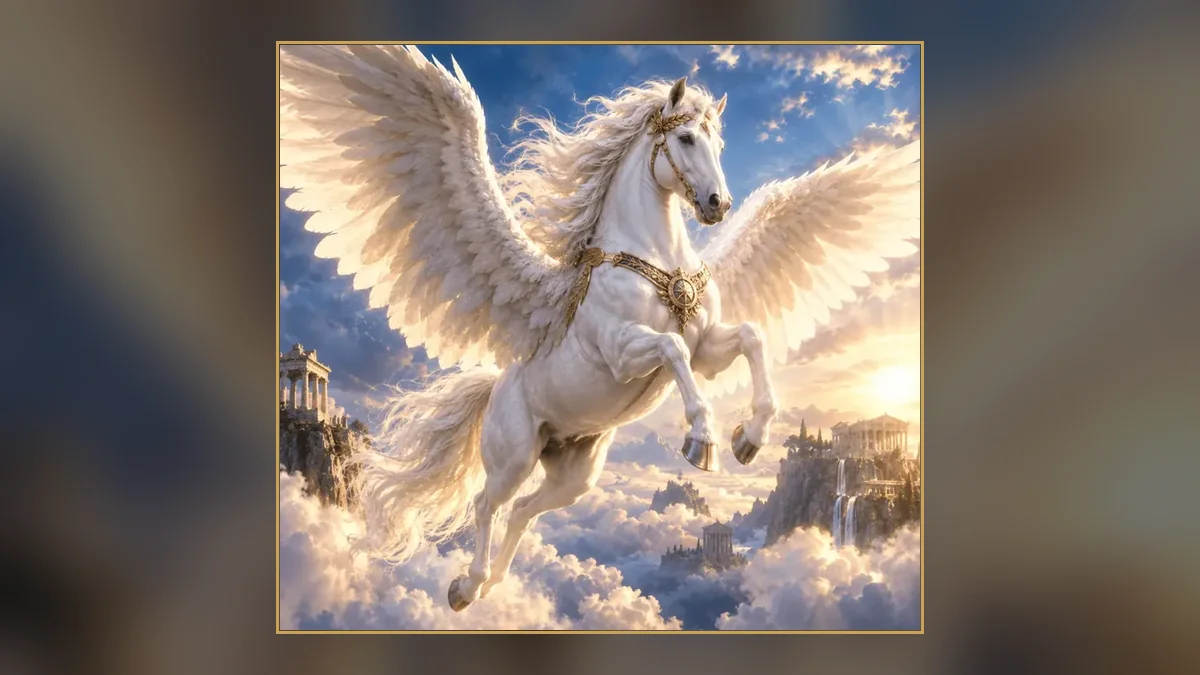
Pegasus is the most cheerful creature in Greek myth, and he comes from the grimmest origin. His mother is Medusa, killed in her sleep. His father is the god of the sea. He is born from the stump of a severed neck, and the moment he is free he does something nobody else in the story does: he goes upward. Over the years the winged horse has become a symbol of inspiration, poetry and freedom, and it is easy to forget how odd his beginning was. This article goes back to it.
Born from a death
Hesiod tells it in the Theogony, in a few plain lines. Poseidon lay with Medusa in a soft meadow among spring flowers. Then, when Perseus cut off her head, the great Chrysaor and the horse Pegasus sprang out of her. Apollodorus, writing much later, adds the logic that readers have always assumed: Medusa was pregnant when she was killed. The children did not come from the head, exactly, but from the place the head had been.
Chrysaor means something like the man with the golden sword, and he is a minor figure who goes on to father the three-bodied Geryon. Pegasus is the one who matters. Hesiod gives him no speech and no motive. The poet says only that the horse flew away, left the earth and went to the home of the immortals, and that he lives in Zeus's house, where he carries the king's thunder and lightning. Later poets liked to picture that house as a stable.
Where the artists put him
The earliest pictures keep him exactly where the poem does, beside his mother. On the pediment of the temple of Artemis at Corfu, carved around 580 BCE, a huge Medusa runs across the centre with a wide grin and her tongue out, and on either side of her, small and almost casual, stand her two children, Pegasus and Chrysaor. Nothing about the scene suggests a birth in agony. It looks like a family group, the mother in the middle with a child on each side, as though the sculptor wanted the viewer to see the monster and the parent in the same figure.
Vase painters of the same century preferred a different moment. They show a small winged horse rising out of the severed neck while Perseus hurries away with the head in a bag. The painters chose, again and again, to put the horse in the picture at the instant of the killing, so that the death and the new life share a single frame. The Greeks plainly did not think of the two as separate stories.
A name that means springs
Hesiod also explains the name, with a bit of Greek wordplay. Pegasus was called that, he says, because he was born near the springs of Ocean, and the Greek word for springs is pegai. A winged horse is named after fresh water coming out of the ground. That is worth holding onto, because the horse's whole mythology keeps coming back to springs.
The most famous is Hippocrene, the horse's fountain, on Mount Helicon in Boeotia. Hesiod himself opens the Theogony on that mountain, with the Muses washing in the streams of Permessus, Hippocrene and holy Olmeius. His poem does not say how Hippocrene got its name. The story that Pegasus struck the rock with his hoof and made the water gush up is told later, by Ovid and by the travel writer Pausanias, and it took a while for the poetic idea to settle: the horse's footprint is a spring, and the spring is where poems come from.
The hoof and the trident
Here is my own reading, and no ancient writer says it outright. Pegasus's father, Poseidon, makes springs by striking rock. In one story he drives his trident into the ground for the girl Amymone, and fresh water pours out at Lerna. In the Athenian tradition he strikes the Acropolis and a salt spring appears, in his contest with Athena for the city. Now his son does the same thing with a hoof. Father and son share a signature move, which is to hit the earth until water arrives.
That makes sense of an odd feature of the myth. Poseidon is not only the god of the sea. The Greeks also worshipped him as the god of horses, of earthquakes and of fresh springs. These look unrelated, but if you have ever seen a horse paw at the ground, or a spring break out of a hillside after a tremor, they are not. Pegasus is where all of these Poseidon things meet in a single animal.
Bellerophon and the bridle
For most of the story, Pegasus is a means of transport. The hero who needed him was Bellerophon, who had been sent to kill the Chimera and could not do it on the ground. Pindar, in his thirteenth Olympian ode, tells how the seer Polyidus told the young man to sleep at the altar of Athena. In the night, the goddess appeared in a dream and gave him a golden bridle. He woke with the bridle in his hand, and went to find the horse, which he found drinking at the spring of Peirene in Corinth, where Pegasus liked to come for water.
Notice what the bridle is. It is a gift from Athena, the goddess of crafts, and the whole scene is about the thing that a skill can do when a wild animal cannot be forced. Bellerophon does not catch Pegasus. He is given the means to be accepted. The horse lets himself be bridled, and rider and mount fly out to meet the Chimera from above, where her fire cannot reach.
The horse who kept flying
The ending belongs to the rider, not the horse. Bellerophon, proud of his success, tried to fly Pegasus all the way up to Olympus. Pindar says, in another ode, that the horse threw him. Bellerophon fell to earth and, in the Iliad's version of his later years, wandered alone across a plain hated by the gods.
And Pegasus? He kept going. He went on up to Olympus, where Hesiod says he lived in the house of Zeus. This is the detail that I find most telling: the horse was never the problem. He served the greatest hero of his age, then threw him when the hero asked for too much, and he ended up serving the king of the gods. No hero killed him, no god punished him, and no one ever owned him for long.
My reading: what Medusa was carrying
Now to the interpretation I mentioned at the start, which is mine and not an ancient one. The standard telling of Perseus's story is a story of a hero beating a monster. But look at what the killing produces. A horse. A brother. Two beautiful and powerful creatures, one of whom is the most admired animal in Greek mythology. Medusa is the dangerous one in the story, and in her death, she delivers the only purely good thing in it.
That does not make the killing any less necessary in the story's own terms. But it adds a complication that the myth seems to know about and not discuss. Medusa has her own tragedy, which Ovid tells at length, as a woman who was assaulted and then punished for it. What Hesiod records is that she was also a mother, and that what came out of her was radiant. The monster in the story is the container for something that has no menace in it at all.
The coin of Corinth
The Corinthians were so fond of the horse that they put him on their money. Corinthian silver staters carried a picture of Pegasus from around 570 BCE, and they stayed in circulation for centuries. The coins were so recognisable that the Greeks called them colts, and merchants around the Mediterranean accepted them readily. There is something fitting about it. The winged horse who would not be owned became the sign that a payment was good.
The city also told the story that Bellerophon had been a Corinthian, and the spring of Peirene, where he found the horse, was one of the city's great fountains. A myth, a spring and a coin all pointed to the same animal. Corinth wanted a winged horse because it had a real fountain to put him at.
In the sky
Pegasus ended among the stars, as one of the great northern constellations. The shape is easy to find in autumn: four bright stars forming a huge square, with the horse's head and legs trailing off from one corner. The Greeks said Zeus put him there in honour of his service, and the story is old enough that the constellation still carries his name in the international list of constellations.
What he is for
Most monsters in the Greek bestiary are dangers to be solved. Pegasus is a gift to be accepted. He appears at the exact moment a horror ends, and he points in the other direction, up and out and away from the ground. I think that is why he stuck, long after the Chimera and the Hydra had faded into the background. He is the proof, inside a very violent mythology, that something can come out of the worst places and be good, and that it will not stay where it was born.
Comments
Sign in to join the conversation.