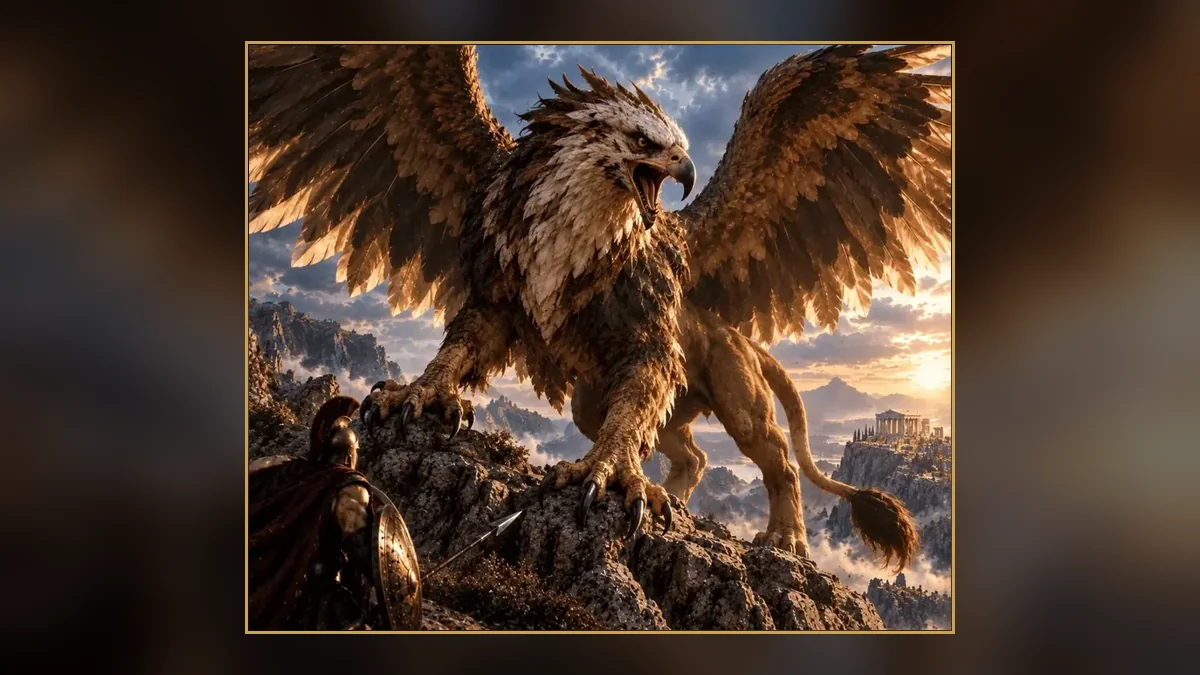
The griffin is a lion with an eagle's head, wings and claws, and it has a job: it guards gold. That sounds like a fantasy, but the Greek sources are oddly specific about where the gold was, who tried to steal it, and who told the story. The tale comes to us through a series of travellers and tribes, and a closer look at that chain suggests the monster may have had a practical purpose. This article follows the griffin from the far north of the Greek world back to the people who needed it to exist.
A lion's body, an eagle's wings
Pausanias gives a short, matter-of-fact description when he is talking about the statue of Athena in the Parthenon, whose helmet carries griffins. They are creatures like lions, he says, with the beak and wings of an eagle. He adds that, according to the poet Aristeas, they live in the far north and guard gold, which the one-eyed Arimaspians try to steal.
That is the standard picture across the ancient world, and it is a good one. The lion is the strongest hunter on the ground, and the eagle is the keenest hunter in the air. Put them together and you have a creature that nothing can approach unseen and nothing can overpower. As a guard, it is hard to improve on.
North of the Scythians
The oldest source is a lost poem, the Arimaspea, attributed to Aristeas of Proconnesus, who is said to have lived in the seventh century BCE. We know it only through Herodotus, who summarises its geography with open scepticism. Beyond the Scythians, Aristeas said, live the Issedones. Beyond them live the Arimaspians, a nation of one-eyed men. Beyond them are the griffins who guard the gold. And beyond the griffins, at the edge of everything, live the Hyperboreans, the people beyond the north wind.
Herodotus passes this on and then says he does not believe it. In another passage he writes that the northern lands of Europe have the most gold, but that he cannot say how it is obtained, and that people say the one-eyed Arimaspians steal it from the griffins. He adds that he cannot accept that there are men who are born with one eye and otherwise look like the rest of us.
The tragedian Aeschylus shows the story had become popular enough to be dropped into a play. In Prometheus Bound, the heroine Io is given a list of strange peoples to avoid on her journey, including the sharp-beaked, silent hounds of Zeus, the griffins, and the one-eyed Arimaspian cavalry who live by a river that carries gold. The phrase hounds of Zeus, in other words, is a very old title for these animals. Notice the word silent. A real watchdog announces itself by barking, and a thief can plan around the sound. A guard that makes no noise is the more frightening kind, because you only learn that it is there when it is already on you.
The one-eyed thieves
Herodotus gives a curious piece of language as well. He says the name Arimaspian comes from two Scythian words, arima, meaning one, and spu, meaning eye. If he is right, the one-eyed men were not a separate monster but a misunderstood name. People who were called one-eyes in a language the Greeks did not speak may have simply been named that by their neighbours, and the Greeks supplied the explanation.
We cannot test it. But it is a reminder of how much of Greek geography in the far north was built from translated rumour, each tribe passing a half-understood account to the next, and the Greeks at the end of the line writing it down.
A story from the supply chain
Now to the idea that I want to put forward. It is my own reading and not an ancient one, but I think it fits the evidence. Think about how gold from the Altai mountains in central Asia could reach a Greek city on the Black Sea. It did not travel in a single trip. It passed from one nation to the next, each one a middleman, each one buying from the people behind and selling to the people ahead. Herodotus describes the same chain for other goods from the north.
Every middleman in a chain like that has a strong interest in keeping the people in front of him from going straight to the source. The easiest way to do it is to tell them the source is guarded by something no one can get past. The Greeks themselves told a very similar story about cinnamon. Herodotus reports that Arabian traders claimed cinnamon sticks were gathered from the nests of enormous birds, and that the only way to get them was to leave out lumps of ox meat and wait for the birds to carry them off. Herodotus simply repeats the tale. The Roman writer Pliny, centuries later, was blunter: he said the stories about cinnamon were obviously made up by the traders to push up their prices.
Read that way, the griffin is a trade secret with wings. A terrifying guardian at the far end of the route tells every curious Greek that the supply is out of reach, and it is far more effective than a locked door. I cannot prove that the stories were deliberately invented. But a monster that sits exactly where a middleman would want one is at least a suspicious coincidence.
Bones in the Gobi
There is a second theory about where the idea came from, which has drawn a lot of attention. The American folklorist Adrienne Mayor argued in a book published in 2000 that the griffin legend was inspired by fossils. In the deserts of Mongolia and the Altai region, where ancient nomads prospected for gold, the ground is full of the bones of Protoceratops, a sheep-sized dinosaur with a beak, four legs, and a bony frill that could look like the base of a wing. Nests of eggs lie among the bones.
On this idea, Scythian miners who saw a beaked, four-legged skeleton with eggs sitting in a gold-bearing region reasonably concluded that some bird-like beast had nested there. It is a lovely idea and an influential one, and it has been challenged by other scholars, who point out that the griffin appears in the art of the Near East and Greece long before there is any evidence that fossil-hunters from Central Asia influenced them. The honest summary is that it may have contributed to the legend, but it is not the whole of it.
An older animal
In fact, the griffin is a good deal older than the Greek stories about the north. Griffins appear in Egyptian and Mesopotamian art, and Bronze Age Crete had them too. In the throne room at Knossos, painted griffins sit on either side of the throne, and a similar scene decorated the throne room at Pylos on the mainland. Whoever sat on those thrones was being guarded by the most dependable animal in the bestiary.
Later the Greeks used griffins as ornaments for the most prestigious offerings they could make. In the seventh century BCE, large bronze cauldrons topped with griffin heads were dedicated at Olympia, Delphi and Samos. Herodotus describes the most famous, a huge bronze bowl that the Samians gave to the temple of Hera, supported by three kneeling bronze figures and ringed with griffin heads around the rim. Whatever they had heard about the north, they knew that a griffin said something about wealth and power.
Apollo and the far north
The northern setting also tied the griffin to Apollo. The Hyperboreans, who lived beyond the griffins at the edge of the known world, were said to be the god's favourite people, and he spent his winters among them. Greek artists occasionally show him travelling on a griffin or in a chariot drawn by them, which makes the creature his carriage across the top of the world.
My reading: a promotion, not an error
Here is a second interpretation of my own. I have written elsewhere on this site about the Chimera, which is a lion, a goat and a snake joined together, and I argued that the Chimera is a category error, an animal that refuses to belong to a kind. The griffin is built from the same technique, and it makes the opposite point. Where the Chimera joins a predator, a victim and a poison into a monster, the griffin joins the best of the land with the best of the sky. The lion is the king of beasts. The eagle is the king of birds. The griffin is a double monarch.
I think that is why the griffin is a symbol of guardianship and royalty, and the Chimera never was. One is a mixture that breaks the rules, and the other is a mixture that raises the rank. Same method, opposite result. Greek artists seem to have known the difference.
What it is for
The griffin is the animal you put at the end of a long road to explain why nobody has been there. It sits on the gold and keeps the edge of the world edgy. Whether it began as a fossil, a trade secret or a royal emblem, it did the same job: it made a faraway place feel dangerous and valuable at the same time. Anyone who has ever told a story to make a distant thing sound unreachable will recognise the technique.
Comments
Sign in to join the conversation.