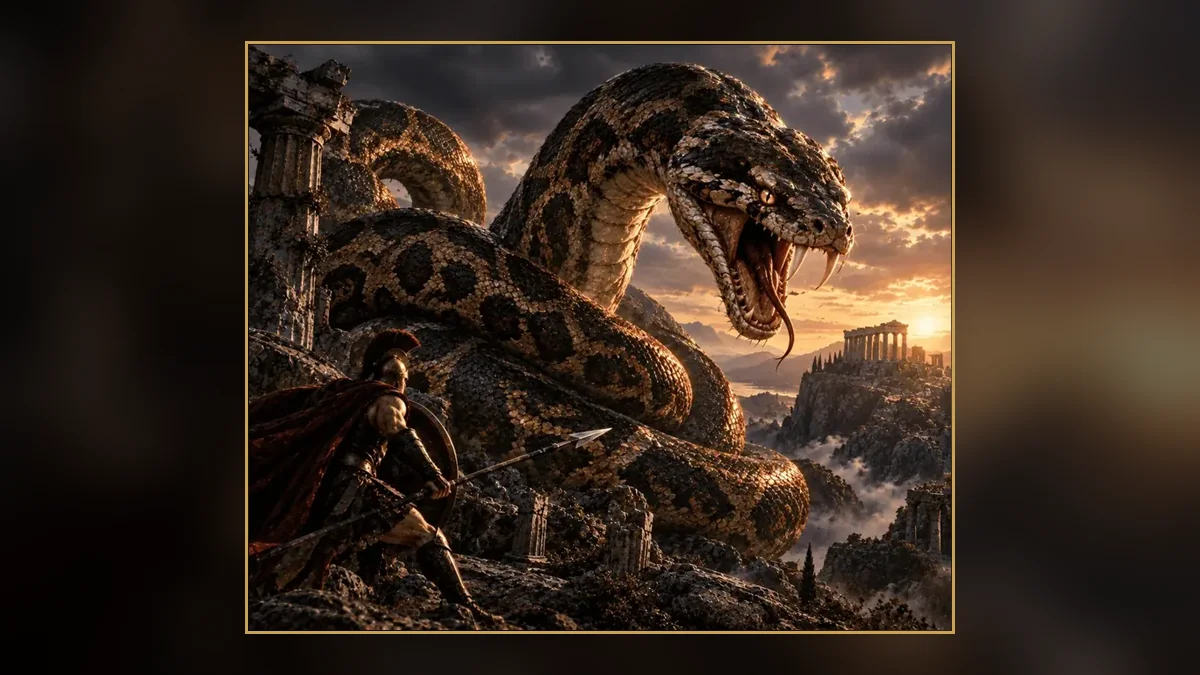
Delphi was the most important oracle in the Greek world, and the story of how Apollo got it begins with a killing. A serpent lived at the spring under Mount Parnassus. A young god came to the place with a bow and decided it would be his temple. The serpent died, and the oracle changed hands. That is how the Greeks told it, and for a story about a simple monster fight, it has an unusual amount of aftermath. Apollo does not walk away from this kill the way Heracles walks away from his. He has to pay for it, and the way he pays says a lot about how the Greeks thought a takeover should work.
The snake at the spring
The fullest early account is in the Homeric Hymn to Apollo, in the section that deals with Delphi. The young god is searching for a place to build his first temple. He tries several sites and finally comes to a hollow under Parnassus, near a fair spring, where he finds a huge she-dragon. The hymn calls her fat and monstrous, a creature who has done a great deal of harm to the people of the area and to their flocks.
Apollo shoots her with an arrow. She writhes in agony, rolls about, and dies, and the god gloats over the body. He tells her to rot there on the earth that feeds mankind, and says she will never escape the heat of the sun. The hymn then gives the place its name: Pytho, from the Greek verb meaning to rot. And Apollo becomes Pythian, the one who made the creature rot.
A name that means two things
The Greeks also derived Pytho from another word, pythesthai, to inquire, which is exactly what people did at Delphi, where visitors came to ask questions of the god. That is a lucky coincidence, or a calculated one. The same syllables mean rot and ask. A place named for a decomposing body is also the place where all of Greece sent its most important questions, and the Greeks did not seem bothered by the association.
Later writers made the snake bigger and gave it a gender and a name. Ovid says Python was born from the mud left by the great flood, and that Apollo used up almost his whole quiver bringing it down. Apollodorus calls the creature simply a snake, born of Earth, who guarded the oracle of Themis. In Ovid's account the serpent is big enough to cover whole stretches of the mountainside. The creature grows in every retelling, which usually means the story matters.
Three owners before Apollo
The point of the legend is that Apollo is not the first. The Greeks had a clear picture of who held the oracle before him. In the opening lines of Aeschylus's Eumenides, the priestess at Delphi lists the succession: first Earth, who was the original prophet, then her daughter Themis, then another Titan, Phoebe, who gave the place to Apollo as a birthday present.
Euripides gives a darker version in Iphigenia among the Taurians. In his account, the baby Apollo kills the serpent while still an infant. Earth, furious that her oracle has been taken, sends dreams to the people of Greece, so that they can learn the future without going to Delphi at all. Apollo goes to Zeus in distress. Zeus, with a nod, takes away the power of the dream-visions, and mortals have to go back to Delphi for their answers.
Read those two together and the structure is plain. The serpent is the guard of an old authority, Earth's, and Apollo's arrival is a change of regime. The Greeks did not pretend that the earlier owner had been illegitimate. They said she was there first, and that she was strong enough to fight back with her own method, which was dreams. It took the king of the gods to close the loophole.
The nurse of Typhon
There is a connection here to the monster I wrote about elsewhere on this site. In the same hymn, the she-dragon killed by Apollo is said to be the creature that Hera gave the infant Typhon to raise. In other words, the snake at Delphi is the nurse of the one enemy who nearly brought down Zeus. Some later writers call her Delphyne, the same name that Apollodorus gives to the half-woman, half-snake who guards Zeus's cut-out sinews in the Corycian cave.
The scholar Joseph Fontenrose argued in a famous study in 1959 that the combat of Apollo and Python and the combat of Zeus and Typhon are two versions of a single old story, a young god fighting a serpent for the right to rule. He may or may not be right in every detail, but the overlap is real. Both stories feature a serpent, a goddess who raised it, a fight, and a victory by a god of the sky. The Greeks seem to have told the story twice, with different gods in the lead.
The exile
Here is where Python's story becomes different from any other monster's. Apollo killed something sacred, and the Greeks believed that killing carried pollution, a kind of spiritual stain that had to be washed away. Several ancient writers say that Apollo had to leave Delphi and go into exile, usually to the Vale of Tempe in Thessaly, where he was purified with laurel. In some versions the exile lasted eight years.
Delphi remembered it. Plutarch describes a festival called the Septerion, celebrated every eight years, in which the Delphians built a little hut to stand for the lair of the dragon. A boy whose parents were both alive, with a group of companions, attacked the hut at night with torches, overturned a table, set the hut on fire, and then ran away from the temple without looking back, all the way to Tempe. The ritual was a reenactment of the killing, and the flight.
My reading: the winner keeps the victim's name
This is where I offer an interpretation that is my own. Look at what Apollo does after the killing. He does not erase the snake. He takes her name. He is called Pythian Apollo. His priestess is the Pythia. His festival, the Pythian Games, is named after her. The sanctuary is called Pytho. Some ancient writers even said that the snake's body was buried under the stone at the centre of the temple, the navel stone known as the omphalos.
That is a shrewd way to take over an institution. You do not tear down what people already trust. You keep its name and put yourself behind it. Anyone coming to Delphi in the classical period was speaking to a god who had put on the title of the creature he had killed, and every time the priestess was called the Pythia, she was announcing the old owner's name. Apollo won the oracle by killing its guardian and then staying on as the guardian's successor. The paperwork was in order: a kill, a penance, a festival, a name.
The exile belongs to the same plan. A god who kills a sacred creature and walks away without cost looks like a conqueror. A god who kills it and then accepts exile and purification looks like someone who has joined an existing order and agreed to its rules. The Septerion ritual says, every eight years, that the new regime remembers what it did.
The song of the fight
The story was also kept alive in music. Strabo describes a piece called the Pythic Nome, an instrumental composition for the double pipe that was performed at the Pythian Games. It was played in five parts, and each part depicted a stage of the combat: the god surveying the ground, the challenge, the fight itself, the triumph, and a last section imitating the hissing of the dying snake. It is one of the oldest known pieces of programme music, a piece of music designed to tell a story without words.
What the ground at Delphi shows
The place itself is dramatic. Delphi sits on a steep slope below the cliffs of Parnassus, with a spring called Castalia running down beside the sanctuary. Ancient writers, including Plutarch, who was a priest there, say that the priestess sat on a tripod above a crack in the rock from which vapours rose. Geologists in recent years have found faults under the temple and traces of light gases in the local springs, and some have proposed that the trances had a physical cause. That claim is argued about, and it is not settled.
Archaeologists have also found evidence of worship at the site long before Apollo, including small female figurines from the Bronze Age. It is tempting to read those as the cult of Earth that the myths remember, but the connection is a guess, however attractive.
What it is for
The monster in this story is not very monstrous. The hymn has to work to make her sound dangerous, and Euripides makes her a guardian doing her duty. What matters about Python is what she shows about authority. Power, in this myth, is not simply seized. It is inherited from something older, and the honest way to take it is to admit the debt. The snake at the spring lost the fight, but her name is still on the door.
Comments
Sign in to join the conversation.