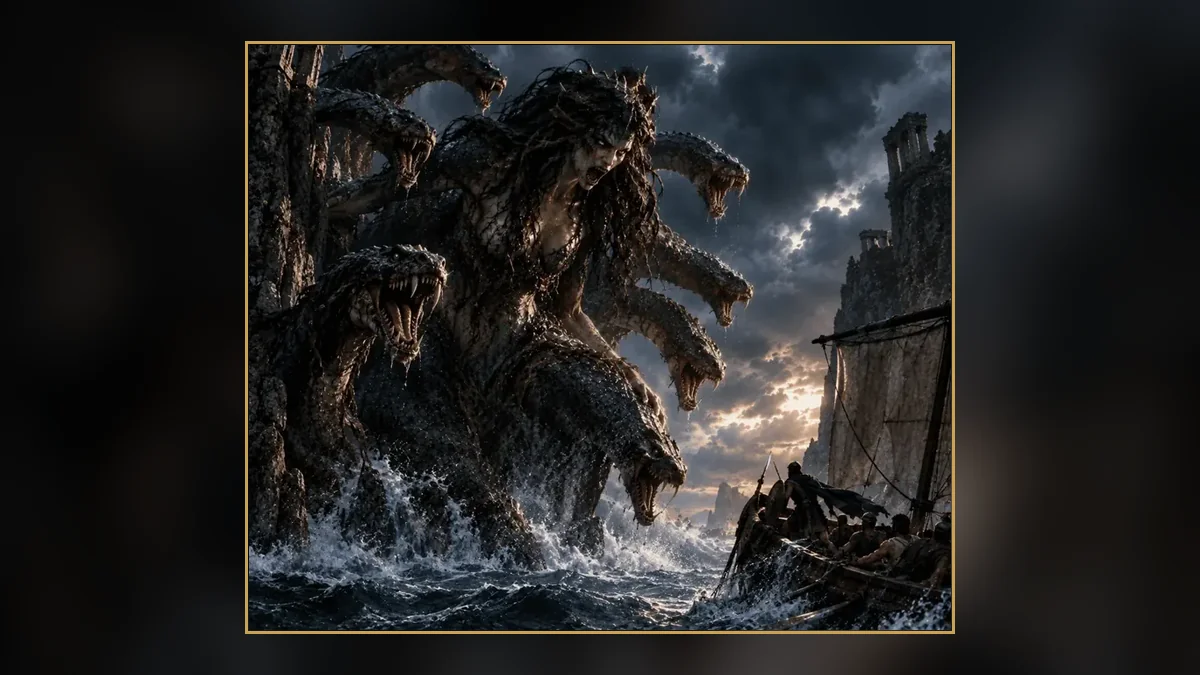
Scylla has one of the most precise descriptions in all of Greek literature, and one of the most precise prices. Circe tells Odysseus how many heads she has, how many men she will take, and how many he should be willing to lose. Nothing else in the Odyssey is quite so exact about the cost of a decision. That is what makes the scene hard to forget: it is a monster story told as a piece of arithmetic, and the arithmetic is the cruel part.
The cave in the cliff
Circe gives the sailing instructions before Odysseus leaves her island. After the Sirens, he will come to a narrow strait between two cliffs. The first is a sheer, smooth rock that rises into the clouds, and a mist hangs around its peak all year, summer and winter, so that no one can see the top. Halfway up is a cave facing west, dark and shadowed, and in it lives Scylla.
Her description is exact. She has twelve feet, all dangling. She has six long necks, each ending in a hideous head with three rows of teeth, set close and thick, packed with black death. From the waist down she is hidden in the hollow of the cave, and the heads stretch out over the water, fishing for dolphins, seals and anything bigger that the sea has brought by. Her voice, the one detail that makes my skin crawl, is like the yelp of a newborn puppy.
The name may be related to the Greek word for a young dog, skylax, and later writers gave her dogs around her waist. In Homer the dog is only in the voice, and the image of something that sounds small and harmless coming from the mouth of a thing that kills is a very good piece of horror.
Six heads, six men
The rule of the strait is simple. No sailor has ever got past without paying. Every head will seize a man from the passing ship, one for each mouth, six in all. Circe is clear about the options. On the other cliff, much lower, lives Charybdis, who three times a day sucks down the sea and three times spews it out. If the ship is caught in the whirlpool, nothing can save it, not even the sea god. So Odysseus must steer close to Scylla's cliff and sail past as fast as he can.
Then she says the sentence that is the heart of the scene. It is far better to mourn six men than to lose the whole crew. Circe is not asking Odysseus to beat Scylla, because he cannot. Scylla, she tells him, is not a mortal creature but an immortal evil, dreadful and savage and impossible to fight. The only choice is the price. The seer has already done the maths: lose six, or lose everyone.
What Odysseus does not say
Now look at what happens when the moment comes. Odysseus has been told everything, and he tells the crew only half of it. He warns them about Charybdis, and he orders the helmsman to steer away from the whirlpool and toward the cliff. About Scylla he says nothing. He admits as much in the poem. He did not mention that part, he says, because if he had, the crew might have panicked, stopped rowing and huddled in the hold.
It is a small, chilling decision, and I think it is one of the most honest pieces of writing about leadership in the ancient world. The man in charge knows that part of the plan includes a loss that cannot be avoided. He has been told exactly how big it is. And he chooses to row on without telling the men who will pay for it. The crew are steering toward their own deaths on the strength of their captain's silence.
The poem does not condemn him for it, and it does not excuse him either. It records the choice and moves on. But the reader, who has seen the instructions, watches the whole thing with a feeling that something is being withheld.
The loss itself
The one thing Odysseus does that Circe told him not to do is put on his armour and take two spears. He stands at the front of the ship, scanning the cliff, trying to catch sight of Scylla before she strikes. He cannot see her anywhere. While everyone is looking at the whirlpool, the six heads come down out of the mist and snatch six of his best men from the deck.
Homer's description of what he sees is among the saddest passages in the poem. The men are lifted into the air, writhing, calling out his name in their last moments, and then the heads carry them to the mouth of the cave and eat them at the door, still shouting, holding out their hands to him. Odysseus says that of all the pitiable things he saw in his years of wandering the sea paths, this was the worst.
Circe had told him not to try to fight. He tried anyway, and nothing came of it. The loss happened exactly as predicted, to the number. What makes the scene so awful is that it is a plan working perfectly. Everything went the way the experienced adviser said it would, and six men were gone.
A fight that cannot be won
Circe's flat ban on fighting deserves its own look. In Greek stories heroes fight monsters. Heracles throttles the lion, Perseus takes the Gorgon's head, Theseus goes into the maze. Scylla is one of the few who comes with an explicit instruction not to bother. Odysseus is a man of cunning, not of force, and this is the chapter that tells him where cunning ends: put the oars down in the water, move fast, and count your dead afterwards.
His one act of defiance is to put on his armour, and the poem lets it fail without comment. It is the old hero's reflex, the one that says a man must at least be seen to stand up. Even the cleverest person in the story cannot always stop himself from reaching for the spear when the warning has already told him it will do no good.
The beauty Circe poisoned
Scylla did not begin as a monster, at least not in the later tradition. The Roman poet Ovid, in the Metamorphoses, tells a long story about a girl who was a beautiful nymph, loved by the sea-god Glaucus. She wanted nothing to do with him and fled. Glaucus went to the sorceress Circe for a love charm, and Circe fell in love with him instead. When he refused her, she turned her jealousy on the girl she thought he preferred. She brewed poison, poured it into the pool where Scylla bathed, and spoke her charms over it.
Scylla waded into the water, up to her waist, and then saw something terrible. Barking dogs had grown out of her body. At first she did not understand that they were part of her. She tried to run from them, and she could not, because the dogs were fixed to her own flesh. She hated Circe, and she hated her new shape, and she haunted the strait from that day, until at last she was turned into a rock that wrecks ships.
I find that story painful, because it is about a very particular kind of horror: the moment you notice that the thing you are afraid of is you. Homer's Scylla is a hazard on a sailing chart. Ovid's is a young woman recoiling from her own body. The monster in the cave was somebody once, and that does not make her any less deadly to the sailors, but it does change what the cliff looks like.
The strait is real
The Greeks and Romans located the story at the Strait of Messina, the narrow channel between the toe of Italy and Sicily. There is a town called Scilla on the Italian side to this day, built beside a tall rocky headland that has carried the name since antiquity. On the Sicilian side, near Capo Peloro, strong tidal currents meet in the narrow channel and produce whirlpools that local people call garofali. They are small and rarely dangerous to modern ships, but a vessel with oars in a flat calm would have felt them.
The English phrase between Scylla and Charybdis still means being forced to choose between two evils. The ancient original is more specific. It is the story of a choice where one option has a known, limited price and the other has an unlimited one, and the sensible captain pays the first.
What she is for
Scylla shows up elsewhere in the tradition. In the Argonautica, the sea nymph Thetis and her sisters guide the Argo safely through the same strait at the request of Hera. In the Aeneid, Aeneas is warned to avoid it altogether and take the long way round Sicily. Later writers even said that Heracles killed her and that her father brought her back to life. She survives every retelling because she fills one narrow slot extremely well.
That slot is the cost of doing something hard. Some problems have no free solution, and the most useful thing anyone can do is to say how much the least bad option will cost. Circe says six. Odysseus pays six. The Greeks, as usual, did not pretend that it was easy to be the one who knew.
Comments
Sign in to join the conversation.