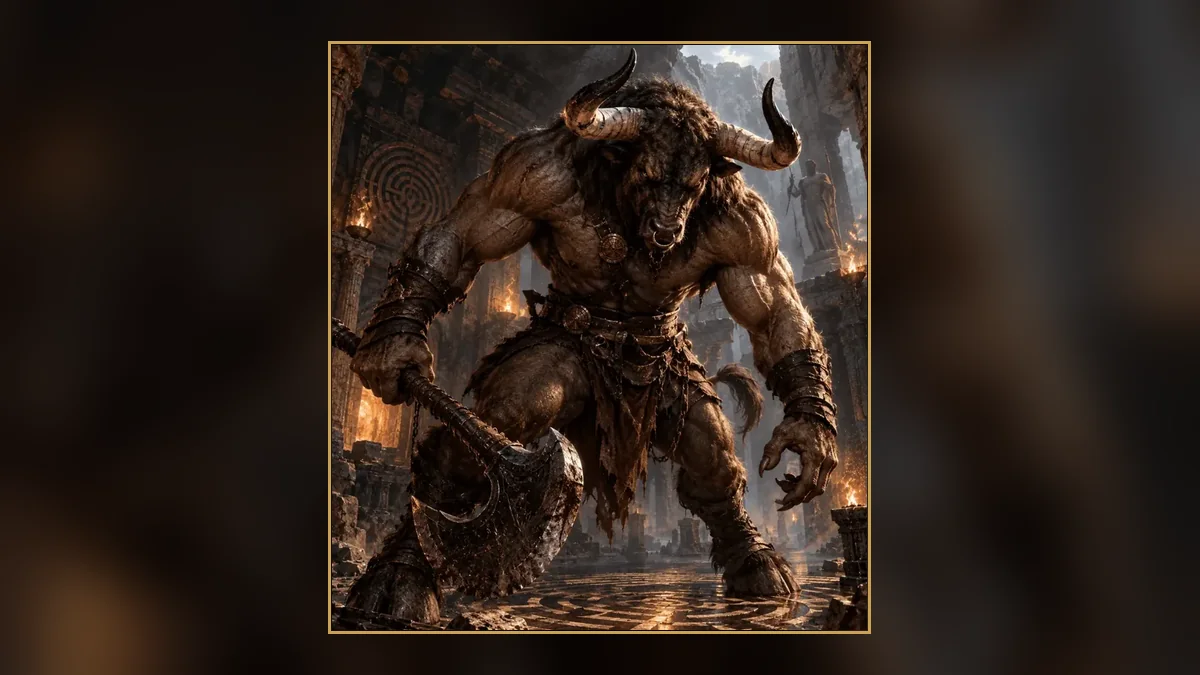
Most people remember the Minotaur as a creature in a maze, waiting for a hero with a ball of thread. That is the last chapter. The first chapter is about a king who wanted to look chosen by the gods, and a bull that came out of the sea to prove it. If you read the story from the beginning, the monster stops looking like a random horror and starts looking like a debt, one that took a generation to come due and was paid by strangers.
The bull that was meant to be given back
Minos wanted to be king of Crete, and his brothers disputed it. According to Apollodorus, he announced that the gods themselves favoured him, and to prove it he prayed to Poseidon for a sign. He asked for a bull to rise from the sea, and promised to sacrifice it as soon as it appeared. Poseidon sent one, and it was a magnificent animal. Minos took the throne, and then he looked at the bull and decided to keep it. He sacrificed a different one in its place.
Think about what that move says. The kingship had been won by a promise to a god, and the first act of the new king was to cheat on the terms. It was a small cheat, a bull swapped for a bull, the kind of thing a person can tell himself does not count. Greek myth is not interested in whether a cheat is small. It is interested in whether the god noticed, and Poseidon always notices.
A wooden cow and a child
Poseidon's revenge was aimed not at Minos but at his wife. He made Pasiphae fall in love with the bull. She went to Daedalus, the Athenian craftsman who lived at the Cretan court, and he built her a hollow wooden cow covered in a real hide, set on wheels, so that she could climb inside. The child that resulted was born with a bull's head on a man's body. Nobody in the story is in any doubt about whose child it was.
The creature is called the Minotaur, which just means Minos's bull. But Apollodorus gives him a name of his own, Asterios, which means starry or glittering. It is also the name Apollodorus gives to the king of Crete who adopted Minos, which is an odd thing to find on a monster, and it is a strangely gentle name besides. The only Greek monster with a proper personal name is also the one who is never shown speaking, never shown choosing, and never shown doing anything except being kept.
The house built to hide something
Minos did not kill the child, and he could not display him. So he asked Daedalus to build a place to keep him: the Labyrinth, a building of winding passages designed so that anyone inside would lose the way out. The word is probably Cretan in origin, and a popular theory ties it to labrys, the double-headed axe that appears all over the ruins of Knossos. On that reading, labyrinth means something like the house of the double axe, which is simply the palace.
This is the part of the story I want to push on. The Labyrinth is the real monster of the myth, in a way that the creature inside it is not. It is a building whose entire purpose is to conceal a family secret, with all the architecture of embarrassment: more passages than a person can follow, designed by the cleverest man on the island, to keep something in and something else out.
Look at what happens to the architect. In Apollodorus's account, when Daedalus later helps Ariadne show Theseus the way out, Minos is furious and shuts Daedalus and his son Icarus inside the very maze he designed. The man who built the trap becomes its prisoner. That is my reading, not an ancient commentary, but I think the story is telling us something about concealment: the structures we build to hide a shame will eventually enclose the people who built them.
Why Athens paid
The next link in the chain seems at first to have nothing to do with Crete. Minos's son Androgeos went to Athens for the games and won every event. In one version the Athenian king Aegeus, jealous, sent him off to deal with the bull of Marathon, which killed him. In another, rival competitors ambushed him. Either way, a Cretan prince died on Athenian soil, and Minos arrived with a fleet.
Athens lost the war, and a plague and famine sat on the city. An oracle said the city must settle on whatever terms Minos demanded. His terms were a tribute: seven young men and seven young women, sent to Crete at fixed intervals, usually given as every nine years, to be fed to the Minotaur. In practice, Athens was paying the price for a crime committed in Athens, to feed a monster created by a crime committed in Crete.
Count the cost. A king broke an oath, and the cost was paid by fourteen teenagers who had never heard of Poseidon. The consequences of a leader's cheating land on the people who were not in the room. Greek tragedy returns to this over and over, but here it is stripped down to a single image: a tribute of children, shipped overseas, for the sake of a family's embarrassment.
The thread
Theseus, son of Aegeus, volunteers or is drawn by lot, depending on the telling, and sails with the black sail that signals mourning. On Crete, Ariadne, the daughter of Minos and Pasiphae, falls for him. She gives him a ball of thread, in Apollodorus on the advice of Daedalus, and tells him to tie it to the entrance and unwind it as he goes. Inside, Theseus finds the Minotaur and kills him, with his fists in Apollodorus's version and with a sword in others, and follows the thread back to the door.
I like to set this beside the dog at the gate of the dead. Cerberus embodies the rule that you can enter but never leave. The Labyrinth turns the same idea into architecture: you can enter, but you cannot find the way out. And the answer, in both cases, is not a stronger weapon. Heracles wrestles the dog with his bare arms, and Theseus uses a length of string. The most important item in the whole story is the one that solves the problem of return.
Then comes the sour ending. Theseus abandons Ariadne on the island of Naxos, and in some tellings Dionysus takes her as his wife. On the voyage home, Theseus forgets to change the black sail to a white one, and Aegeus, watching from the cliff, believes his son is dead and throws himself into the sea, which is why it is called the Aegean. The monster is gone, and the family wreckage is not. It spreads, like a stain, across two kingdoms.
A man called Bull
Not everyone in antiquity was willing to believe in a bull-headed man. Plutarch, in his life of Theseus, records the explanation offered by some writers: that the Minotaur was no monster but a Cretan general named Taurus, which is simply the Greek word for bull. According to this version, Taurus was a harsh and arrogant commander who treated the Athenian captives badly, until Theseus beat him in the funeral games for Androgeos, and Minos was glad to see him humbled.
I do not take that as history, but I enjoy it as evidence of what people wanted from the story. They wanted the monster to be a person, because a person can be defeated by being outdone at something. The more rationalising ancient readers wanted the Minotaur to be a human cruelty with a nickname.
What the ground at Knossos can tell us
The Labyrinth was long treated as pure myth until Arthur Evans started digging at Knossos in 1900 and uncovered a huge, sprawling palace complex, with hundreds of interconnected rooms, storage chambers and staircases built over centuries. The double axe is everywhere in the carving. So are bulls: the famous frescoes show acrobats vaulting over charging bulls, and drinking vessels were made in the shape of bull heads.
No one has found a Minotaur, or anything like a cage for one. But some of the coins that Knossos itself issued in the classical period show a maze pattern on one side, and on some, a figure of the monster, so the Cretans of that age clearly took pride in the legend. The honest summary is that the bull and the axe were real symbols of Minoan Crete, and the palace really was an easy place to get lost in, which is a decent explanation for how a story like this could take root. Whether there was any further kernel of fact, the evidence does not say.
What he is for
The Minotaur is a strange member of the monster cast, because he is the only one who is innocent in his origins. Cerberus, the Hydra and the rest are born to be threats. This one is born because of someone else's broken promise, kept out of sight for being embarrassing, and fed on children for being hungry. The hero who kills him is doing something necessary, and still the story keeps a little pity for the animal at the centre.
That is what I take from him. Greek myth understood that the worst monsters are not invented by enemies. They are made by the people at the top who decide that a small cheat will not matter, and then spend the rest of their lives building walls around the consequences.
Comments
Sign in to join the conversation.