Thebes was a real and important city in Boeotia, the region north of Athens. Its Bronze Age palace has been excavated, and clay tablets found there show it was a serious power in the late Mycenaean world. In the myths, it plays a different role. Athens is where the Greeks put the stories they felt proud of. Thebes is where they put the stories about what can go wrong in a family, a city, or a mind.
A stranger with a cow
The founder was Cadmus, a prince from Phoenicia. His sister Europa had been carried away by Zeus in the shape of a bull, and their father sent Cadmus out to find her and not to come home without her. He never found her. At Delphi the oracle told him to stop searching, follow a cow marked with a moon on each flank, and build a city where she lay down.
The cow led him into Boeotia and rested on the spot. Cadmus meant to sacrifice her to Athena and sent his men to a nearby spring for water. The spring was guarded by a dragon sacred to Ares, and it killed them. Cadmus killed the dragon in revenge.
Athena told him to pull out the dragon's teeth and sow them in the ground. A crop of armed men rose from the furrows and, as soon as they saw each other, began fighting. Only five survived, and they became the ancestors of the noble Theban families, who were known as the Sown Men. The new city's citadel was called the Cadmea in his honour.
A city that starts with a murder and a crop of soldiers is going to have trouble with blood. My own reading is that the story tells you straight away what kind of place this is.
The wedding the gods attended
Cadmus paid for the dragon with years of service to Ares, and at the end of it he was given Harmonia, the daughter of Ares and Aphrodite, as his wife. The poet Pindar says the gods came to this wedding, which was rare for a mortal one. The Muses sang, Apollo played the lyre, and the guests brought gifts, including a wonderful necklace.
That necklace made a mess of things for generations. In the tales it brings bad luck to every woman who owns it, and it passes down through the family. Even a perfect party turns out to have an invoice attached.
The daughters
Cadmus and Harmonia had four daughters, Semele, Ino, Autonoe and Agave, and each of them ends badly. Semele was loved by Zeus. Hera, jealous, appeared to her as an old nurse and encouraged her to ask her lover to show himself in his true form. Zeus had sworn to give her anything she asked, and when he appeared as the god of thunder, she was killed by the fire. He pulled the unborn child from her body and sewed him into his thigh, and he was born again as Dionysus.
The god grew up and came back to the city of his mother's family, and the family did not receive him. His cousin Pentheus, who was king, banned his worship and tried to arrest him. Dionysus drove the women of Thebes, Agave among them, into the mountains in a frenzy. When Pentheus climbed a tree to spy on them, his own mother and aunts mistook him for a lion and tore him apart. Agave came back carrying his head, proud of her hunting, and realised what she had done.
That is the story of Euripides' play The Bacchae, and it is one of the most disturbing in Greek drama. The god is not cruel for pleasure. The city refuses him, and the refusal is the crime.
The traditions say that Cadmus and Harmonia, after the disaster, left Thebes and were changed into snakes. Later poets let them end in the Isles of the Blessed. Even in the kindest ending they leave as foreigners.
The walls and the music
The next generation built the city's defences. Amphion and Zethus, twin sons of Zeus, are credited with the lower town. Zethus lifted the stones with his arms. Amphion, who had been given a lyre by Hermes, played so beautifully that the stones moved into place by themselves. The walls were said to have seven gates, and Thebes is the city of the seven gates, a phrase that is still used.
The family that couldn't escape
The best-known Theban stories belong to a later king's household. Laius was warned by an oracle that his son would kill him, and he left the baby on a mountainside with its feet pinned. A shepherd took the child to Corinth, where he grew up as Oedipus, and the prophecy found him by the road.
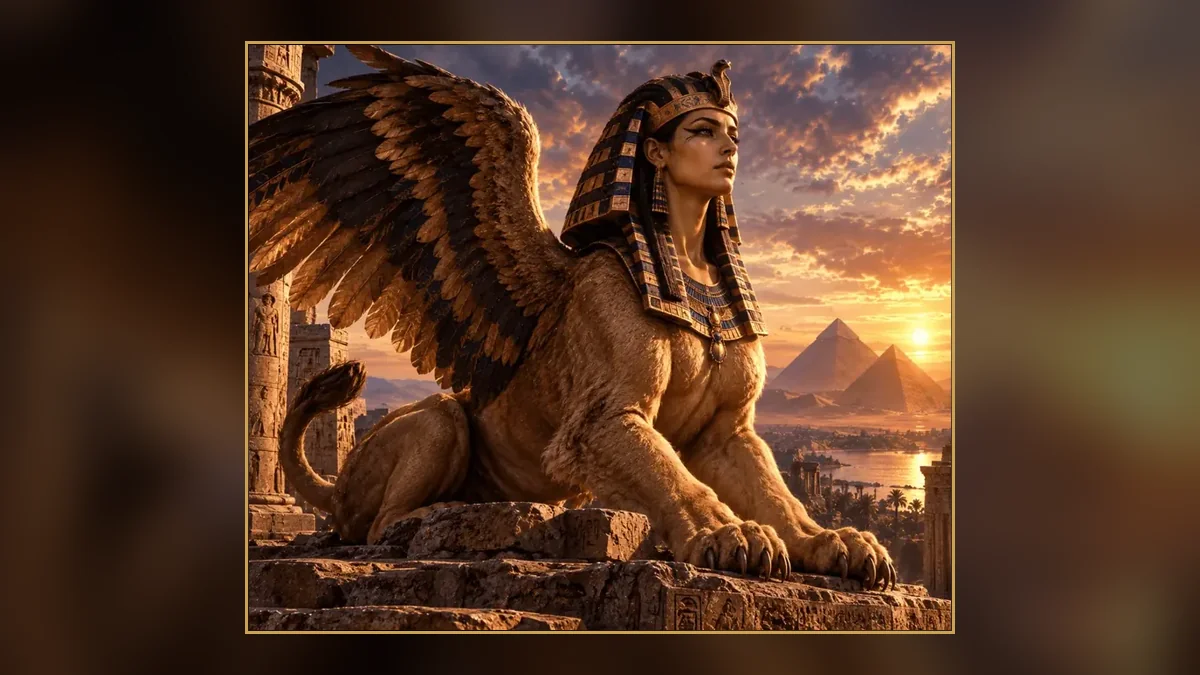
When Oedipus came to Thebes, the city was being terrorised by the Sphinx, a monster that asked travellers a riddle and killed them if they failed. He answered it correctly and was made king, married the widowed queen Jocasta, and the pieces of the truth came together years later during a plague. Jocasta hanged herself, and Oedipus put out his own eyes. The Library has an article on the Sphinx.
His sons Eteocles and Polynices were meant to share the throne in alternate years. Eteocles refused to hand over, and Polynices raised an army of seven champions to take the city by force. They killed each other in single combat. Their sister Antigone buried Polynices against the new king's orders and was condemned to death for it. When the next generation, the Epigoni, finally took the city, they destroyed it.
Heracles and the prophet
Thebes has bright spots as well. Heracles was born here, to Alcmene, and he spent his early life in the city and married Megara, the king's daughter. Hera's madness ruined that too. The blind prophet Tiresias also lived here, the one man in these stories who has been both a man and a woman, and who is always called in when someone needs the truth they do not want.
Why it keeps happening here
Look at what the stories have in common. A god arrives, an oracle speaks, or an old promise comes due, and the people involved cannot cope. Each time, the problem is not that the gods are present. It is that someone tries to avoid what has been said. I think that is why Thebes became the tragedians' favourite city. It is the place where a family is trapped by a pattern, and every attempt to leave it makes the pattern tighter.