Crete is the largest of the Greek islands, and in the myths it is a place where things get hidden. A baby god was hidden here from his father. A monster was hidden here from the world. Even the island's reputation was a sort of hiding, since the Greeks said Cretans could not be trusted to tell the truth about anything, including their own gods.
The cave where Zeus grew up
Cronus had been swallowing his children to stop one of them overthrowing him. When Rhea was about to give birth to Zeus she went to Crete and hid him in a cave, then handed Cronus a stone wrapped in cloth to swallow in his place. Two mountains claimed the cave, Dikte in the east and Ida in the centre, and the island has never settled the argument.
The baby needed guarding and feeding. A goat named Amalthea gave him milk, and in other versions a nymph did the nursing. A group of spirit warriors called the Curetes danced around the cave clashing spears on shields, so Cronus would not hear the baby cry. It is a lovely picture, a king of the universe being raised inside a wall of noise.
Here is the odd part. Crete also claimed to have Zeus's grave. The third-century poet Callimachus tells the Cretans off for it in a hymn. Cretans are always liars, he says, since you did not die, you are forever. The island was famous enough for this that the philosopher Epimenides of Crete became the setting for a classic logic puzzle: a Cretan says all Cretans lie.
A bull, a girl and a dynasty
Zeus fell for Europa, a princess from the coast of Phoenicia, and approached her in the shape of a bull so gentle that she climbed onto his back. He swam her across the sea to Crete. Her three sons were Minos, Rhadamanthys and Sarpedon, and Minos became king.
Minos is the first great sea-ruler of Greek tradition. The historian Thucydides says he built the first real navy and cleared pirates from the Aegean. That memory of a sea power is probably the part with some truth behind it. The archaeological record shows a wealthy Bronze Age civilisation on Crete, with palaces and ships, many centuries before Homer.
The monster in the house
Minos asked Poseidon for a sign that his rule was approved, and the god sent a magnificent white bull from the sea. Minos was meant to sacrifice it. He kept it instead, because it was too fine to kill. As a punishment, Poseidon made his wife Pasiphae fall in love with the bull.
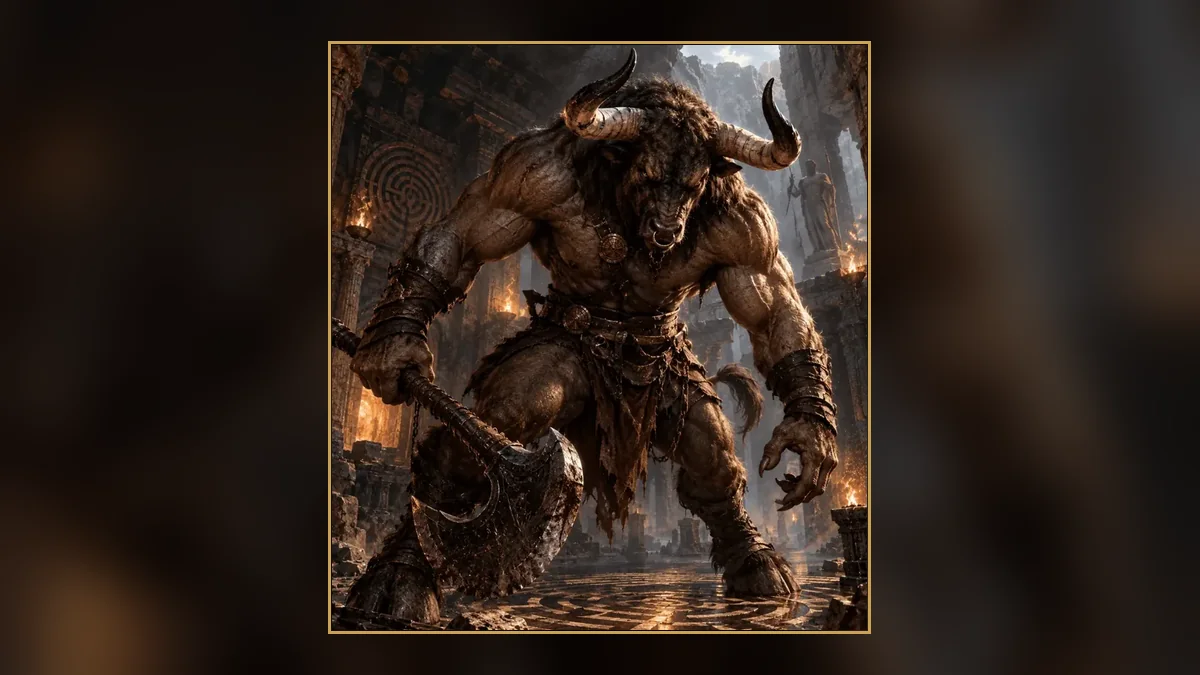
Pasiphae had the master craftsman Daedalus build her a wooden cow to hide inside. The child that came of it was the Minotaur, a person with a bull's head. Minos could not kill the creature, since it was his wife's son, so he had Daedalus build a structure to hold it. That is the labyrinth.
The story that follows is about debt. Athens lost a war to Minos and had to send seven young men and seven young women to Crete every nine years, to be fed to the Minotaur. The third time, the prince Theseus volunteered. Minos' daughter Ariadne gave him a thread to find his way back out of the maze, and he killed the Minotaur and left with her. What happened to her afterward is a story for its own page.
Wings and a bronze man
Minos was furious with Daedalus and shut him up in the labyrinth with his son Icarus. The craftsman made wings from feathers and wax, and they flew out. Icarus ignored his father's warning, climbed too high, and the sun melted the wax. He fell into the sea near the island that now carries his name.
A smaller figure from Crete is Talos, a bronze giant who walked the island's coast three times a day throwing rocks at ships. In the Argonautica, the sorceress Medea defeats him by casting a spell on the single vein in his ankle, closed by a bronze nail. The ship carries on without him.
Heracles also visited the island. His seventh labour was to bring the Cretan bull back to the mainland, and in some tellings it is the very same bull Pasiphae loved.
What the diggers found
The archaeology is the part that surprises people. In 1900 Arthur Evans started digging at Knossos, and he found a palace complex with hundreds of rooms, painted walls, storage jars taller than a person, and a fresco of people vaulting over the back of a bull. No maze, and no monster, but you can see why the story attached itself to the place. A building with that many corridors confuses a visitor.
One old guess for where the word labyrinth comes from is labrys, a double-headed axe that appears all over the palace decoration. That guess is still debated, but I like it. The house of the double axe turns into the house of the trapped monster.
The last journey of Minos
The king did not die on Crete. According to the story, he chased Daedalus all the way to Sicily, where the local king's daughters killed him by scalding him in a bath. In another turn of the screw, Minos went on to become one of the three judges of the dead in the Underworld.
That is why I read Crete as the island of consequences. Every gift in these stories arrives with a price. The bull from the sea was a gift. The labyrinth was a solution. The wings were a way out. And each one costs somebody a child.
Nearby in the myths