Greek myth has several seas, but the Aegean is the one closest to home. It is the water between mainland Greece and the coast of what is now Turkey, scattered with islands so closely that on a clear day you can often see the next one before you leave the last. For the people telling these stories it was less an ocean than a road.
The name
The usual story concerns King Aegeus of Athens. His son Theseus sailed to Crete to face the Minotaur, and the two agreed on a signal. If Theseus lived, his ship would come home under white sails instead of the black ones it left with. Theseus succeeded, but in the excitement, or the grief of losing Ariadne, depending on the version, he forgot to change them.
Aegeus was watching from a cliff. He saw the black sails, decided his son was dead, and threw himself into the water. From then on the sea carried his name.
The Greeks themselves were not sure about the derivation. Ancient writers suggested other explanations, including a city called Aigai and a queen of the Amazons who drowned there. I like the Aegeus version best, because a whole sea named after an unchanged flag is the kind of detail a poet would not invent more cleverly.
Poseidon at home
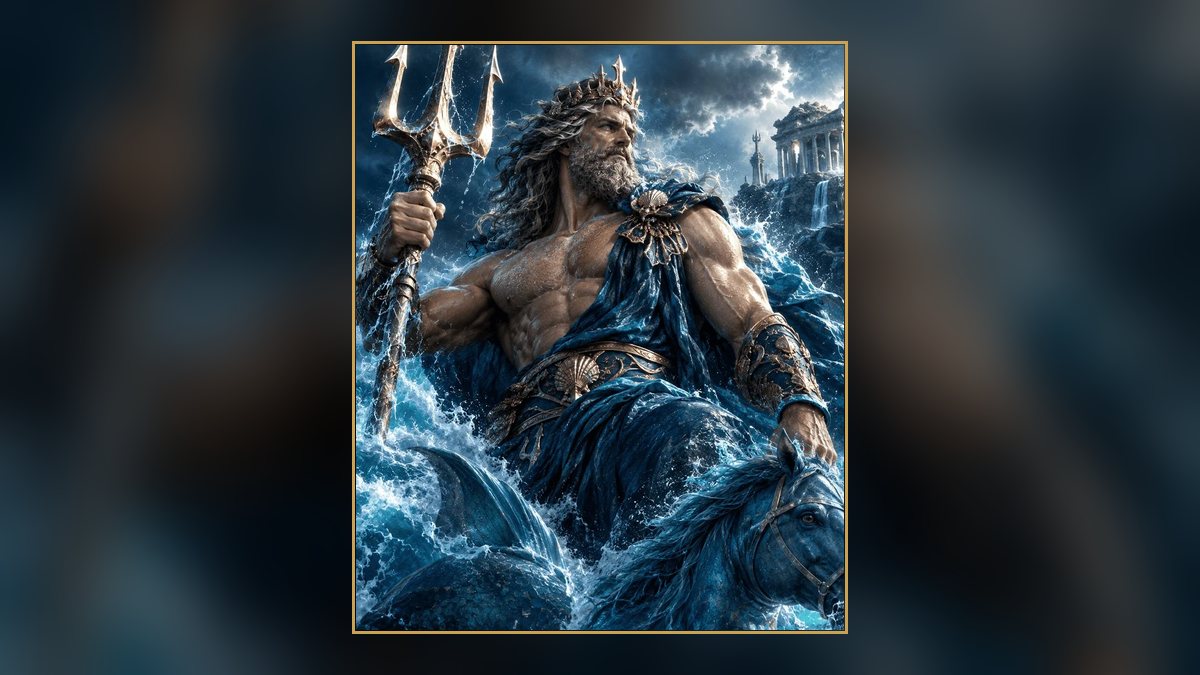
Poseidon rules the sea, and in the Iliad he has a golden palace at a place called Aigai, deep under the water. He keeps his horses there, and he drives them across the waves in a chariot drawn by fast beasts with bronze hooves and golden manes. The sea monsters and the dolphins leap up and part before him.
Around the god lives a crowd. The Nereids are fifty sea-nymphs, the daughters of the old sea god Nereus, who is a wise and truthful figure and can foretell the future if caught. Their number includes Thetis, the mother of Achilles, who rises from the water to console her son in the Iliad. Triton, Poseidon's son, blows a conch shell to calm or raise the waves.
Islands with stories
Many Aegean islands are the setting of a single famous scene. Delos is where Leto, hunted by Hera, finally found a place willing to let her give birth, and she bore Apollo and Artemis there. The island was said to have been floating until then, which suits the place. Lemnos is where Hephaestus landed after his fall from Olympus. Naxos is where Ariadne was left behind, and where Dionysus found her.
Seen that way, the sea is a map of events. A sailor could cross it by touching down in one story after another.
The way home from Troy
The sea is also the antagonist of the Trojan aftermath. After the Greeks sacked Troy, Athena was angry about the desecration of her temple, and she asked Zeus and Poseidon to make the voyage home a disaster. A storm broke over the fleet, and many ships were wrecked near the coast of Euboea. Ajax the Locrian, the man who had dragged Cassandra from the altar, was drowned.
Agamemnon got home, only to be murdered by his wife. Menelaus wandered for years in Egypt. Odysseus took a decade, and a large part of the Odyssey is a catalogue of everything the sea and its coasts could do to him. The Aegean is where the heroes' wars get their price.
Going the other way
Ships went east as well as west. The Argonauts sailed the whole length of the Aegean and through the narrow strait into the Black Sea to find the Golden Fleece. In some versions, they got through only after letting a dove fly ahead of them between a pair of crashing cliffs.
In the same waters, a young man named Icarus fell from the sky, and the sea near the island of Ikaria is named for him. The gods made the sea a place where ambition ends up.
The one I would pick
Of all the water stories, I find the original one the strongest. The sea is named for a failure to communicate. A father waits, a son returns, and a flag is the wrong colour. Nothing in that story is magic. It is a mistake any family might make, and the whole sea is its memorial.
That is also what the Aegean does to the myths in general. It is the place where the gods' decisions meet human errors, and the water gets to keep whatever is left over.