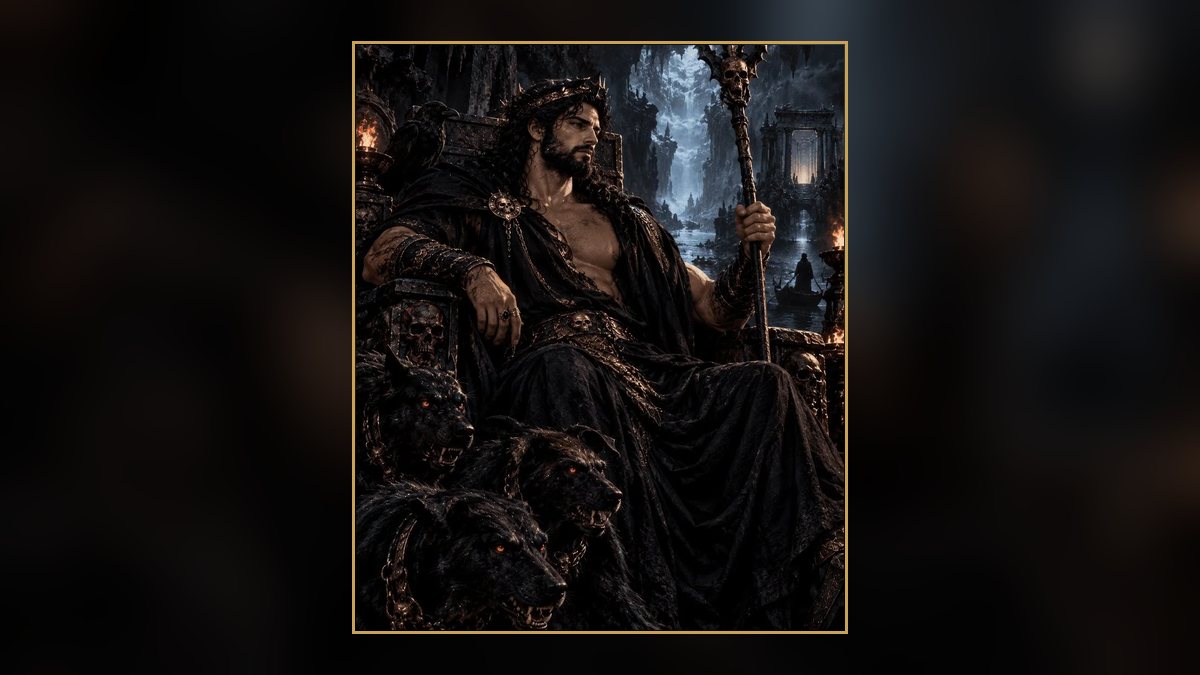
Hades is both the god and the place. It is the same word for the house and the man who owns it, and in ordinary speech to go to Hades simply meant to die. Homer calls it the house of Hades and leaves it at that. Before anything else, it helps to drop the picture most of us carry in, the one with flames and a red devil. Nothing like that is down there.
Getting in
The Greeks never agreed on one door. A cave at Cape Taenarum, at the southern tip of the Peloponnese, was one entrance people pointed to. Another was the river Acheron in the north-west, where a real shrine for speaking with the dead stood near the water. Homer has Odysseus sail past the edge of the known world to a dark shore beyond Ocean instead.
I find it reassuring that nobody settled the question. The entrance is wherever the story needs it. The underworld is not a place with an address, it is a direction.
The river crossing
Five rivers run through it, and each one is named for something about death. The Styx is the river of oaths, which the gods themselves swear by. The Acheron is the river of woe, the Cocytus of lament, the Phlegethon of fire, and the Lethe is the river of forgetting.
The dead cross by ferry, and the ferryman is Charon, an old and grubby figure who takes only those who have been properly buried. The unburied drift on the shore for a hundred years. The fare you have probably heard about, a coin in the mouth, is more of a later habit than an early rule. By the time of the comic playwright Aristophanes the price is already a joke the audience knows.
On the far bank waits Cerberus, the three-headed dog. Hesiod says he fawns on anyone who walks in and eats anyone who tries to leave. The gate is built to be easy in and impossible out, which is the whole point of a gate on this side.
Who lives there
In Homer, almost everybody ends up in the same grey meadow, which is covered in asphodel, a pale and rather dull flower. These are the shades, and they are not much. Odysseus has to pour fresh blood into a trench before any of them can talk to him, because without it they are only faint squeaking things, like bats in a cave in the later description.
The most famous line from the visit comes from Achilles. Odysseus tries to congratulate him on ruling the dead, and Achilles answers that he would rather be a hired hand working for a poor farmer on earth than be lord over everyone down here. For a hero who chose a short glorious life over a long dull one, it is a harsh moment, and Homer lets it stand.
Later writers sorted the dead more carefully. Plato has three judges, Minos, Rhadamanthys and Aeacus, who weigh each soul. The good go to the Elysian Fields or the Isles of the Blessed, the best of all, at the edge of the world where the weather is mild. The worst go to Tartarus, which gets its own page.
The queen
Persephone is the reason the place has a human face. Hades took her, according to the Homeric Hymn to Demeter, with Zeus's quiet approval, and she ate pomegranate seeds before she could leave. That bound her to the underworld for part of every year, and the Greeks said the seasons were the result: grain grows while she is above ground and the earth goes bare while she is below.
What I notice is that she does not stay a victim. She rules down there. When living people come asking for favours, it is Persephone they often have to persuade.
People who came back
The best stories in the place are about getting out. Orpheus walked down with his lyre and sang so well that Hades agreed to give back his wife Eurydice, on one condition: he must not look behind him until they were in the sunlight. He looked, and she was gone.
Heracles went down in his last labour to bring Cerberus up, and in some versions he wrestled Thanatos, Death himself, at a grave to win back a woman named Alcestis. Theseus and his friend Pirithous went to steal Persephone for Pirithous and were seated in a chair that held them fast. Heracles pulled Theseus free. Pirithous was left behind.
Sisyphus cheated his way out for a time by chaining Thanatos, which stopped people dying until the gods stepped in. All of these stories are about the same limit, and each tests it from a different angle.
What I think it is about
The Greek underworld is not mainly a place of punishment. It is a place of record-keeping where nothing grows and nothing changes. The great fear in these stories is not pain, it is being forgotten. That is why the rivers and the shades and Achilles' bitter answer all feel so quiet.
The Eleusinian Mysteries offered one way around it. The hymn says that anyone who has seen the rites is fortunate, and that the uninitiated will have a worse fate in the dark. We do not know exactly what the initiates were shown. We do know they felt they had been given something to take down with them.