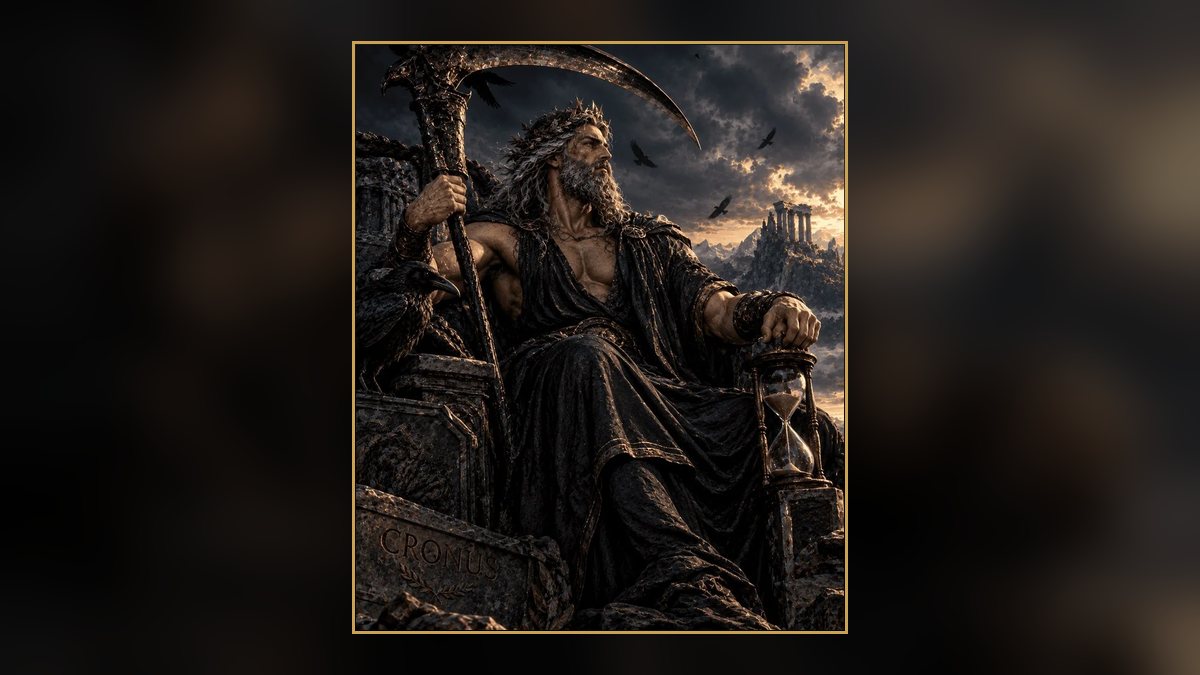
If the Underworld is the house of the dead, Tartarus is the cellar under it. It sits so far beneath the earth that Hesiod needs a trick to describe the distance. Drop a bronze anvil from the sky, he says, and it falls for nine days and nights before it hits the ground. Drop the same anvil from the ground and it needs another nine days to reach Tartarus.
That is a measurement meant to make you stop and picture the dark between. Nobody walks to Tartarus. Things are thrown there.
A prison with a fence and three guards
Hesiod fills in the architecture as if he were describing a fortress. There is a bronze fence around it. Night is poured around its neck in three layers, and above those layers grow the roots of earth and sea. Poseidon fitted the bronze gates himself.
Its wardens are the three Hundred-Handers, Cottus, Briareus and Gyges. The irony is deliberate. Their own father Uranus threw them into the earth because he hated how they looked, and Zeus, on Gaia's advice, freed them and fed them nectar to make them his allies. Once the war ended, the jailed became the jailers. They hold the place for the man who let them out.
The Cyclopes have a similar history. Uranus locked them away too, and Zeus freed them, and in return they forged his thunderbolt. In the version of the story where Cronus does the imprisoning, he is simply following his father's example.
Who is inside
The first big group is the Titans. When the ten-year war ended, the defeated ones were bound and sent down, and Zeus's brother Poseidon built the door behind them. Not every Titan went. Themis, Prometheus and Oceanus, among others, were on the winning side or kept out of it, and stayed free.
The second is Typhon. After the battle with Zeus, Hesiod says the monster was hurled down into Tartarus, groaning, and his storms are still blowing out of it. Typhon, in other words, is a prisoner whose breath is the wind.
A later poet, Pindar, offers a gentler ending. In his version Zeus eventually released the Titans, and Cronus now rules the Isles of the Blessed. The gods can forgive, it turns out, once a threat is old enough.
Tartarus as a person
Tartarus is also a being, not just a place. Hesiod names him among the first things to exist, right beside Chaos, Earth and Eros. He is not a ruler or a character with scenes. He is a depth with a name, the way Earth is a ground with a name.
When Gaia is furious at the gods for locking up her children, she and Tartarus produce Typhon between them. So the place that holds the monster also fathered him, which strikes me as the cleanest piece of mythic accounting in the whole poem.
Zeus uses it as a threat
In the Iliad, Zeus calls a meeting and tells the gods to stay out of the war at Troy. Anyone who disobeys, he says, will be grabbed and thrown into misty Tartarus, as far below the house of Hades as heaven is above the earth. Then he reminds them that he is stronger than all of them together, and nobody argues.
That is the early function of Tartarus. It is not a place where bad people go. It is where powers that threaten Zeus's rule go, and the threat of it keeps the household in line. It is the ultimate argument in a family where nobody else can win one.
The punishments people remember
The famous torments come from a slightly later layer, and they are the ones you probably know. Tantalus stands in water that drains away whenever he bends to drink, under fruit that lifts out of reach. Sisyphus pushes a boulder uphill, and it rolls down every time it nears the top. Ixion is tied to a turning wheel. Tityus lies stretched on the ground with two vultures eating at his liver.
Homer shows several of these in his visit to the Underworld, though he does not use the name Tartarus for them. The Danaids, the daughters who killed their husbands on their wedding night, were set to fill a leaking jar with water, which is a later addition.
Look at the pattern in these punishments. Each one takes the sin and turns it into an endless version of itself. Tantalus wanted what belonged to the gods and is shown permanent wanting. Sisyphus cheated death and is given work that never ends. This is an idea of justice you could argue with, but it is neat.
A shift in what the place means
My own reading is that Tartarus changes over time. In Hesiod it is about order. It is where the gods store the old powers that cannot be allowed to run loose. By the time of Plato, it has become a place for souls who cannot be cured of their wrongdoing, which is a moral idea. The pit stayed the same and its job changed.
That change is worth noticing when you read older and newer versions of the same story. Both are describing the same hole in the earth, but one is afraid of rebellion and the other is afraid of guilt.
Nearby in the myths