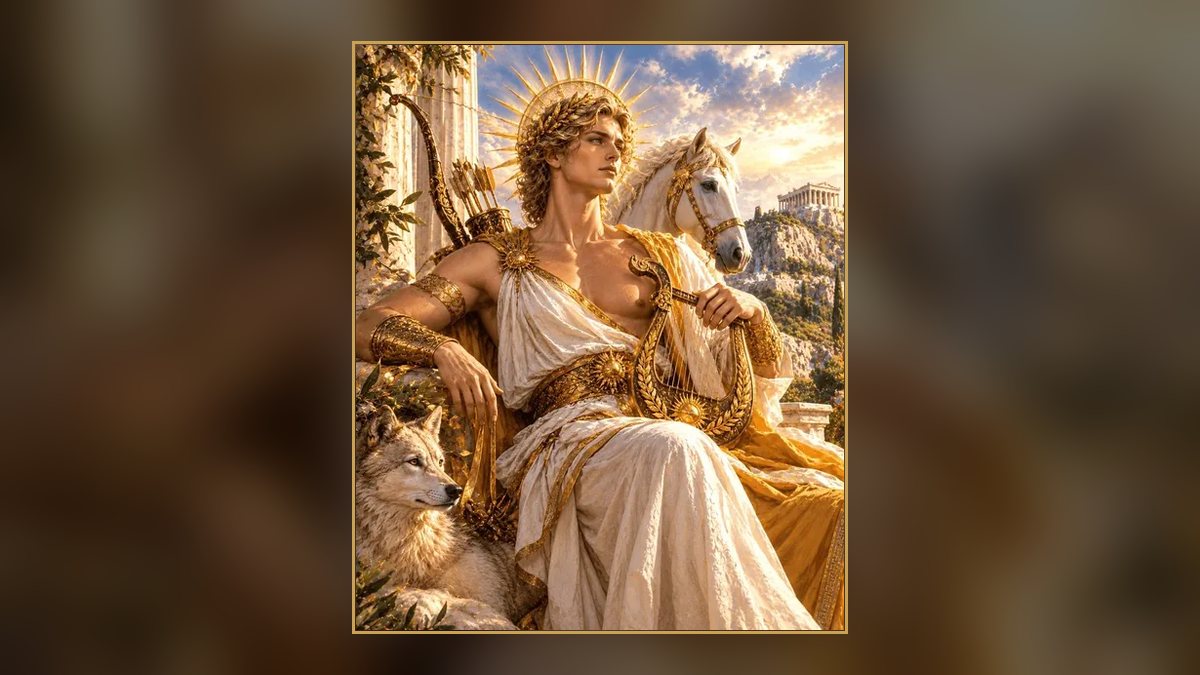
Delphi sits on a steep slope of Mount Parnassus, in central Greece, above a gorge and facing a long valley of olive trees. To the ancient Greeks this was the centre of the world. The story goes that Zeus released two eagles from opposite ends of the earth, and they met here, so a carved stone was set in the shrine to mark the exact middle. It was called the omphalos, the navel.
People came to Delphi for the same reason people ask anyone for advice. They had a decision they could not make alone. A king wondering whether to go to war. A city thinking of founding a colony. A private person asking whether to marry. The answer came through a woman called the Pythia.
Before Apollo
The shrine was older than the god who made it famous. In the earliest story the oracle belonged to Gaia, the Earth, and a huge snake called Python guarded the place. Apollo came here as a young god, killed the serpent, and took over the oracle. That cost him something, since killing a sacred creature made him ritually unclean, and he had to leave and be purified before he could return.
The Pythian Games were founded to mark the victory, and they ran every four years. It was a sort of second Olympics, with music contests as well as athletics, which suits the god of the lyre. You can read the full story of the snake on the Python article.
How a question was answered
The Pythia was a priestess, usually an older woman, who sat on a tripod in the innermost room of the temple. Before she took her seat she washed in the spring of Castalia and chewed laurel leaves, the plant sacred to Apollo. Questions were put to her by temple priests, and answers were written down or turned into verse.
Ancient writers describe her as going into a trance, with her words coming out hard to follow. A long tradition says the cracks in the rock below the temple released a vapour that affected her. Modern geologists have argued about this since the early 2000s, with some finding traces of gas in the springs and others doubting it. It remains an open question, and I would not state it as settled.
The most important thing about the answers is that they were rarely plain. The god spoke in riddles, and a careless listener heard whatever he wanted.
The famous misunderstanding
King Croesus of Lydia was rich and ambitious and wanted to know whether to attack Persia. The oracle told him that if he crossed the river Halys, he would destroy a great empire. He crossed, he lost, and the empire he destroyed was his own. When he complained, the priests replied that the god had never said which empire.
A story with a similar shape is attached to Oedipus. Before he was born, an oracle told his father Laius that his son would kill him. Later, as a young man, Oedipus went to Delphi himself and was told he would kill his father and marry his mother. He ran from the prophecy, and running was how it found him.
I read these stories as warnings about listening. The oracle is not lying. The people hearing it are in a hurry.
Wise sayings carved in stone
Visitors entering the temple saw short sayings inscribed on it. The best known is Know yourself. Another, Nothing in excess, was said to be a sort of motto of the Greek ideal of balance. Ancient writers credited them to the Seven Sages, but the real origin is uncertain.
The philosopher Socrates had a connection to Delphi. A friend asked the oracle whether anyone was wiser than Socrates and was told no. Socrates thought this could not be right, and spent years questioning people to test it. That, he said, is how he began his life as a philosopher. The oracle in effect sent him into the marketplace.
The other god in the house
Apollo did not hold the shrine alone. Dionysus was honoured here too, and the old tradition says that Apollo left Delphi for the three winter months, the god of wine taking his place. A dedication to both gods in the same temple tells you how the Greeks liked to balance order with madness in their religion.
The ending
The oracle's influence faded over many centuries, as cities lost their independence and Christianity spread. Later writers tell of a final message to the emperor Julian in the fourth century, said to announce that the hall was fallen and the spring had dried up. The story comes to us secondhand, so treat it with some care.
What remains today is a ruined temple floor, a theatre, a stadium on the high slope, and a spectacular view. If you stand there, the question Delphi asked is easy to feel. The future is hidden, advice is available, and the advice will not make the choice for you.