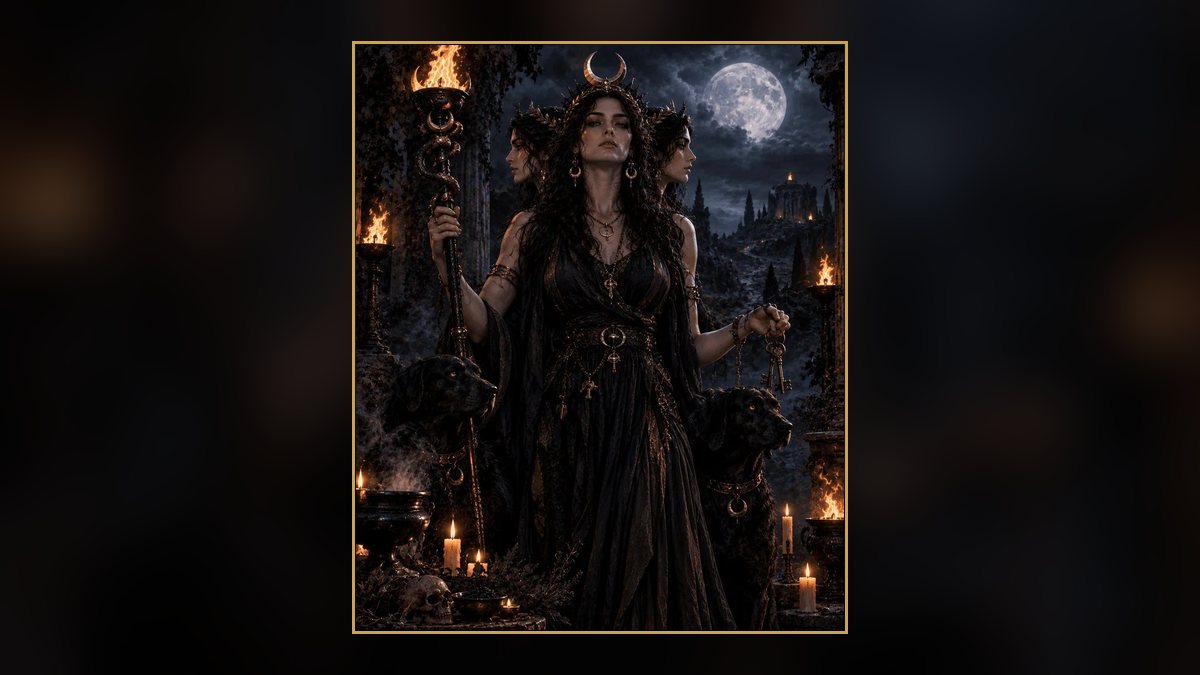
If you walked through an ancient Greek town, there was a fair chance you would come across a small pillar at a corner, a doorway or a fork in the road, topped with three female figures standing back to back. They faced in three directions, and each wore a calm expression, and they were Hecate. This is the picture that the epithet Trimorphos sums up. The word means three-formed, and in the earliest centuries it was not a way of saying she was strange. It was a way of saying she watched every road.
An old goddess with a wide brief
Hecate shows up first in Hesiod, in the Theogony, and the passage is unusually warm. Hesiod says that Zeus honoured her above all the other gods. She was the daughter of two Titans, Perses and Asteria, and when Zeus took power he did not take away her share of the world, as he might have done with an old-order goddess. He let her keep her portion of the earth, the sea and the starry sky, and he added to it.
The poet then lists what she does. She helps people who ask, and she gives good fortune to hunters, athletes, sailors and herdsmen. A prayer to her can win a victory in a contest, or fill the nets, or increase the flocks. She also looks after the young, and Hesiod says she is a nurse of children. In the Hymn to Demeter she plays another part, carrying a torch to help the grieving mother search for her daughter, and she is one of the two witnesses who heard Persephone scream.
Three shares of the world, then, and the epithet makes more sense with that in mind. A goddess who has a place on the land, in the water and in the sky is already something like three.
The sculptor’s idea
Pausanias gives us the next piece. He says that the sculptor Alcamenes, working in Athens in the later fifth century BCE, was the first to make an image of Hecate with three bodies joined together around a single column. It stood beside the temple of Wingless Victory on the Acropolis bastion, and it gave the goddess the byname Epipyrgidia, on the tower.
Whether or not Alcamenes really invented it, the type spread. Small three-figured pillars, called hekataia, were set up outside houses and at the points where roads divided. A traveller coming up to a three-way junction had a figure looking down each of the branches, so the goddess could watch for danger on all of them. A related title, Trioditis, means she of the three roads.
Supper at the crossroads
She had a monthly ritual too. On the last evening of each month, at the dark of the moon, Athenian households left a meal for her at a crossroads. It was called Hecate’s supper, and it included eggs, cheese, fish and small loaves. Before they put it out, people purified the house and swept the dirt out of it, and left the sweepings at the same place. In the comedy Wealth, by Aristophanes, a character jokes that the poorest people snatch these suppers up and eat them.
You can see how the practice fits the title. The crossroads was an uncertain spot, where travellers could be robbed and where nobody was at home. It was also the natural place to put the leftovers of a purification, the things the household wanted gone. Hecate stood there in her triple form, watching, and received the offering.
Dogs were sacred to her, and in some places a puppy was sacrificed in her honour, for she was a goddess who travelled by night and was said to be accompanied by howls. A torch in each hand was her usual sign. The two lit torches in the dark road are probably the oldest part of the picture, and the three faces came later.
What three can mean
Later writers gave the number a lot of weight. Poets and philosophers of the Roman period said that Hecate was the moon, the earth and the underworld, or maiden, mother and crone, or three forms who looked three ways, and the idea has had a long life in modern books about witchcraft. Most of this goes well beyond the evidence of the classical period. The statues did not come with commentary.
What you can say with some confidence is simpler. For the Greeks of the fifth century, three was the number of a place where choices are made. A fork has three arms, if you count the one you came from. A doorway has an inside, an outside and the threshold between them. A goddess who stood where three things met was a goddess of passing from one to another, and the three faces on the pillar were a plain way to say that she saw each one.
The name reminds me that old religion often worked by being literal. If you were afraid of the dark road, you put a goddess with three heads on it, and she looked both ways, and in the third direction too.